L.A. City Measure HLA Improvements: Still Only 300 Feet, But It’s Complicated


(Disclaimer note: I, Streetsblog Editor Joe Linton, do not claim to be a neutral observer here. Outside of my Streetsblog reporting, I have repeatedly challenged the city’s Measure HLA inaction. I am fighting for HLA in court and at the Board of Public Works. I don’t have an financial stake in this, but I am an interested party in Measure HLA matters.)
It has been two and a half years since voters approved the pro-multimodal transportation Measure HLA. How many miles of new bus/bike/walk/accessibility facilities have been installed since Measure HLA became law in early 2024?
Spoiler: the answer is still just 300 feet.
But you shouldn’t have to come to Streetsblog to find this quantified. Measure HLA required the city to set up a website to “provide the public access to monitoring and evaluation data for the implementation of the Mobility Plan as required by [Measure HLA].”
The city’s HLA dashboard website has been online since early 2025, but it’s basically a sad joke: incomplete, opaque, and in many places outdated and incorrect. It’s worse than malicious compliance.
The public still has no straightforward way of tracking city progress related to HLA or the Mobility Plan that HLA requires the city to implement.
Brief HLA Background
In March 2024, L.A. City voters approved Measure HLA, designed to install planned walk/bus/bike improvements when the city repaves or reconfigures streets. Improvements triggered are those the city approved in 2015 in the Mobility Plan 2035.
In order to avoid triggering HLA improvements, the city has repeatedly changed which streets it repaves. When HLA took effect (April 2024), the city essentially paused repaving streets where improvements were planned. In July 2025, the city paused all repaving, instead shifting to costly “large asphalt repair” partial repaving [video]. In March 2026, the city reduced “LAR” and resumed some full curb-to-curb repaving, though avoiding HLA (and ADA) by focusing heavily on smaller streets without sidewalks [video part 1, part 2].
Find additional HLA info at earlier SBLA coverage: HLA timeline (March 2026), recent city resurfacing analysis (October 2026), or all posts tagged HLA.
The City Measure HLA Dashboard
As mentioned above, the voter-approved HLA ballot measure text required the city to provide its HLA dashboard website to track HLA-required Mobility Plan implementation. The city’s HLA dashboard went live in April 2025; view it here.
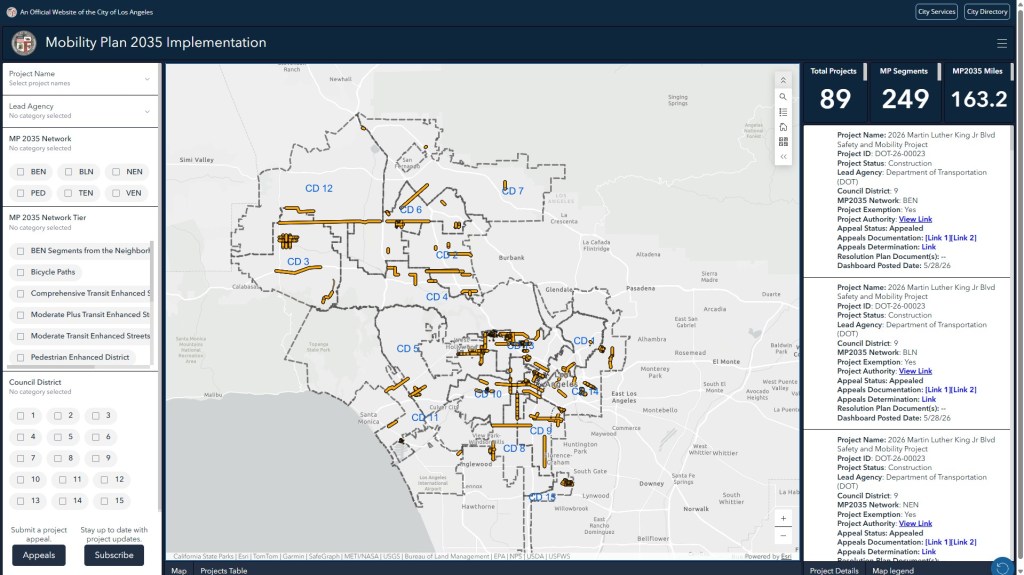
According to HLA, for each project the HLA Mobility Plan website must include:
- a brief description
- distance
- location
- status (e.g. completed, in progress, approved)
- Enhanced Complete Street System enhancements [such as bus lanes, bike lanes, etc.] that are planned to be installed or completed
In addition, HLA law requires a “list of all improvement projects on Mobility Plan Streets that the City has determined are not required to be improved pursuant to [Measure HLA] and the reason the City determined it does not apply.”
L.A. City has leaned heavily into that latter part of the site. As of today, the city dashboard site asserts that 70+ of 89 projects mapped (or 87 projects listed) are exempt from Measure HLA. Most projects are entirely exempt; a few are partially exempt.
The dashboard website never includes a positive statement like “this project was triggered by HLA.” The closest it gets is along the lines of “this project is not exempt from HLA.”
Much of the dashboard is not up to date. It appears that the city enters an initial project status (like “Design” or “Construction”) then never updates the project status.
Generally, the website is opaque and incomplete. It’s certainly not a place where the general public can easily “monitor or evaluate the implementation of the Mobility Plan.”
Some HLA Implementation Metrics Can Be Somewhat Complicated
Bus and bike facilities are fairly easy to track by length: how many miles? (It’s not a problem, but the city often reports these as lane-miles – one mile of two-way bike lanes counts as two lane-miles.)
Reporting walk and accessibility improvements is less straightforward. These include curb ramps and sidewalk repair, but could also be crosswalks, street trees, bulb-outs, etc. Reporting just the length of these projects is less informative.
In some locations (see below) the city has installed some Mobility Plan improvements (bus lanes) while omitting others (bike/walk).
The city has claimed some projects were installed due to HLA, then later city statements claim the same projects were exempt from HLA (see below).
What HLA/Mobility Plan Improvements Are Done?
As of early November 2026, the city dashboard website lists just one HLA project implemented: Reseda Boulevard bike lanes in Tarzana, completed in late 2024. The ~300 feet of new bike lanes were triggered by city street repaving. This is the only facility that the dashboard lists as not HLA exempt and completed.
That’s all. More than two and a half years into HLA, the city claims the law triggered installation of just 300 feet of bike lanes. (This total remains unchanged since SBLA reported it in March.)
It’s a bit more complicated than that. The dashboard is incomplete and wrong. Some of this is even in the city’s favor; the city has installed a few facilities that are in the city Mobility Plan, but basically has not told anyone (at least not via the dashboard where it’s required to report these).
There are a couple of Mobility Plan bus lane projects that the city installed since HLA took effect, but the dashboard doesn’t count these as HLA projects:
- Earlier this year, the city Department of Transportation (LADOT) added a third of a mile of new bus-only lane on Alvarado Street. The dashboard claims the project is currently under construction, and the project’s HLA form does not mention the bus lane is part of the project (only that the city repurposed a peak-hour travel lane there). The city claims that this project is exempt from HLA as “restriping without other improvements” that is “to pre-comply with the Mobility Plan 2035 networks through ‘quick-build’ materials.” So the city’s position is essentially that this project complied with part of the Mobility Plan, but that this new bus lanes mileage doesn’t count as Mobility Plan enhancement installed. It appears that the city is doing this to avoid also installing other HLA-required improvements (walk, bike, and additional bus improvements) on this part of Alvarado.
- A couple of months ago, the city completed four miles of Florence Avenue bus-only lanes. In 2023, Metro announced this project as “a collaborative effort between Metro and LADOT” and noted that it would include resurfacing done by StreetsLA (the city Public Works Bureau of Street Services). The Florence bus lanes do not appear on the city’s HLA dashboard – not as a completed Mobility Plan enhancement, nor as an exempt project.
In June, the city also installed a Mobility Plan bike lane project on Terra Bella Street. (As part of Metro adding light rail on Van Nuys Boulevard, the city removed 5.6 bike lane lane-miles on Van Nuys, “replacing” them with 4.8 lane-miles on Terra Bella.) The dashboard lists the completed Terra Bella project status as in “Design” and claims the project is exempt from HLA. In terms of the Mobility Plan enhancements, this remove/add project’s net output is arguably negative: -0.8 lane-miles.
There are other places where the city installed Mobility Plan bike lanes, but the city claims the projects are HLA exempt. Examples include Mission Road and San Vicente Boulevard.
Further, there are a few projects that city representatives had claimed that HLA had triggered, but the city dashboard later formally declared exempt.
- In January 28 testimony to the City Council Public Works Committee, Bureau of Street Services (StreetsLA) General Manager Keith Mozee, when asked about StreetsLA’s current HLA projects, responded that just one StreetsLA project “relates to HLA”: the city’s Martin Luther King Jr. Boulevard project. When the city added the MLK project to the dashboard (in late May), the city claimed that MLK was exempt from HLA.
- In November 2024, LADOT spokesperson Colin Sweeney told a Next City reporter that HLA had triggered three facilities: improvements on Hollywood Boulevard, Manchester Boulevard, and Reseda (above). But in 2025, when the city listed projects on the dashboard, the city omitted Manchester. The city claimed that Hollywood was exempt from HLA.
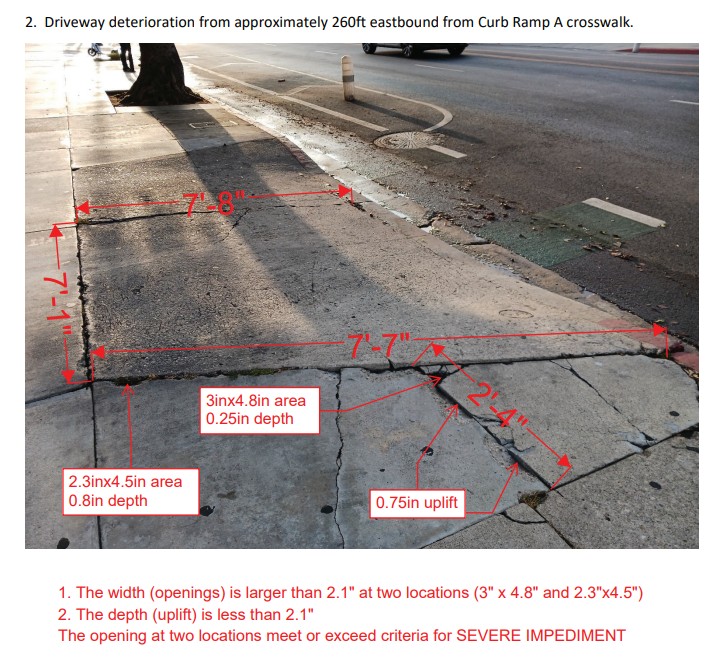
For what it’s worth, Hollywood Blvd. gets even more complicated. On appeal (that I submitted), the Board of Public Works split the project, deciding that most of two-mile Hollywood project was exempt from HLA, but HLA did apply to about 2,000 feet. For that short section, the city committed to installing HLA-triggered sidewalk repairs by 2029 – five years after the 2024 street resurfacing.
(Part of Hollywood is also in my second HLA lawsuit.)
What Future HLA-Required Mobility Plan Improvements Are Coming?
Some HLA-triggered improvements are on the way, sort of.
The city dashboard website now claims that some parts of some future projects are “not exempt” from HLA. These are noted here mostly to point out the Kafkaesque complications in tracking HLA progress due to the city piecemealing projects into several small chunks, some of which the city claims are too small to trigger HLA.
- Spring/Alameda Safety and Mobility Project – The city dashboard asserts that the short parts of the under construction 1.2-mile Spring/Alameda project trigger HLA. The dashboard claims that this project is not one single project, but actually three projects – with two short sections (totaling ~0.4 mile) that trigger HLA and one long project (~0.8 mile) exempt from HLA.
- Pico Blvd Safety and Mobility Plan Project – The dashboard claims that this 3.5-mile project is actually four projects – with three short sections (totaling ~0.7 mile) that trigger HLA and one long project (~2.8 miles) exempt from HLA.
Conclusion: Just 300 Feet So Far
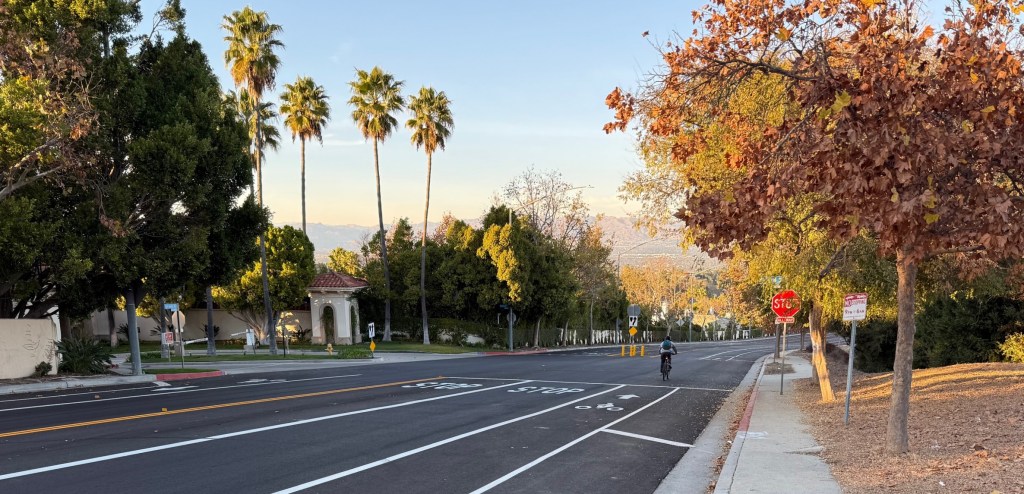
The bad news is that, officially (according to city data from the city dashboard for the public to monitor HLA-required Mobility Plan implementation) the only project that HLA required the city to install was 300 feet of Reseda Boulevard bike lanes.
How can the public track projects that the city implemented, but did not attribute to HLA? Not easily. There are various HLA-era Mobility Plan bicycle projects that the city installed, but claimed that HLA did not trigger, including projects mentioned above (Hollywood, MLK, Terra Bella/Van Nuys) and several others (Lankershim Boulevard, Mission Road, etc.). There are also bus lane projects, including Alvarado, Florence, and Roscoe Boulevard.
It’s not easy to tally these because the city doesn’t really follow its Mobility Plan. The city implements bus and bike projects that are in the city’s Mobility Plan and ones that are not part of the city plan. This is generally not a bad thing (the city shouldn’t limit itself to the plan), but it means that when LADOT or Streetsblog report annual bike lane mileage implemented, it’s not all Mobility Plan implemented.
And bike and bus facilities are easier to track than walk and accessibility facilities.
The city appears to have somewhat stepped up installation of curb ramps, and continues to do some sidewalk repair. But officially – according to the dashboard – no completed walk/access projects have been triggered by HLA.