“Disrespectful” and “infuriating”: L.A.’s progress on making streets safe and accessible for disabled people stalled for decades

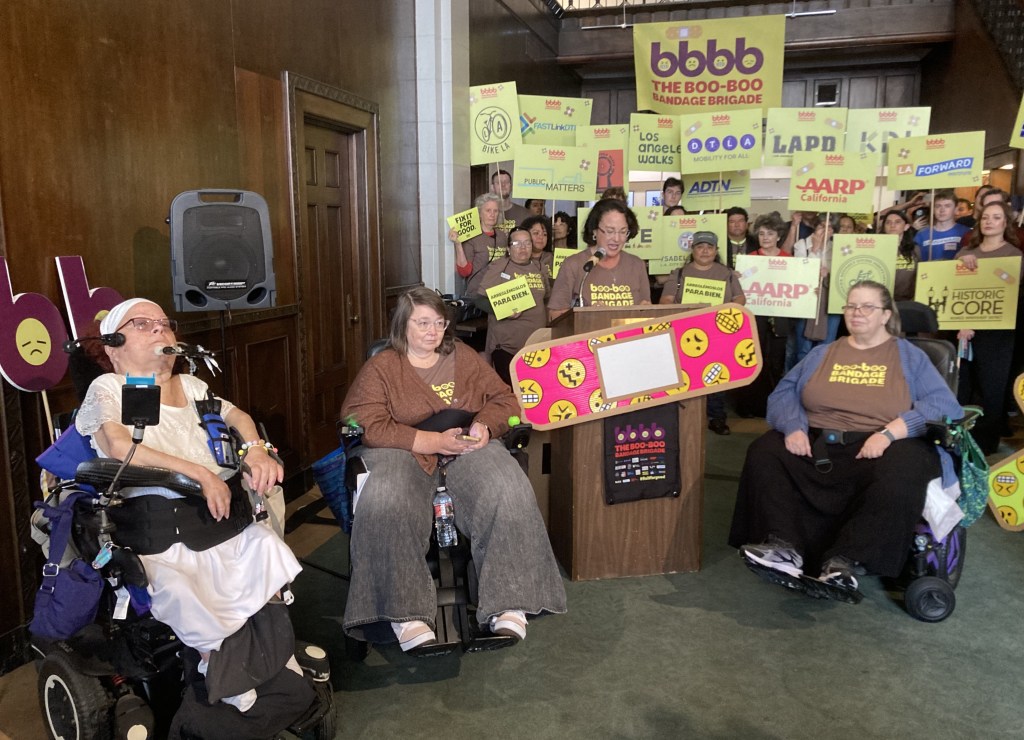
Disabled Angelenos have been fighting for equal access to city streets for decades. But the city has often treated accessibility as a burden or merely as a matter of legal compliance. Even worse, now city officials are saying that a decades-old legal requirement — adding curb ramps for wheelchair access during repaving — prevents them from maintaining streets in a state of good repair, pitting disability rights against smooth and functioning streets.
The 1990 Americans with Disabilities Act made it illegal to discriminate against people with disabilities. Title II of the ADA specifies that any new public facilities must be accessible, including streets and sidewalks. If a city repaves a street, which enhances and improves the experience of driving, walking and biking on that street, then the courts have ruled that those same benefits should be available to people using wheelchairs.
“If a street is to be altered to make it more usable for the general public, it must also be made more usable for those with ambulatory disabilities,” wrote the 1993 court opinion.
Unfortunately, the city of L.A. has treated wheelchair-accessible pedestrian facilities as an afterthought, including the sidewalks, curb ramps and crosswalks that disabled people need to get to work or school, visit friends or family or use public transportation.
According to Oren Hadar in his newsletter “The Future is LA,” the city stopped repaving last year mainly due to new ADA guidelines called the Public Right-of-Way Accessibility Guidelines (PROWAG).
In the works since 1999, PROWAG updates minimum accessibility for the public-right-of-way, including curb ramps and crosswalks. While it is true that new guidelines were released in 2023, the mandate to add curb ramps during repaving is over 30 years old, going into effect in 1992.
Furthermore, the U.S. Department of Justice — which is the enforcing agency — has yet to adopt PROWAG, meaning that it is not enforceable in the public-right-of-way except for transit projects like bus stops (the U.S. Department of Transportation adopted the new standards as of 2025).
If the federal government is not cracking down on L.A. over PROWAG, why has the city stopped fully repaving streets? And how did it get away with breaking the law for decades?
Streetsblog L.A. reached out to multiple departments for this story, including LADOT, the Bureau of Engineering (which manages L.A.’s sidewalk program), StreetsLA and the Department on Disability. All of them referred inquiries to the mayor’s office.
Mayor Bass’ office did not respond to a detailed list of questions about PROWAG, curb ramps, repaving, the city’s ADA transition plan, an ongoing disability rights lawsuit or the mayor’s role in ADA compliance.
While PROWAG might not be enforceable, existing ADA requirements still are, explained Anna Zivarts, organizer with the Nondrivers Alliance and author of When Driving Is Not an Option. Unfortunately, cities tend to see disability justice as a matter of legal compliance.
“They don’t want to get sued,” Zivarts said. “I get that. But when ADA or when disability becomes just about compliance, it really shuts down broader conversations about, ‘What would it take to make it possible for people to go where they need to go?’”
Even if the DOJ is not cracking down on L.A. because of PROWAG — and there’s no evidence that it is — the city still has both a legal and a moral obligation to disabled Angelenos.
In fact, the city is still toiling away at a 30-year $1.4 billion legal settlement mandating that it fix sidewalks and add curb ramps to remove obstacles for people with disabilities — a settlement that has barely made a dent since it officially began in 2017.
Deborah Murphy, long-time pedestrian advocate and urban planner, called the city’s management of the public-right-of-way “disrespectful” to people with disabilities.
“The city staff just doesn’t get it,” Murphy said. “They don’t understand access and what it’s like to be a person with disabilities, whether they’re blind or visually impaired or walking with a cane or in a wheelchair.”
If L.A. hasn’t been following the law, what has it been doing?
After Title II of the ADA went into effect, cities were tasked with coming up with a transition plan by summer 1992 to make facilities accessible to people with disabilities. L.A. took much longer. According to city reports, in the late 90s, the U.S. Department of Justice was pushing L.A. to comply with the law by submitting an appropriate ADA transition plan for pedestrian facilities — even threatening to rescind federal funding.
The pressure worked. In 1998, elected officials put Proposition JJ, a 20-year property tax, on the ballot to raise funds for curb ramps and sidewalk repairs. Voters defeated the measure, 57 percent to 43 percent. After the ballot measure failed, city councilmembers approved a plan to install 40,000 curb ramps over five years using $50 million from a settlement with tobacco companies.
Unfortunately, this curb ramp blitz ended after three short years. In 2002, a city report stated that the program would be ending with 22,500 access ramps installed. It’s unclear why the number of ramps was nearly cut in half from the initial 40,000 and why the city chose not to continue to fund the program, though a state and citywide budget crisis might be to blame. Even during this period of building thousands of ramps, it seems the city was not following the directive to add curb ramps during repaving and in 2003, a disability rights organization threatened legal action.
In response, the public works department drafted a new policy in 2004, according to a report from the Department on Disability. The same report notes that there were only two crews assigned to construct curb ramps “due to budgetary constraints.” Once again, it seems like the standard was inconsistently applied, if at all.
In 2006, disabled Angelenos sued the city over the lack of curb ramps, but it was a 2010 lawsuit that ushered in a new sidewalk program for the city of LA. That year, another group of disabled Angelenos filed a lawsuit alleging that the city of L.A. was violating the civil rights of disabled people by not providing accessible crosswalks, sidewalks and curb ramps. In the filing, the plaintiffs pointed out that the city was not adding access ramps during repaving. That lawsuit resulted in the Willits settlement, with L.A. agreeing to spend nearly $1.4 billion over 30 years — $31 million per year adjusted for inflation — to fix sidewalks and add curb ramps.
Since the Willits lawsuit was settled in 2015, the Safe Sidewalks L.A. program managed by the Bureau of Engineering is the primary way that Angelenos with disabilities can request accessibility improvements.
Despite this landmark settlement, progress has been painfully slow. In a 2025 presentation for transportation professionals, city of L.A.’s ADA Coordinator Natalie Sparrow said that the program is fixing roughly 15 miles of sidewalks and adding 50 curb ramps per year. For context, L.A. has about 9,000 miles of sidewalks. The program receives roughly 1,000 access requests per year and completes 300.
Cynde Soto, a systems change advocate with Communities Actively Living Independent & Free (CALIF), called the lack of progress “infuriating.”
“What has been done? It’s hard to say,” she said, citing the city’s quarterly meeting on its progress. “They only show and they only talk about just a few miles of sidewalk.”
It’s not just curb ramps — a pattern of disrespect
L.A.’s failure to add curb ramps during repaving for over 30 years is not the only reason that streets and sidewalks are inaccessible.
Part of the problem is how L.A. implements street improvement projects. The L.A. Department of Transportation doesn’t repave streets — that responsibility falls to StreetsLA (the Bureau of Street Services). StreetsLA, in turn, doesn’t manage sidewalks; that role falls to the Bureau of Engineering. Instead of working together, the different bureaus operating in the public-of-right-way are often competing for the same pots of grant funding.
Unlike most major cities, L.A. doesn’t have a long-term capital infrastructure plan that shows who is doing what with what money. Without the oversight of a long-term planning process, city departments have not consistently prioritized or funded accessibility improvements. The result: Streets and sidewalks that don’t reflect how people with disabilities move around the city.
City crews will fix the sidewalk and add a curb ramp but not add a crosswalk, said Murphy (painting a crosswalk would be LADOT’s responsibility, whereas BOE or StreetsLA would build a curb ramp). “People walk along a sidewalk and they have to cross the street,” she said. “People don’t go in a donut around an entire block and never leave that block.”
This failure to consider accessibility holistically could explain why LADOT doesn’t always include missing curb ramps during street safety improvement projects.
When cities and transportation agencies are focused on legal compliance instead of how people walk and roll, you end up with curb ramps and sidewalks that are technically ADA-compliant but hostile to pedestrians, including people using mobility devices.
It’s also a problem of longstanding departmental culture that can be tough to change. The bureau responsible for adding curb ramps during repaving, StreetsLA, has prioritized smooth streets for cars over all else, said advocates.
It’s all about a single metric: The Pavement Condition Index.
In fact, between 2005 and today, Los Angeles brought its PCI score from 41 to 69, paving 2,400 lane miles at the height of the 2017 to 2018 fiscal year, according to StreetsLA chief Keith Mozee in a December 2025 presentation to the charter reform commission on the department’s role and responsibilities. As the city’s PCI went up, street and sidewalk access for disabled people wasn’t given the same level of priority or funding.
“When BOE and StreetsLA look at pavement quality, they’re looking at it for a car,” Murphy said. “They’re not even thinking about what a pedestrian or a cyclist needs when they’re on the roadway.”
Now, StreetsLA says it’s following ADA by only fully repaving streets when it can also add access ramps. According to Mozee, StreetsLA can only afford to build 300 curb ramps this fiscal year, which means it can only repave a fraction of L.A. streets. At this level of repaving, the city’s PCI will degrade by 2% every year, meaning more potholes.
“We’re only relegated to 860 lane miles of which we’re only able to pave 60 lane miles, unfortunately, and that’s due to constraints related to access ramp construction,” Mozee said in his charter reform commission presentation.
Instead of repaving streets, the bureau is primarily doing large asphalt repairs.
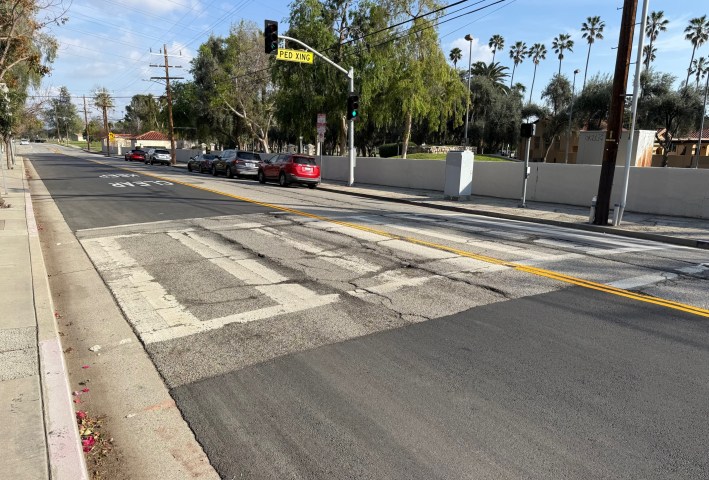
Is L.A. violating ADA by doing large asphalt repairs?
StreetsLA appears to be skirting the law by not repaving the full width of the street, sometimes leaving a narrow strip unpaved. It follows a tortured logic: If a person using a wheelchair crossed the street, they would be crossing from curb-to-curb and, conveniently, the city did not impact their entire path of travel.
Cities repaving in such a way as to avoid curb ramp upgrades is nothing new.
“Sometimes you’ll see paving jobs, like, really obvious paving where they’re clearly trying to not trigger [curb ramps],” Zivarts said.
Large asphalt repairs are not new either — they’re included in a 2004 budget summary as the larger counterpart to “small asphalt” or pothole repairs. What is new is that the city appears to be doing them in order to avoid adding legally required curb ramps. Is the city violating ADA?
Maybe. According to guidance from the Department of Justice, structuring street improvement projects in order to avoid ADA upgrades could open a city up to legal challenges.
“I feel like you might be able to get away with it on one project, but if it becomes a pattern where — because the key is, if you’re resurfacing through the crosswalk, that’s the trigger,” said Juliet Shoultz, transportation systems engineer for the Access Board, the federal agency that develops ADA standards.
Designing projects to avoid triggering certain improvements is an engrained practice in the city of L.A., said Murphy, who writes active transportation grant applications for StreetsLA, LADOT and the Bureau of Engineering.
“‘If we do this, we’re going to have to do that. If we fix this piece of a sidewalk, we’re going to have to do it for the entire block’ — even though they’re going after grant money,” Murphy said. “I mean, it’s like the logic is not even there.”
In a 2024 presentation for nonprofit Investing in Place, Paula Pearlman, an attorney for the Willits’ plaintiffs, discussed the city’s prolonged failure to add access ramps during repaving. According to Pearlman, class counsel and the city were in mediation talks about the settlement in December 2023. City council files show a closed-door meeting about Willits happening as recently as October 2025. If mediation fails, the lawsuit would head back to court.
Could this new directive be the result of a multi-year process to renegotiate the Willits settlement? Advocates can only speculate.
“They know they’re in trouble,” said Soto. “Also, they do want to get things right when the Olympics, Paralympics come.”
Attorneys for the Willits’ plaintiffs did not respond to emails requesting an interview.
Streets for All, an organization pushing for safer streets put Measure HLA on the ballot to try to force the city to follow its own mobility plan. The measure was approved by a majority of voters, but city officials appear to be blocking implementation.
Like the curb ramp requirement, Measure HLA mobility plan elements are also triggered by repaving, meaning that the city claims large asphalt repairs don’t trigger bike, bus and pedestrian improvements. Part of the confusion over the reason for the city’s switch from repaving to large asphalt repairs stems from the overlap between ADA, Measure HLA and the Willits settlement.
“The city just doesn’t want anybody else to tell them what to do,” Murphy said. “So they’re finding every way to work around HLA, Willits, whatever it is.”
Measure HLA didn’t take inspiration from the ADA requirement to add access ramps during repaving, said Michael Schneider, founder of Streets for All, though they both follow the same logic that other cities use during projects. If you’re repairing the street anyway, why not add required upgrades at the same time?
What are other cities doing?
According to StreetsLA, the bureau, like the rest of public works, operates from a “multi-benefit one Infrastructure” framework, meaning that when it repaves streets, it also upgrades curb ramps, repairs sidewalks and trims street trees.
Unfortunately, this approach has not been consistently implemented — at least according to street safety advocates, disability advocates or any cursory inventory of the street itself.
Unlike other cities, L.A. has not adopted a consistent complete streets policy, which not only limits access to daily activities for disabled Angelenos, but also has deadly consequences for people walking, rolling, and biking.
That said, the tension between repaving streets and making safety and accessibility improvements is not unique to LA. In Oakland, one activist came up with the slogan, “Streets paved or lives saved?”
“Sometimes, [fixing] potholes and paving will actually increase speeds and make the street more dangerous if you’re not putting explicit safety treatments too,” said Anwar Baroudi, chair of Oakland’s Mayor’s Commission on People with Disabilities. “The question is, do you want safer streets, or do you want faster streets?”
Baroudi said that the prohibitive cost of curb ramps has never come up in discussions with the city about street improvement projects. Last year, Oakland reached its own settlement to fix sidewalks and add curb ramps after a 2023 lawsuit from people with disabilities.
The city of Seattle has adopted some but not all PROWAG guidelines. Tom Hewitt, Seattle Department of Transportation’s ADA coordinator, explained that the city is waiting on the DOJ to adopt PROWAG. The city has its own rules for street projects, some of which go above-and-beyond existing standards.
Seattle has a leg up on Los Angeles with dedicated funding for ADA upgrades from the 2024 transportation levy and automatic traffic enforcement cameras.
Hewitt said that a curb ramp can cost $5,000 to $25,000, depending on the project — $5,000 to $10,000 each if the project is upgrading an entire intersection, more if the curb ramp is a standalone project. One intersection with eight curb ramps could cost $40,000 to $80,000.
Los Angeles, in contrast, spends $50,000 per ramp, meaning a single intersection could cost $400,000. It’s possible that the inflated costs are due to each curb ramp being treated as a bespoke project rather than as part of a holistic approach to street improvements.
L.A. may not have the money to install curb ramps, but big cities like L.A. do have the resources to delay implementing ADA improvements, explained Dorian Taylor, ADA coordinator for Pierce Transit.
“Compliance often becomes about dollars and cents and risk management instead of like, ‘Access is a human right,’” he said.
No one knows how many curb ramps need to be fixed
To comply with ADA, cities are required to produce a self-evaluation and transition plan that would bring all facilities, including sidewalks and curb ramps, into legal compliance. However, one study found that only 13% of a sample of 401 cities and counties had transition plans “readily available.”
L.A. is part of the 87%. Although transition plans are by law required to be available to the public, the city’s ADA coordinator did not respond to an email asking for the location of the transition plan for pedestrian facilities. When Streetsblog L.A. reached out to the Bureau of Engineering, a spokesperson said she needed to coordinate with the mayor’s office to answer questions about the transition plan.
The last city-wide transition plan and self-evaluation was completed in 2000, over 25 years ago. The new version has been in the works since then-Mayor Antonio Villaraigosa established an ad hoc ADA committee in 2012. The Department on Disability did not respond to a question about when the new transition plan will be completed.
The “vagueness” of the transition plan requirement within ADA is a systemic issue, said Taylor. Not only are transition plans meant to be current, they are also supposed to engage the disability community.
“It’s unfortunately a forgotten piece of planning,” Taylor said. “They should be living documents that are updated and have strategies to remove barriers.”
In a 2021 audit of the sidewalk program, the city controller noted that the only updated transition plan for the public-right-of-way was the Willits settlement, even though “[t]he City’s obligations under the Willits settlement do not encompass the entirety of the City’s obligations under the ADA.”
Meanwhile, there is no plan to comprehensively assess sidewalks or curb ramps. While BOE and StreetsLA completed a pedestrian facilities inventory and assessment pilot last year, the next phase focuses only on areas surrounding Olympic and Paralympic venues.
As part of the Willits settlement, the city was supposed to set up a dashboard showing major street improvement projects and repaving that might trigger ADA upgrades. Over eight years after the settlement officially went into effect, the city was still working on that dashboard.

Streetsblog has migrated to a new comment system. New commenters can register directly in the comments section of any article. Returning commenters: your previous comments and display name have been preserved, but you'll need to reclaim your account by clicking "Forgot your password?" on the sign-in form, entering your email, and following the verification link to set a new password — this is required because passwords could not be carried over during the migration. For questions, contact tips@streetsblog.org.