Updates on L.A. City Stopping Resurfacing, Instead Doing “Large Asphalt Repair”

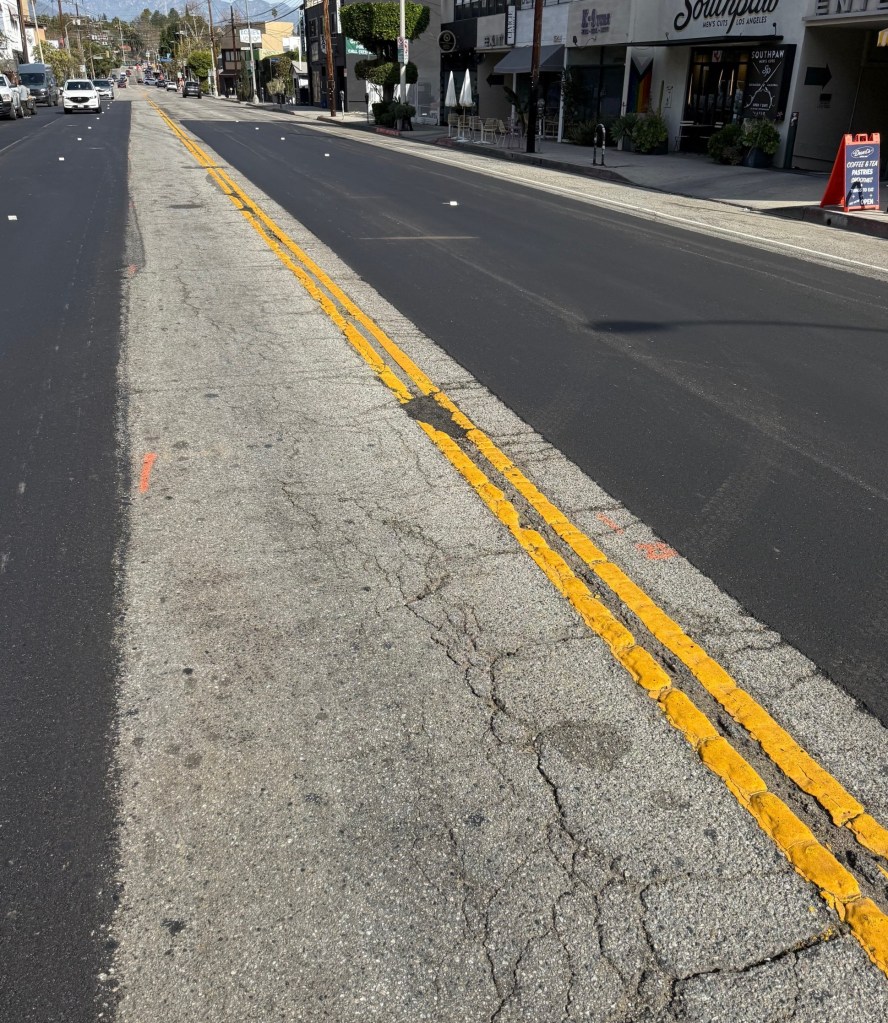
In early December, Oren Hadar at The Future Is L.A. broke the news that L.A. City had quietly stopped resurfacing streets. Prior to July 1, 2025, the Bureau of Street Services (StreetsLA) repaved entire streets from curb to curb. In July, StreetsLA instead shifted to so-called “large asphalt repair” (LAR). Hadar noted that the shift appeared to primarily be to avoid triggering adding missing curb ramps (for wheelchair access), but also arguably avoids some bus/bike/walk/access improvements under Measure HLA law.
Measure HLA became law in April 2024; it requires L.A. City to install planned bus/bike/walk facilities during street resurfacing. Wheelchair access is required by the federal ADA (Americans with Disabilities Act) which became law in 1990. Curb ramps have long been required under ADA, but it appears that the city is reacting to new ADA rules (PROWAG – Public Right-of-Way Accessibility Guidelines) reiterating that requirement. PROWAG became law in early 2025.
Streetsblog recapped Hadar’s LAR findings in a post and a short video (if you’re unfamiliar with LAR, watch the one-minute explainer). Hadar subsequently co-authored an LAT editorial on LAR.
Today there is still little official information on the what/why/how/where of L.A. City “large asphalt repair.” This post includes some additional LAR information gleaned since December, but the overall picture is still emerging.
What LAR looks like
Before July 2025, StreetsLA’s “PPP” Pavement Protection Program routinely resurfaced entire roadbeds – from curb to curb.
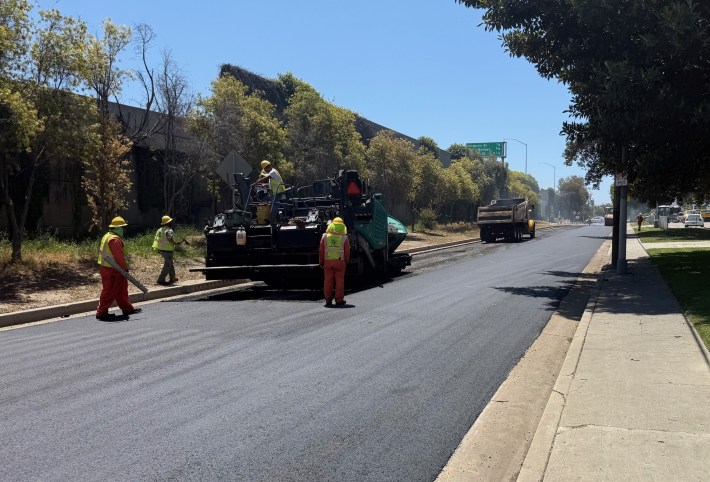
At that time, L.A. did some “LAR” repaving here and there, but the vast majority of PPP work was full curb-to-curb repaving.
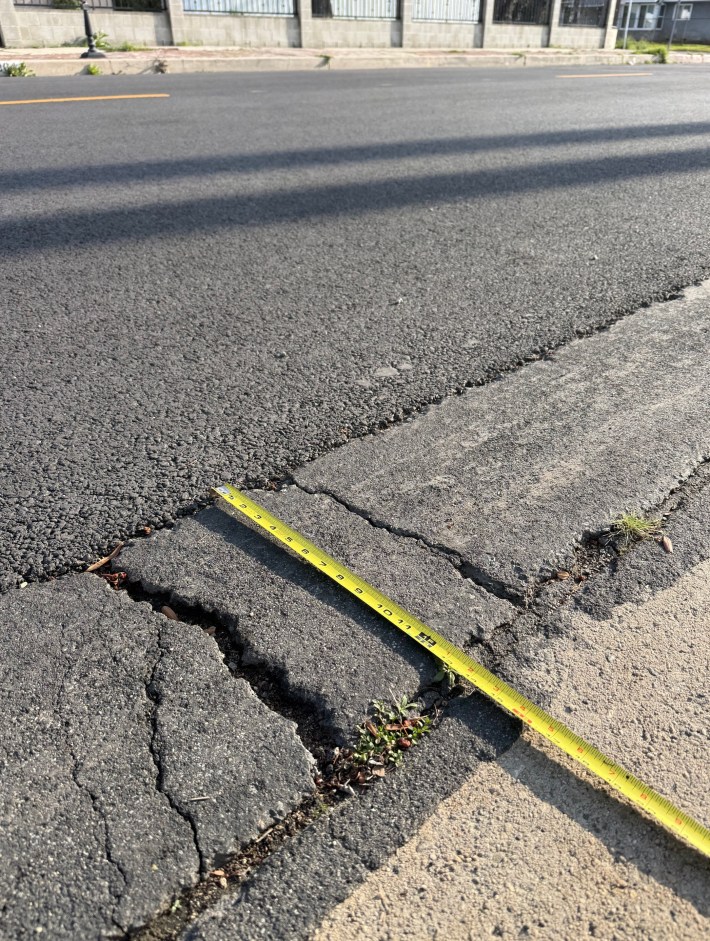
Since July 2025, StreetsLA uses the same equipment, the same crews, the same process, but resurfaces only part of the street. LAR does not resurface the entire width, but leaves a strip (or strips) of asphalt untouched and unrepaired.
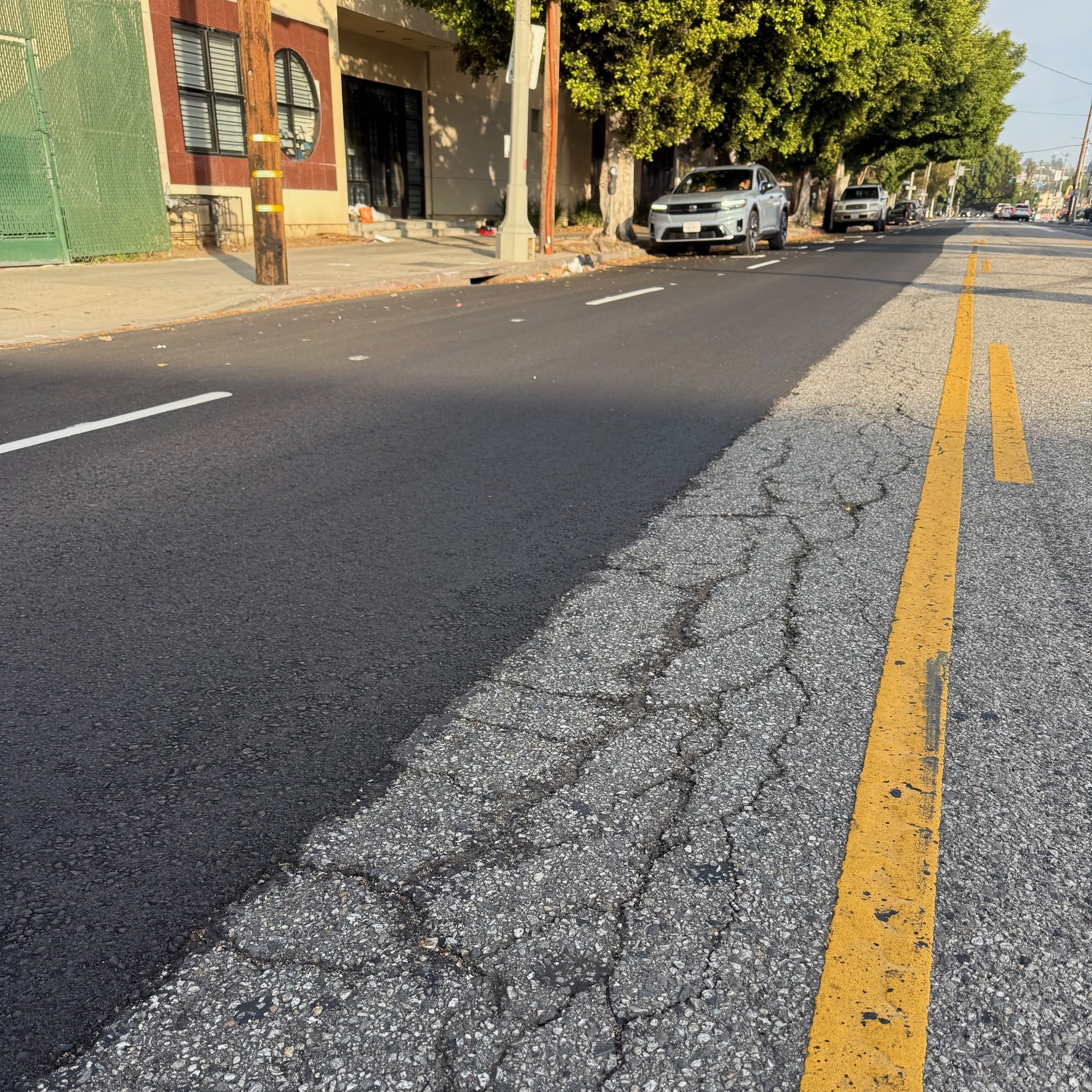
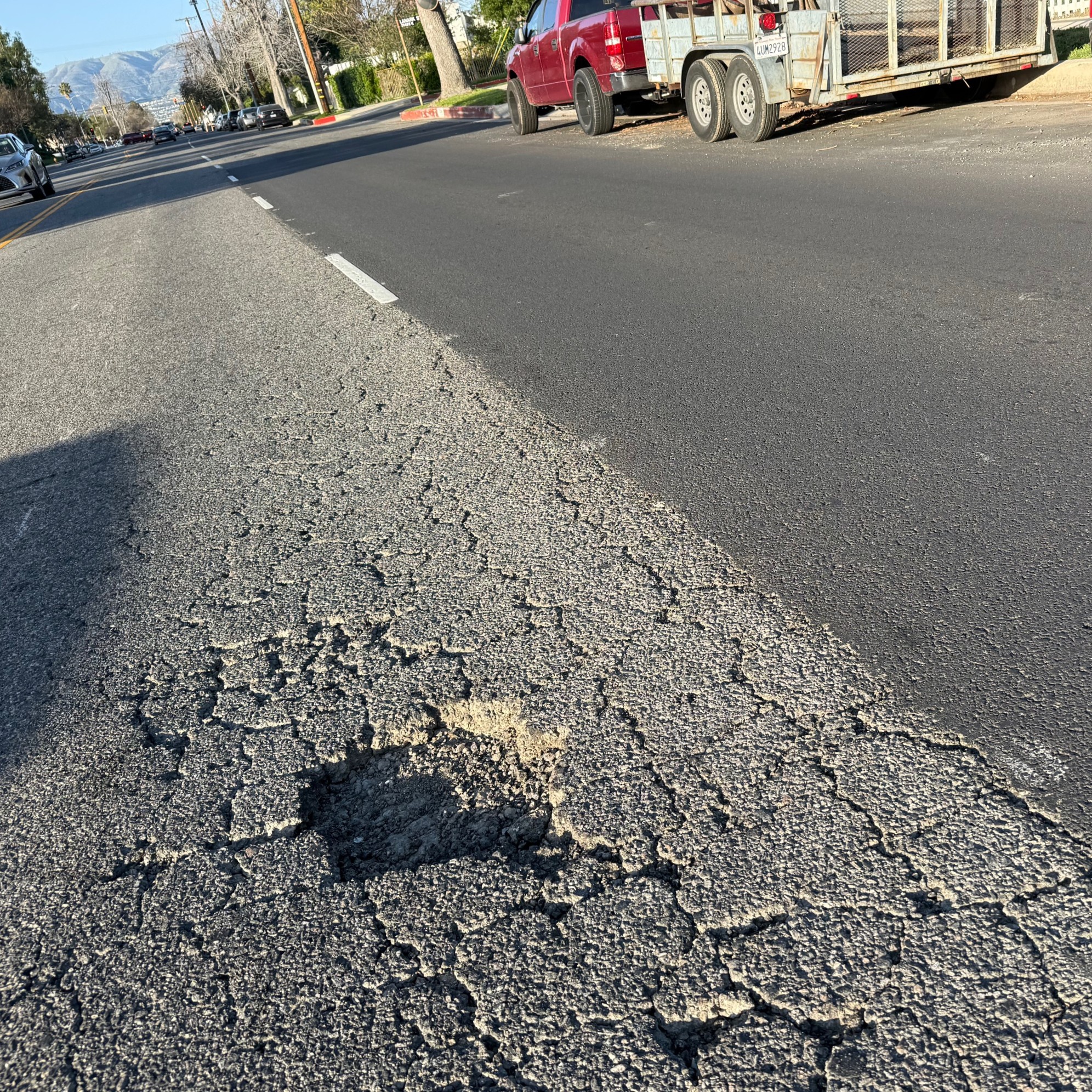
Slow Concrete Ramp Work vs. Fast Asphalt Street Work
Recent StreetsLA statements reiterate that (as Hadar reported) the recent no-resurfacing shift is primarily about federal accessibility law and less about Measure HLA.
In a presentation at the January 28 City Council Public Works Committee (audio, slides), General Manager Keith Mozee attributed the shift to large asphalt repair to cuts to StreetsLA workforce. In the current and past year, StreetsLA’s staffing budget was cut 26 percent. Per Mozee [at 8:24], these cuts resulted in a lack of heavy duty truck operators and equipment operators, “Without these positions basically we’re ineffective in trying to do our work. That’s one of the reasons we had to pivot to doing large asphalt repairs, because this current fiscal year we don’t have enough drivers, truck drivers, basically to haul our asphalt material.”
Councilmember Imelda Padilla responded asking [at 15:40] Mozee about how Measure HLA “completely changed the way you prioritize street repaving.” Mozee answered that, “Basically, it’s not just HLA, it’s the federal ADA requirement.”
“Whatever my [street resurfacing] program budget is,” Mozee asserted “I need basically to match that with the capacity to build out these ramps.”
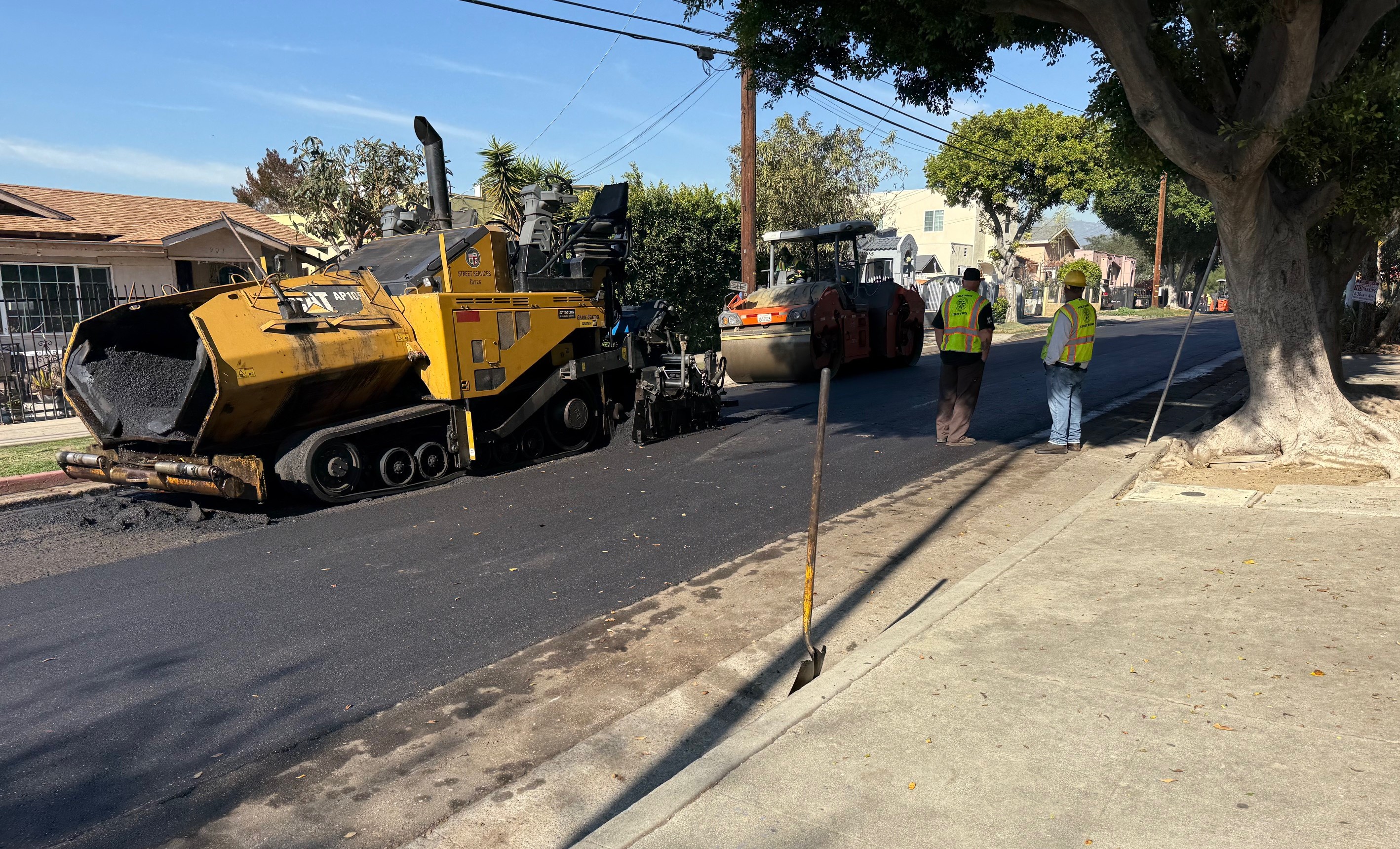
Mozee went into detail comparing slow concrete curb accessibility work to the faster asphalt street work. Per Mozee, “there’s approximately 14 ramps in a mile.” So for “one crew to build out those 14 ramps will take approximately three months.” In contrast, he said, “a paving crew on a good day… could pave that same mile in a weekend or one week, at most.”
Mozee asserted that HLA “limits” StreetsLA resurfacing work, but repeatedly focused on ADA as the main limitation:
We have always been inclusive of HLA projects and all projects, but with that being said, it [HLA] does limit our ability to resurface streets, unfortunately. It’s not just that it needs a mobility bike lane or anything like that, [but] It’s the inability of [StreetsLA] to construct enough access ramps.”
Further Mozee statements appeared to largely relegate his bureau’s HLA work to a sort of special projects realm, not part of the routine accommodation that HLA proponents envisioned. “As it relates to HLA,” Mozee noted that StreetsLA is doing resurfacing and ramps for one MLK Boulevard project, and will “next year… coordinate with LADOT [Department of Transportation] to work with them on their priorities… and reconfiguring our five-year resurfacing program.”
(Context added March 1: The city claims that the grant-funded MLK project is exempt from Measure HLA.)
Note that StreetsLA and LADOT have been promising a joint HLA work plan since June 2024, but it appears that no such plan exists. It has never been shared with the public. To date, nearly two years after HLA was approved by voters, the city has installed HLA-required upgrades on just one street segment, Reseda Boulevard in late 2024. That one ~300-foot-long project appeared to come as a surprise to city staff.
BSS: Full Resurfacing Coming Soon, Waiting on Curb Ramps
In January, the L.A. Times looked into the proliferation of potholes on city streets. The Times questioned StreetsLA about large asphalt repair patching instead of repaving roads in their entirety. Per LAT, StreetsLA spokesperson Dan Halden responded that street resurfacing “has always been expected to take place later this fiscal year.”
As of today, the StreetsLA Resurfacing Recently Completed webpage still shows zero resurfacing completed this year (FY25-26). (Though this isn’t entirely true – see below).
SBLA checked in with Halden about where and when to expect this year’s resurfacing. Halden responded that resurfacing is waiting behind curb ramp installation. Halden’s statement in full:
In FY 25-26, resurfacing remains a core component of the Bureau of Street Services’ Pavement Preservation Program (PPP), which also includes Large Asphalt Repairs (LARs) on major corridors. So far this fiscal year, the Bureau has been focused on installing up to 300 curb ramps, a required step to prepare segments for eventual resurfacing in the later half of the fiscal year. The Bureau looks forward to its resurfacing projects in FY 25-26.
Large Asphalt Repair is Inefficient and Expensive
A former city employee reached out to SBLA noting that repaving smaller shorter areas is generally less cost-effective compared to larger, longer areas:
[StreetsLA] would always tell me that there was such a significant fixed cost of mobilizing paving equipment [so] they wanted long corridors [all] at once and to not have to waste time repositioning equipment all the time…
Now they’re doing the opposite. Small chunks. I wouldn’t be surprised if their repaving cost per square foot is going up 25-50% with all these tiny patches. [StreetsLA is] choosing to do their job inefficiently to avoid PROWAG [ADA curb-ramp requirements] and HLA.
For a given area (for example a square-foot), the city pays more for LAR than it had in the past for regular curb-to-curb resurfacing.
As LAR Increased, Street Resurfacing Output Decreased
Last fiscal year (July 2024 to June 2025), StreetsLA resurfaced 312 lane-miles of L.A. Streets [per StreetsLA page 154]. This fiscal year, StreetsLA appears to be on track to resurface around 100-160 lane miles.
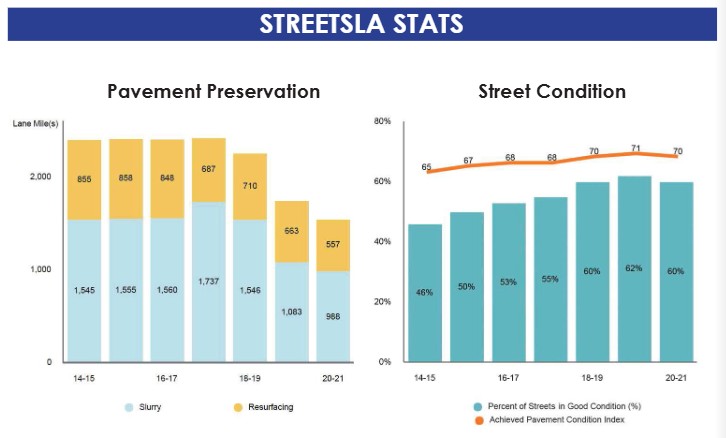
In the longer term, the drop-off is even more dramatic. A decade ago, StreetsLA resurfaced 600-800 lane miles annually.
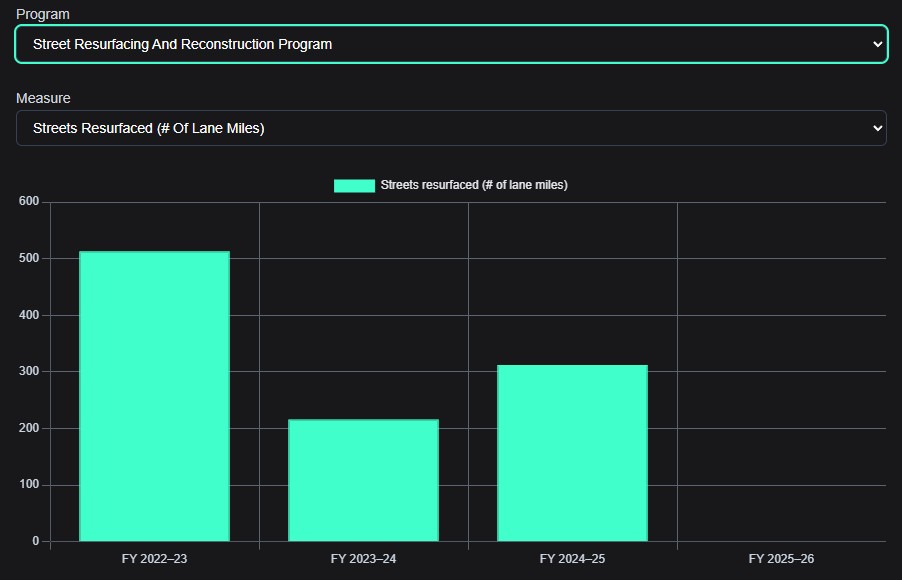
Comparing current LAR to past resurfacing, it’s difficult to get an apples-to-apples comparison because StreetsLA has changed the way they report resurfacing.
In the past, StreetsLA reported resurfacing as lane miles. Now the StreetsLA dashboard reports LAR in square feet. Today, the fiscal-year-to-date completed LAR totals 2.8 million square feet (and zero resurfacing). Dividing 2.8 million by 5280 feet/mile and ~10 feet/lane, yields the equivalent of ~54 resurfaced lane miles. 54 miles in 7 months would correspond to about 92 lane miles for the full fiscal year. Seven months into the fiscal year, StreetsLA is on pace to LAR approximately 90-100 lane-miles.
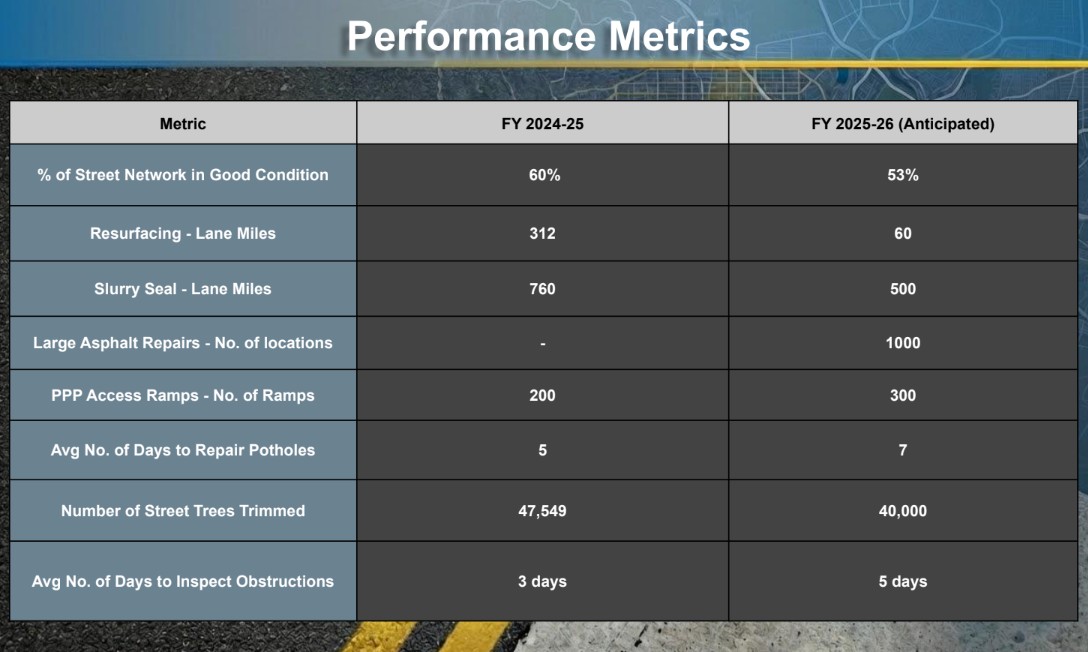
Then there’s the (apparently additional) resurfacing that Halden announced to the Times. In a January presentation, BSS anticipated 60 resurfaced lane miles. Assuming those 60 are separate from LAR, the total resurfaced lane miles this year will be ~160 miles [~60 plus ~92].
In any case, that’s a big drop off: 312 miles to 160 miles or less.
And, as Hadar noted, for FY26-27 StreetsLA’s proposed budget anticipates resurfacing just 60 lane miles next year.
The shift to LAR is not the only factor in this decrease. Budget cuts have decreased StreetsLA output. In an April 2025 memo, StreetsLA anticipated that budgetary belt-tightening would reduce annual resurfacing from 312 lane miles to approximately 280 lane miles.
The council and mayor approved that ~280 mile resurfacing budget. Then BSS changed its practice from resurfacing to LAR. That shift appears to be a significant factor causing the current steep decrease.
As LAR Increased, Street Conditions Worsened
Fewer lane-miles resurfaced means, you guessed it, more cracked and potholed streets. StreetsLA measures this via what they term the Pavement Condition Index (PCI), which scores each street segment on a scale of 0 to 100 (failed to perfect respectively). StreetsLA reports the overall street conditions as the percentage of streets in good condition.
From the charts above, circa 2020 L.A.’s percentage of streets in good condition was around 60 percent. From the January StreetsLA presentation [slide], last year it was 60 percent, and StreetsLA anticipates it will drop to 53 percent this year (by June).
With a similar budget and paving practices anticipated in FY26-27, overall pavement condition could continue to worsen.
Some Streets Still Get Full Resurfacing
As explained above, since July 1, 2025, most StreetsLA repaving work is partial “LAR”, with new asphalt alongside cracked un-resurfaced sections.
But in a few locations, mostly suburban San Fernando Valley streets, the city has continued to do some regular old curb-to-curb full resurfacing.
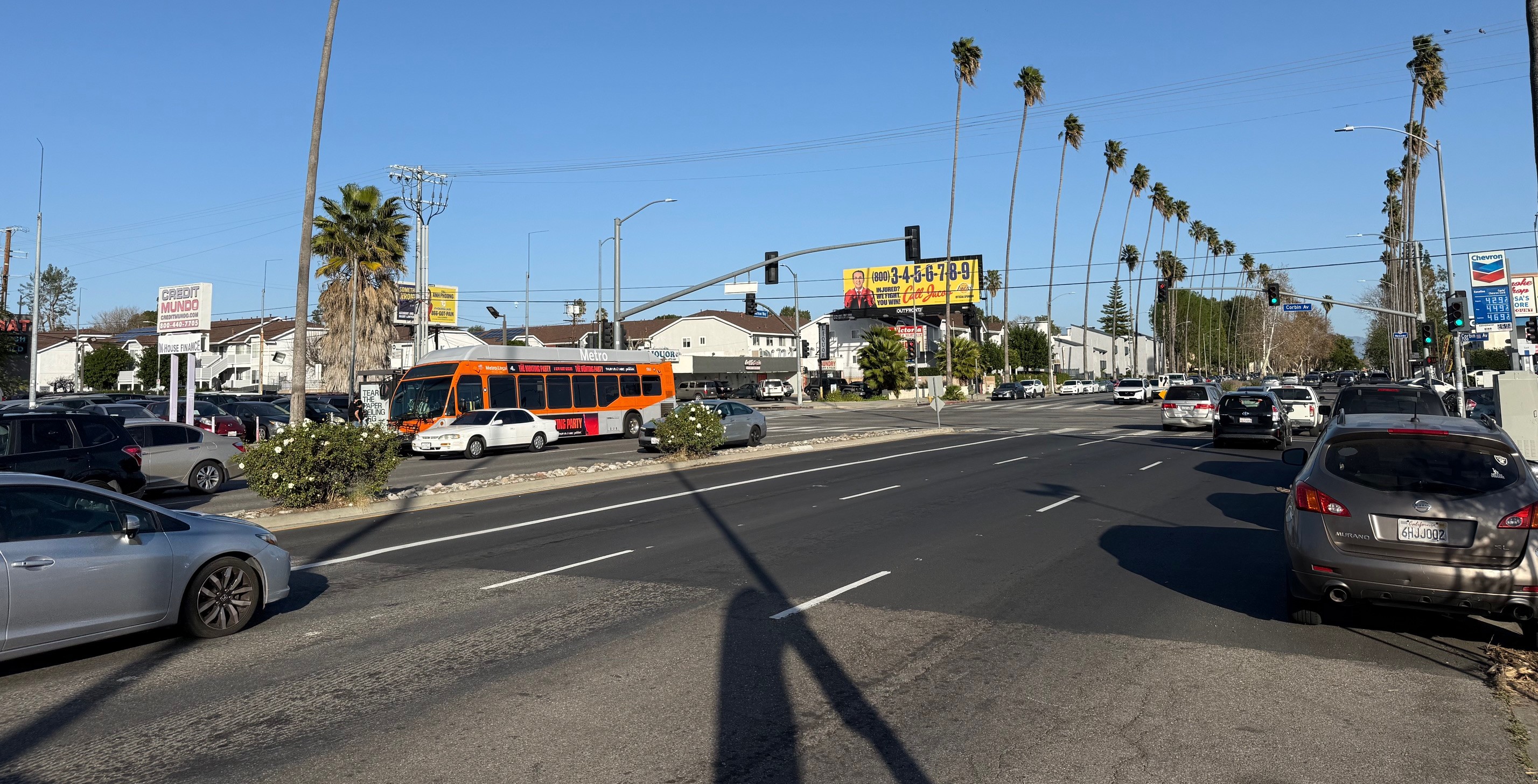
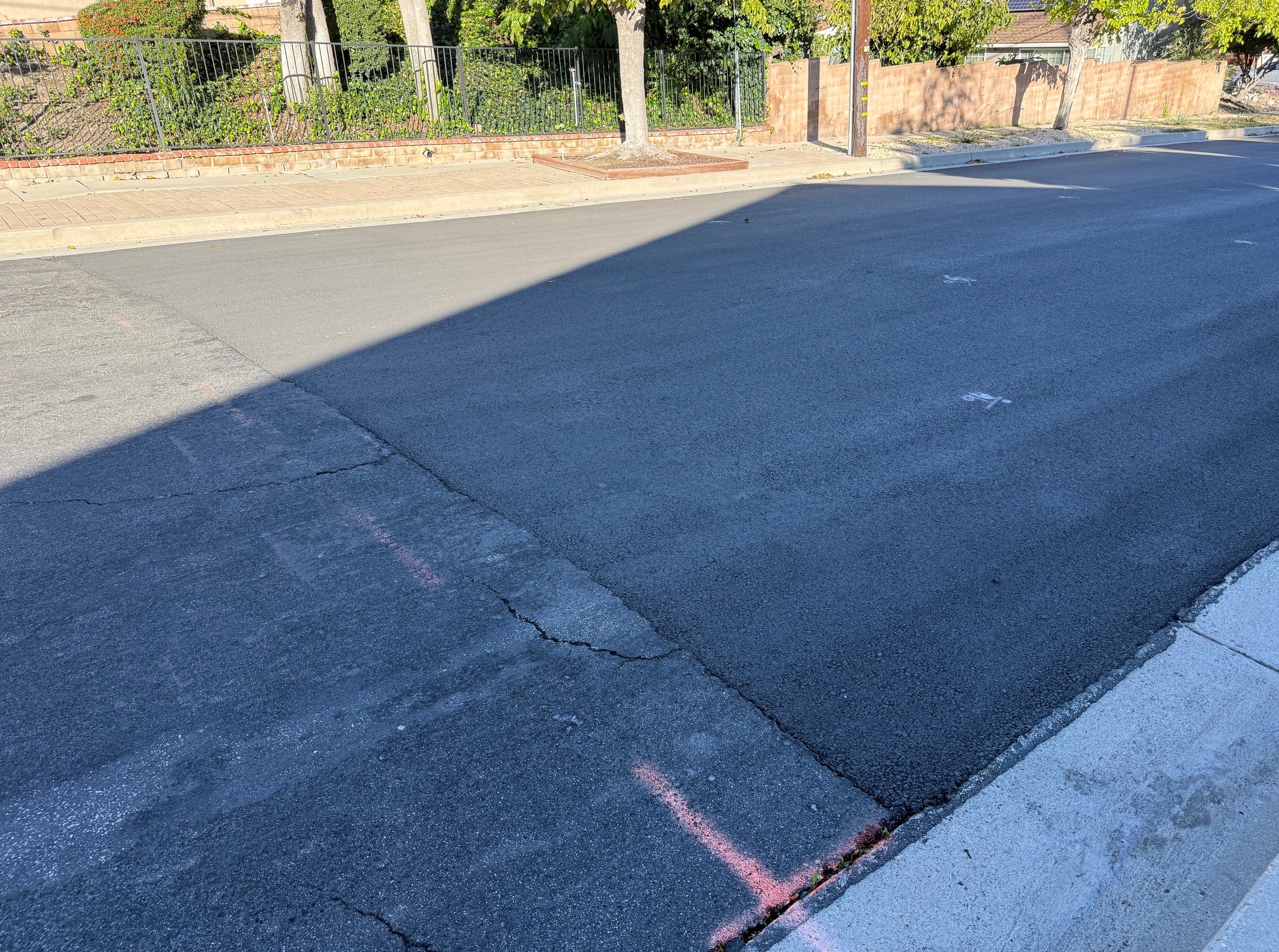
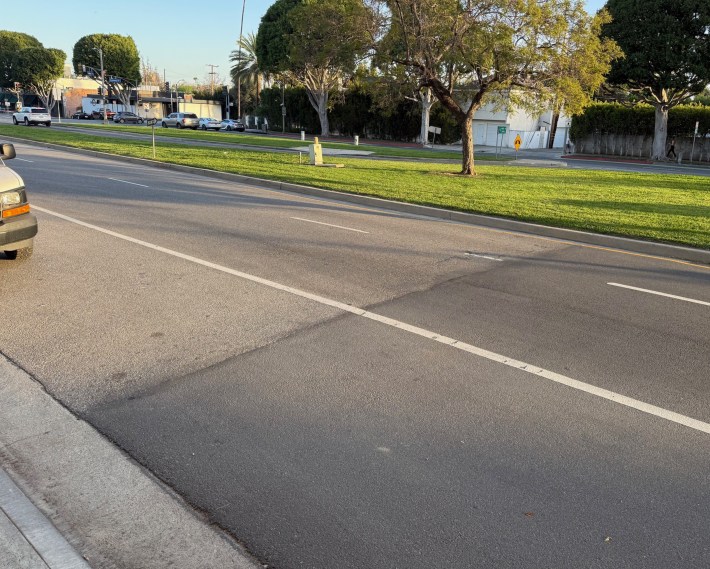
These fully resurfaced locations may be where the city determined that streets were already ADA-PROWAG-compliant? They appear indistinguishable from city resurfacing completed and reported last year, but StreetsLA has not reported any of them on its resurfacing completed webpage. SBLA asked StreetsLA if these are considered LAR or resurfacing; StreetsLA did not answer that question.
Streetsblog has migrated to a new comment system. New commenters can register directly in the comments section of any article. Returning commenters: your previous comments and display name have been preserved, but you'll need to reclaim your account by clicking "Forgot your password?" on the sign-in form, entering your email, and following the verification link to set a new password — this is required because passwords could not be carried over during the migration. For questions, contact tips@streetsblog.org.