Santa Monica/West L.A. Leaders Urge Caltrans to Build “Ohio to Ohio” Bike Link With Santa Monica Boulevard Rehab

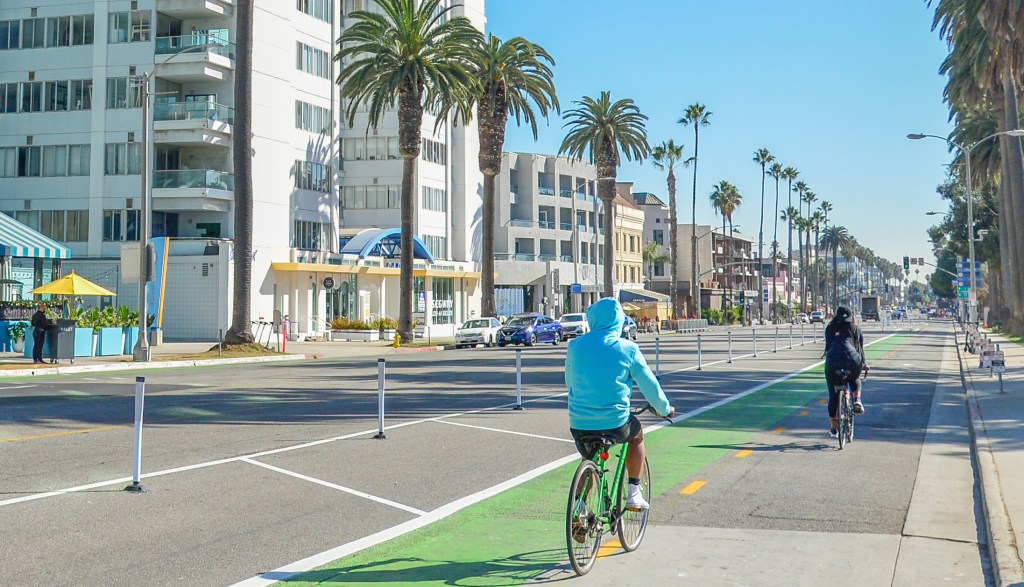
A growing chorus of elected officials representing Santa Monica are pressing Caltrans to stop treating bike safety as an afterthought and instead deliver a long-planned protected bicycle connection at the same time it repaves Santa Monica Boulevard.
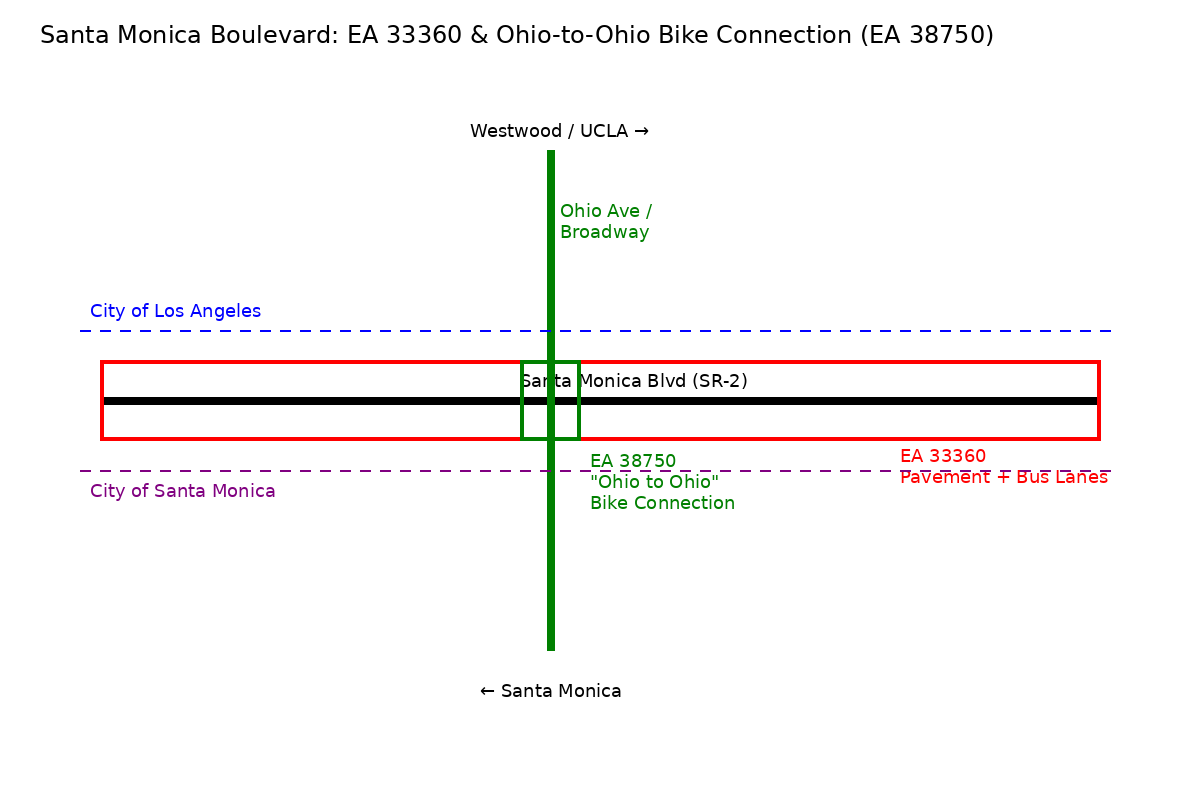
In letters sent to Caltrans leadership over the past six weeks, Santa Monica Mayor Caroline Torosis, State Senator Ben Allen, and Assemblymember Rick Chavez Zbur are all urging the agency to combine two projects on the same stretch of roadway: a major pavement rehabilitation and bus lane project on Santa Monica Boulevard, and a much smaller but crucial bicycle project known as the “Ohio to Ohio” connection (Ohio to Ohio). Read the letters here: Allen, Torosis, Zbur.
At stake, they argue, is whether the state will seize an easy opportunity to close a glaring gap in the Westside bike network — or repave the road now and leave riders navigating a high-speed arterial for decades to come.
What Caltrans Is Building Now
Caltrans is moving forward with its Santa Monica Boulevard Multimodal Project (Blvd. Project), a large pavement rehabilitation project on Santa Monica Boulevard that will also add peak-hour bus lanes. The project is widely supported by local officials for its transit benefits.
“We applaud Caltrans for delivering the transit lanes included in Blvd. Project, which will greatly improve travel times on two of Santa Monica’s Big Blue Bus routes,” Mayor Torosis wrote in the January 29 letter to Caltrans District 7 Director Gloria Roberts.
But the agency is planning to delay Ohio to Ohio — the project that would add protected bike lanes across a short segment of Santa Monica Boulevard that connects Ohio Avenue in Los Angeles to Broadway in Santa Monica — until a future State Highway Operation and Protection Program (SHOPP) grant cycle.
That delay, elected officials say, would effectively strand two major bike networks on opposite sides of one of the Westside’s busiest corridors.
Why “Ohio to Ohio” Matters
Ohio Avenue is one of the few low-stress streets that crosses the 405 Freeway and is already becoming a backbone of protected bike infrastructure in both cities. Los Angeles is building a protected bikeway along Ohio toward Westwood, while Santa Monica is upgrading Broadway — the continuation of Ohio west of Santa Monica Boulevard — into a fully protected corridor.
“Busy Santa Monica Boulevard acts as a barrier between the two discontinuous portions of Ohio Avenue,” Torosis wrote, noting that Broadway already functions as “the backbone” of Santa Monica’s growing protected bike network.
Without the short connector on Santa Monica Boulevard, riders traveling between Santa Monica, West L.A., UCLA, and the future Wilshire subway will be forced onto a wide, fast arterial — exactly the scenario California’s Complete Streets policies are meant to prevent.
Policy, Safety, and Cost Concerns
Assemblymember Zbur laid out the stakes most bluntly in a December 23 letter to Caltrans Director Dina El-Tawansy, warning that proceeding with the projects separately violates state policy, undermines safety, and wastes public money. Letter from Asm Zbur re EA 3336…
“Pavement rehabilitation is not a neutral intervention,” Zbur wrote, citing California’s Complete Streets framework and Caltrans’ own Director’s Policies. Rehabilitation projects, he emphasized, are a primary opportunity — and obligation — to add multimodal safety improvements when feasible.
Zbur also flagged the safety risk of repaving Santa Monica Boulevard without protected bike infrastructure, noting that sharrows are no longer permitted on roads of this speed and that riders will inevitably use the corridor anyway.
“As Santa Monica builds a protected bike lane up Broadway and Los Angeles builds a protected 1.3-mile bike lane along Ohio to Westwood,” he wrote, “more residents will end up making the choice to complete the ‘Ohio to Ohio’ connection along a major, high-speed artery, regardless of whether or not there is a protected bike lane.”
Senator Allen echoed those concerns in a February 3 letter, stressing that delaying the bike project would force the state to tear up newly paved roadway later — at far higher cost.
“Implementing these improvements as separate projects would increase costs as duplicative design, traffic control, and construction mobilization costs will all be incurred,” Allen wrote, calling on Caltrans to complete both projects simultaneously “to more efficiently and safely maximize Caltrans impact at the lowest cost.”
Zbur went further, citing examples of protected bike lanes delivered by local cities for roughly $45–$55 per linear foot — and warning that separating the projects could dramatically inflate costs for taxpayers. Letter from Asm Zbur re EA 3336…
A Narrow Window — and a Clear Ask
All three officials argue that there is still time to do this right. Zbur notes that construction staging has not yet begun on the relevant segment and that integrating the bike project would not require reopening CEQA — an issue that has become moot for projects like this under SB 71 since January 1, 2026.
Their request is straightforward: build the Ohio-to-Ohio protected bike connection now, while Santa Monica Boulevard is already under construction.
“Advancing the Ohio to Ohio connection now will provide outsized benefit as a critical link in the broader regional network,” Torosis wrote, “welcoming riders of all ages and abilities, while mitigating congestion and harmful greenhouse gas emissions caused by decades of automobile focused planning.”
For a state agency that routinely says it supports Complete Streets, climate goals, and safety for all users, the Westside’s elected leaders are making the case that this is exactly the moment to prove it — not by adding another study or deferring to a future funding cycle, but by pouring concrete once, and getting it right.

Read More:
Streetsblog has migrated to a new comment system. New commenters can register directly in the comments section of any article. Returning commenters: your previous comments and display name have been preserved, but you'll need to reclaim your account by clicking "Forgot your password?" on the sign-in form, entering your email, and following the verification link to set a new password — this is required because passwords could not be carried over during the migration. For questions, contact tips@streetsblog.org.