Viral Pothole Video Madness Shows How L.A. is Failing its Streets

Popular New York City Mayor Zohran Mamdani has repeatedly emphasized his commitment to the fundamental task of filling potholes. When Instagrammer Sp3der_ posted a short video asking Mamdani to fill two potholes, the mayor got headline news credit for having the two holes filled the same day.
Soon after, L.A. comedian Simone Boyce posted a similar pothole video, calling on Mayor Bass to “Mamdani” a pothole near Melrose Avenue.
Mayor Bass responded to Boyce, though, due to a parked car, the city couldn’t fill the hole that same day.
Some criticized the Mayor for taking to social media to declare victory before actually filling the hole. Nonetheless, the next day, Mayor Bass shared that the city did fix the pothole.
Meanwhile writer/journalist Alissa Walker (of Torched and L.A. Podcast) weighed in asking for the mayor to fix a car-sized pothole, which Walker had already reported to the city.
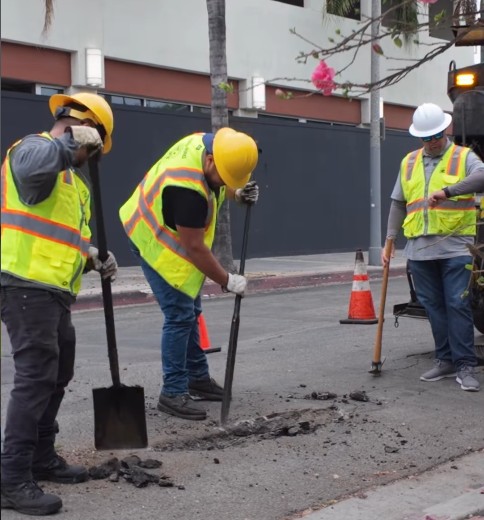
The mayor responded to Walker. Two days later city workers repaired the massive hole.
But wait! Why are there so many potholes to begin with?
It’s somewhat complicated.
Street conditions are impacted by city budget priorities, weather, traffic patterns, and more.
Walker noted that the city lacks a “CIP” – a multi-year Capital Infrastructure Program would go a long way toward ensuring investments go toward city priorities, like basic maintenance, or perhaps even equity, safety, environment, or climate.
Last winter was wetter than average, leading to greater wear and tear on asphalt. Today the city is in its second year of a fiscal crunch, meaning fewer workers out fixing and maintaining streets.
In this sort of situation, the city probably should be maintaining streets as efficiently as possible, right? Unfortunately, that has not been the case. The city’s Department of Public Works Bureau of Street Services (called StreetsLA) has been changing which streets it repaves, and how it repaves them.
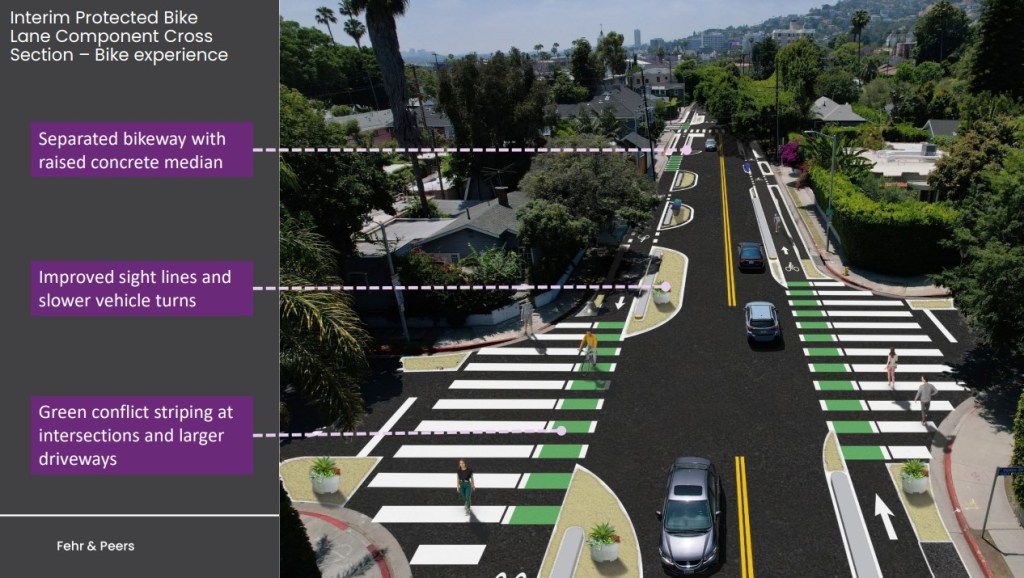
The changes are a response to two new laws, called HLA and ADA PROWAG. The Healthy Streets L.A. initiative (Measure HLA), approved by voters in 2024, requires the city to install planned bus/bike/walk/access improvement when resurfacing certain streets. The Americans with Disabilities Act federal Public Right of Way Accessibility Guidelines, which became law in 2025, require the city to improve accessibility during resurfacing.
In 2024, StreetsLA essentially paused resurfacing on “Mobility Plan network streets” – street sections that the city’s 2015 Mobility Plan designated for bus, bike or walk improvements.
Then the big change came in July 2025. In order to avoid PROWAG and HLA, StreetsLA almost entirely stopped basic street resurfacing, and instead embarked on “Large Asphalt Repair.”
StreetsLA decided to resurface just parts of streets, instead of the full curb-to-curb resurfacing that they had done for decades. “Large Asphalt Repair” was ineffective and inefficient, resulting in a tightened StreetsLA budget accomplishing less and less.
After advocates [disclaimer: including me, acting in a non-work capacity] began to challenge Large Asphalt Repair, asserting it actually does trigger HLA and ADA, the city abruptly stopped “LAR,” around April 2026. Then resurfacing street selection got even worse; the city shifted to pretty much only resurfacing streets without sidewalks.
Resurfacing streets without sidewalks avoids PROWAG and HLA, but it means that StreetsLA is focusing city resurfacing work on well-off suburban areas, including many hillside areas. Even worse, according to the city, many of these suburban streets now being resurfaced are already in good shape. They don’t even need to be resurfaced.
The result of all this is a sort of man-made perfect storm. The streets that Boyce and Walker and likely you, the readers, are travelling on are a degraded mess.
Streetsblog has migrated to a new comment system. New commenters can register directly in the comments section of any article. Returning commenters: your previous comments and display name have been preserved, but you'll need to reclaim your account by clicking "Forgot your password?" on the sign-in form, entering your email, and following the verification link to set a new password — this is required because passwords could not be carried over during the migration. For questions, contact tips@streetsblog.org.