Metro Board September 2026 Update: Electric Buses, Open Streets, Bike-Share, and More

Here are highlights from today’s Metro board meeting.
Electric Buses
The Metro board approved $337 million for the purchase of 220 new battery electric buses [staff report] to be manufactured by El Dorado National California (ENC). Metro staff had recommended approving authority for extending the contract for up to nearly a half-billion dollars worth of ENC buses. Mayor Karen Bass and City Councilmember Katy Yaroslavsky shepherded an amendment putting the purchase on a shorter leash: approving an initial 220, then subjecting contract extensions to future Metro board approval.
Metro has a fleet of about 2,000 buses. Today about 7 percent are electric; this purchase will up that to over 20 percent.
This electric bus procurement has been messy.
Though Environmental Justice and environment advocates have pushed for bus electrification, Metro staff often favor continued use of natural gas buses, which have served Metro riders dependably. Though agencies in Asia and Europe operate massive fleets of electric buses, U.S. electric bus manufacturers are few, and have produced buses somewhat less capable and less reliable than fossil fuel powered ones. Transit experts note that a reliable fossil fuel bus has more environmental benefits than unreliable electric bus. NYC and Boston have hit recent snags in expanding e-bus fleets.
Then there’s the manufacturing jobs picture. Labor advocates have criticized Metro’s somewhat opaque procurement process that selected ENC, a non-union shop that has not produced electric buses. ENC has manufactured plenty of Metro non-electric buses in the past. Unionized bus manufacturer New Flyer came in a close second.
All in all, the “start with just 220 buses and see how it goes” approach was grudgingly supported by most labor, transit, and environmental advocates commenting today. The purchase will put Metro in the forefront of U.S. electric bus fleets. Metro electric bus operations should significantly reduce air, climate, and noise pollution, and help spur domestic bus manufacturing – assuming the buses are reliable.
It remains to be seen if the course of true Metro bus electrification will ever run smooth.
Tepid Metrolink Support
The board approved a multi-part Metrolink item [staff report], which includes Metro’s ongoing recently reduced funding for Metrolink’s budget.
Metrolink is basically in crisis mode. With equipment issues and flagging ridership (and little support from the state or federal government), the six-county regional rail system is cutting service and increasing fares to stave off a downward spiral.
The bad news coming from this Metro board cycle is that there seems to be a rift opening between Metro and Metrolink. There are no clear Metrolink champions on the Metro board (that role often fell to recently retired boardmembers Ara Najarian and John Fasana). Metro staff are overtly critical of Metrolink performance, which Metro helped worsen. In a sort of rob-Peter-to-pay-Paul move, Metro seems to be overly focused on its own bottom line (which it should definitely mostly focus on) and therefore not looking for constructive steps to help minimize Metrolink troubles. At the end of the day, the losers are likely to be Southern California transit riders, many of whom frequent – and depend on – both agencies.
Metro Ridership Increasing
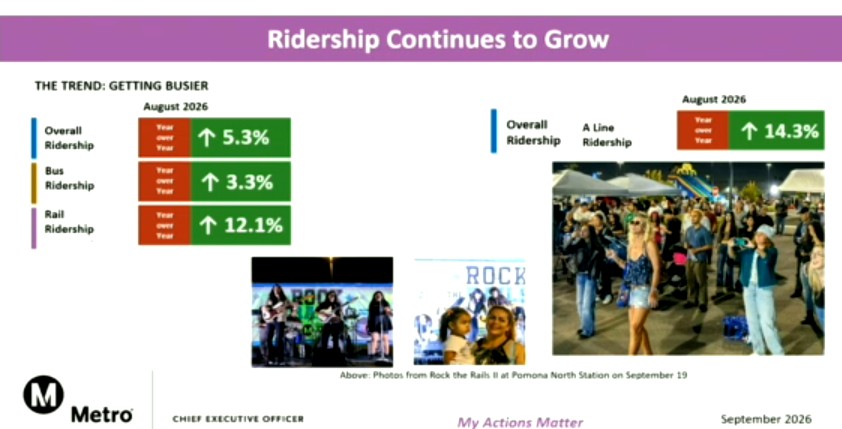
Metro saw a 5.3% increase in weekday ridership in August 2026, compared to 2025.
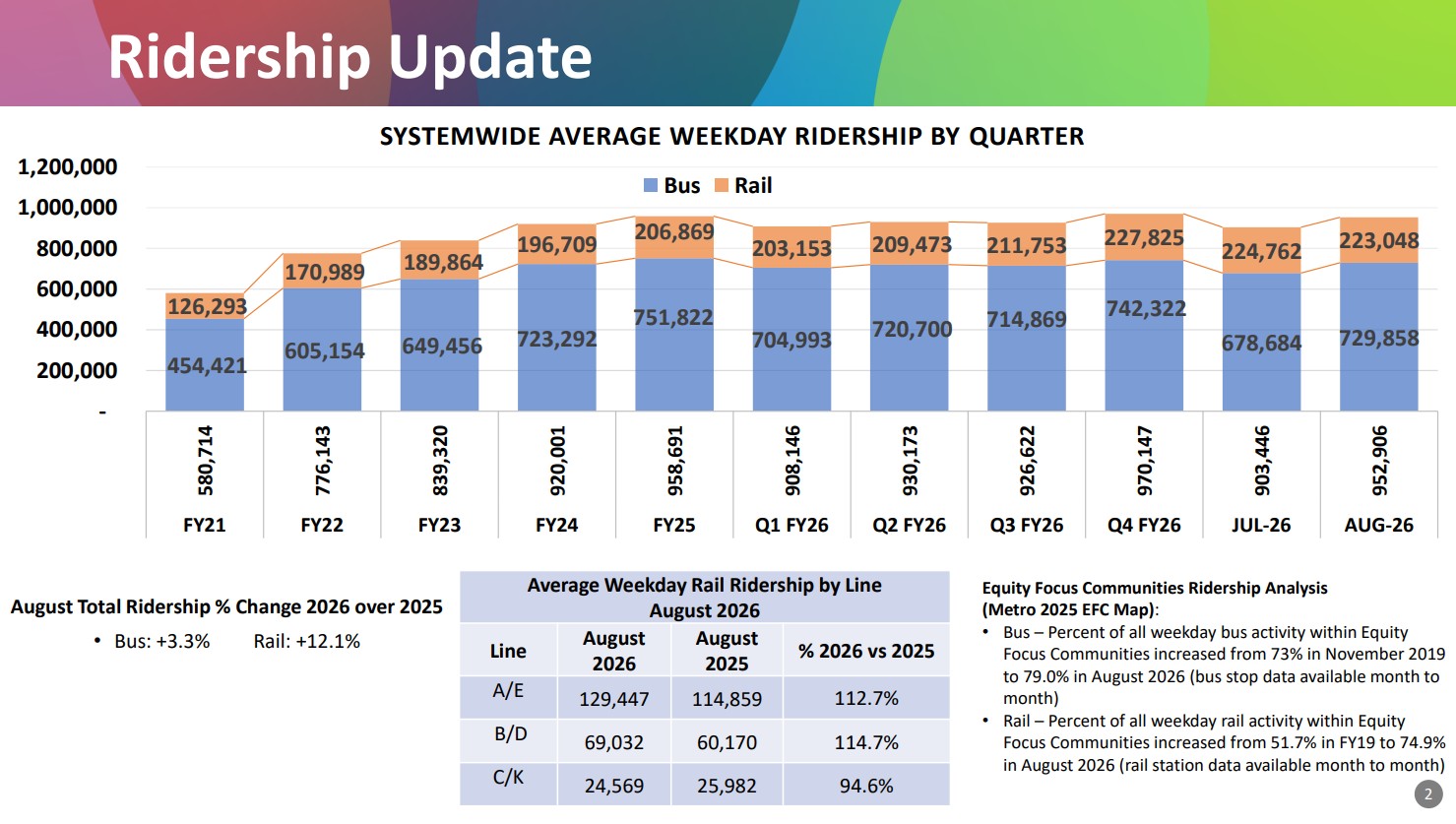
Metro opened new A Line and D Line extensions last year, resulting in significant rail ridership growth. Here are August rail highlights from a Metro ridership press release:
- A line trips increased 14.3%, with Saturdays growing nearly 17%.
- B line trips increased by 6%, with Sundays up 32%
- With the new extension open, D line trips shot up nearly 63%
- The E line saw a 10% increase, with weekdays up 11.3%
Vermont Transit Corridor Budget Approved
The Metro board greenlit building the Vermont Transit Corridor project [staff report]. The $413 million 12.4-mile 26 station Bus Rapid Transit (BRT) line is already in the early “pre-construction” phase. Today’s approval keeps the project on track for opening before the 2028 Olympics.
Light Rail Reliability Crossover Improvements
Also in advance of the 2028 Olympics, Metro will add four new cross-over tracks: two on the A Line, and two on the E Line. The improvements are called the A&E Line Interlock Project [staff report].
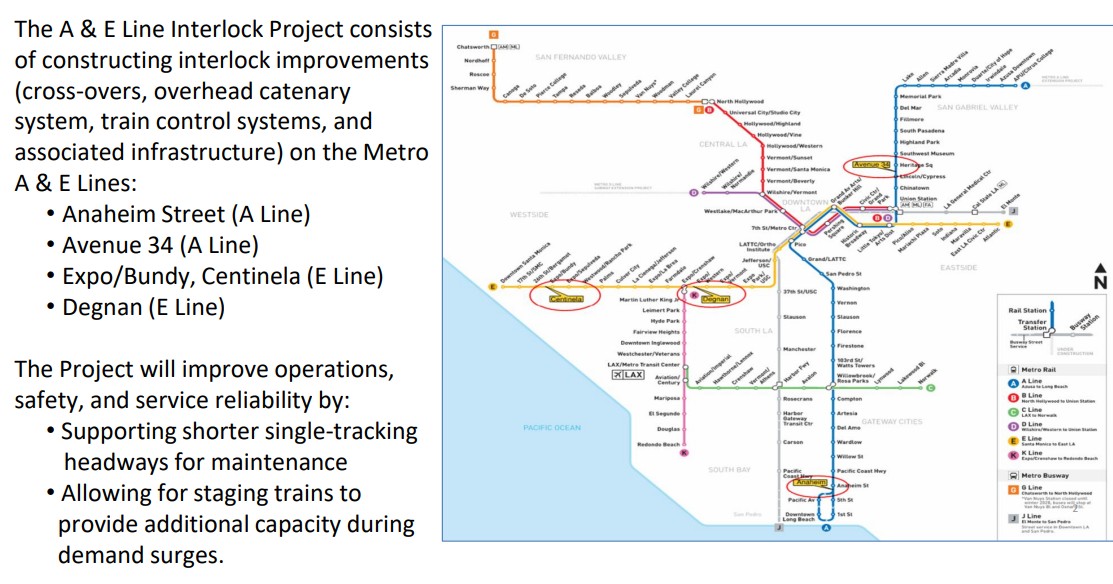
Everyday trains won’t use these new tracks, but they benefit riders by making disruptions less disruptive. In a pinch (scheduled maintenance, unexpected equipment failure, etc.), these crossovers allow shorter single-tracking, meaning more riders getting to their destinations sooner. This is a positive example of Metro Olympic efforts that will also benefit ongoing riders for decades to come.
Motion LIFE U-Pass
Mayor Bass recently pledged to “develop a plan” to move Metro toward free transit. Today, the board approved a Bass motion, which directs Metro staff to report on possibilities for expanding Metro programs serving low income riders and students. Both programs are vitally important and chronically under-enrolled.
The report back is due in 90 days, putting it well after the November 3 mayoral election.
Metro Bike Share Expansion
The board approved grant-funded expansion of Metro Bike Share [staff report].
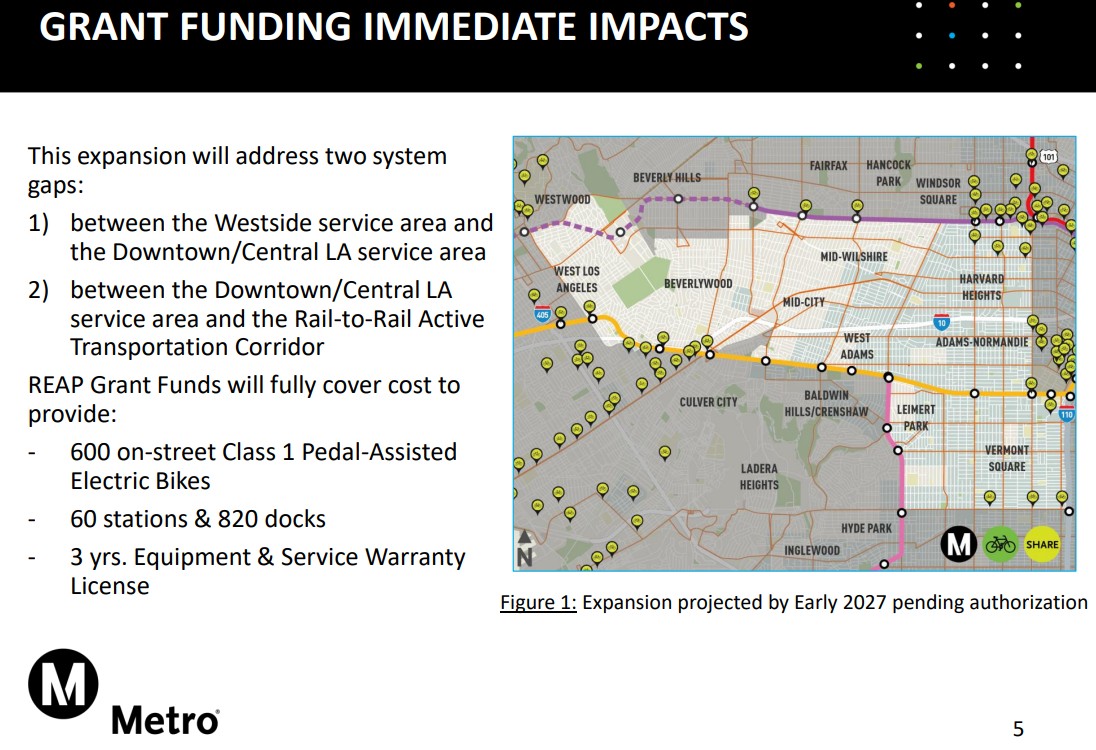
Metro Bike Share will expand about 30 percent. Metro will add 60 new docking stations (820 docks) and 600 new e-bikes. New stations will be located in the city of Los Angeles across South L.A., Mid-City, and West L.A. neighborhoods.
See additional bike-share details SBLA reported last week.
Open Streets Funding
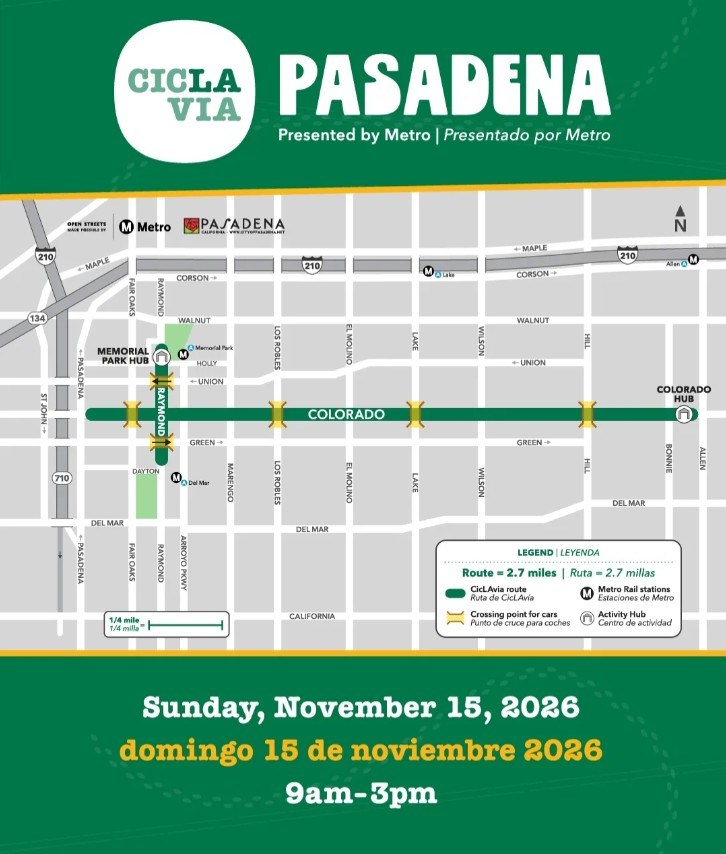
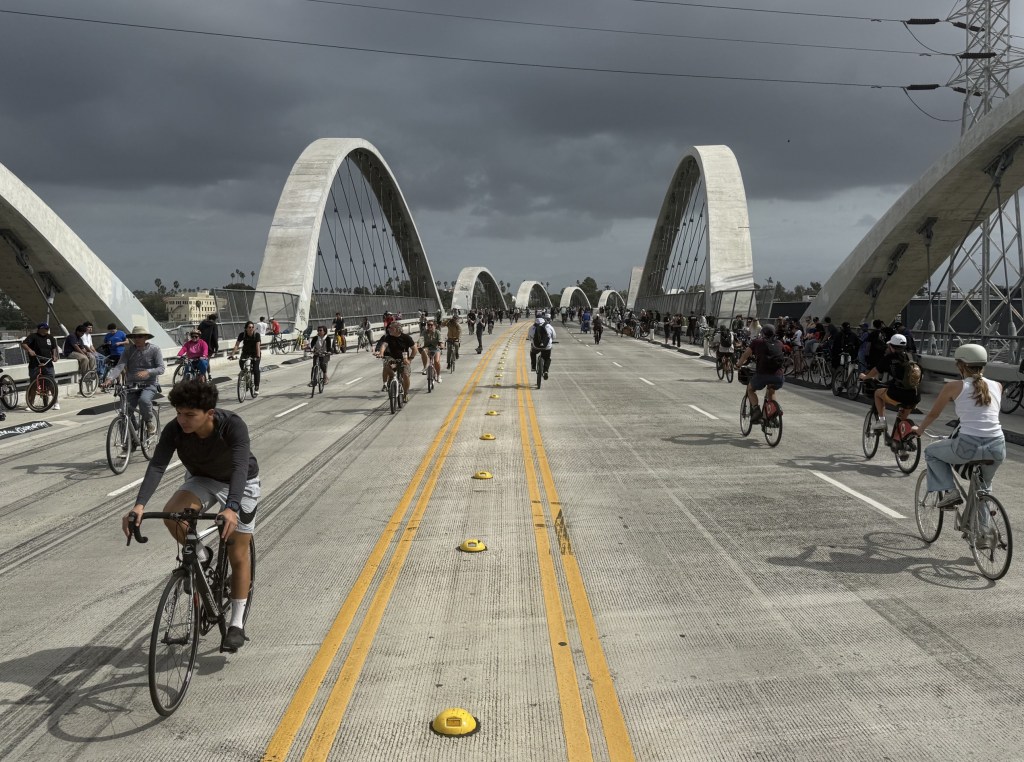
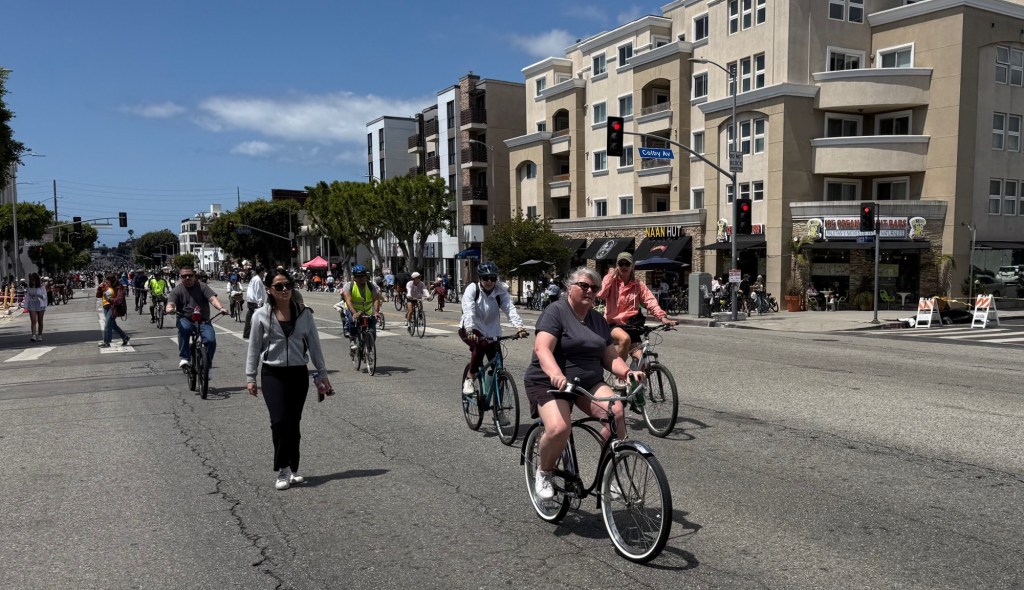
The Metro board approved $1 million for grants for open streets events [staff report]. CicLAvias and other open streets will not be paused for all of next year. These funds are very much the result of the persistent efforts of County Supervisor Lindsey Horvath.
See additional open streets details SBLA reported last week.
Read More:
Streetsblog has migrated to a new comment system. New commenters can register directly in the comments section of any article. Returning commenters: your previous comments and display name have been preserved, but you'll need to reclaim your account by clicking "Forgot your password?" on the sign-in form, entering your email, and following the verification link to set a new password — this is required because passwords could not be carried over during the migration. For questions, contact tips@streetsblog.org.