Alhambra Approves New Pilot Bus Routes
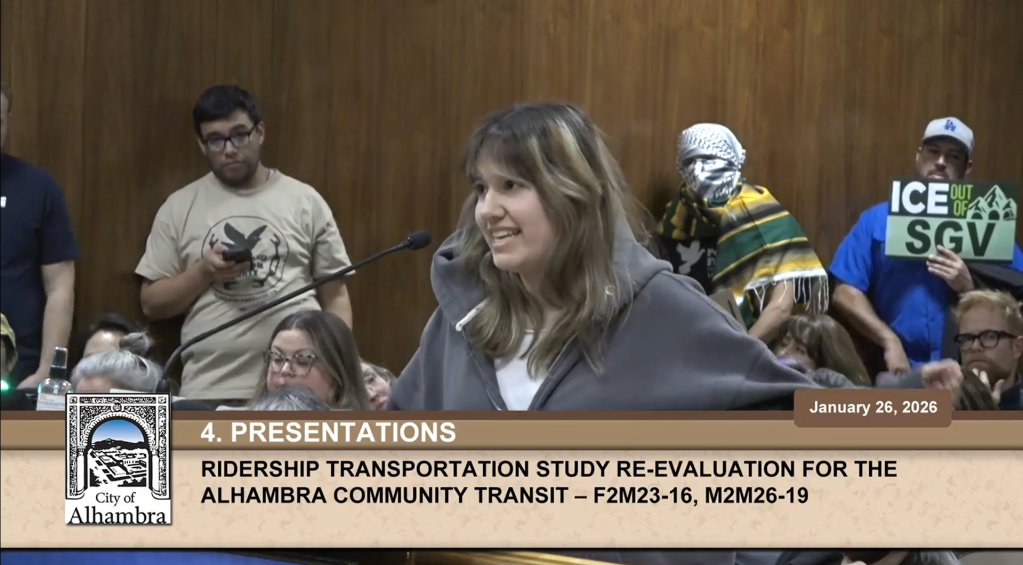
After a rocky city council meeting, the votes are in and Alhambra Community Transit will be piloting new versions of its local bus routes next summer. The program will run for a yearlong study period.
- The Green Line loops around the city’s main business corridors with four buses running both ways
- The Blue Line runs three buses back and forth from the city’s downtown to the transit center at Cal State Los Angeles (with limited hours)
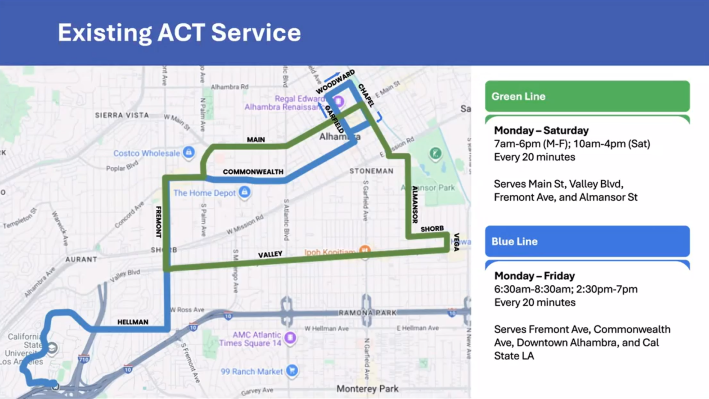
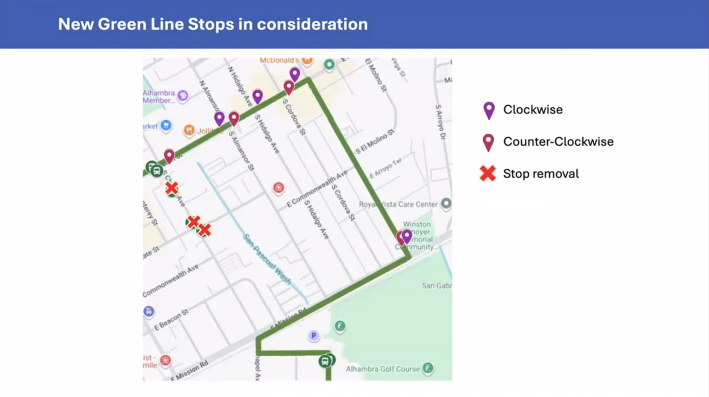
Proposed modifications to the Green Line widen the loop a little bit towards the city’s east and west boundaries. The Blue Line, meanwhile, would be radically changed to reduce redundancy and steer service toward the city’s underserved south side below the 10 Freeway.
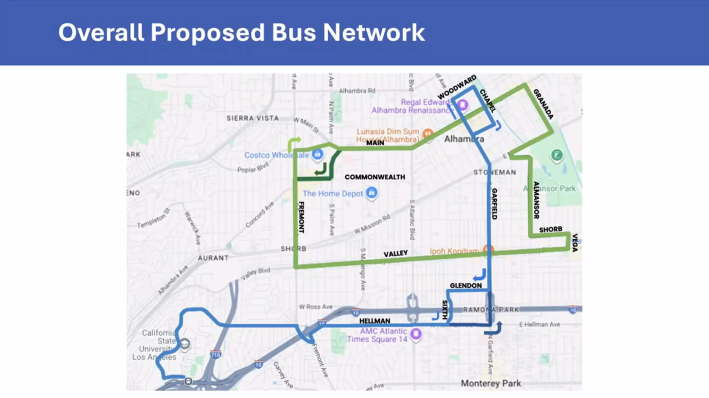
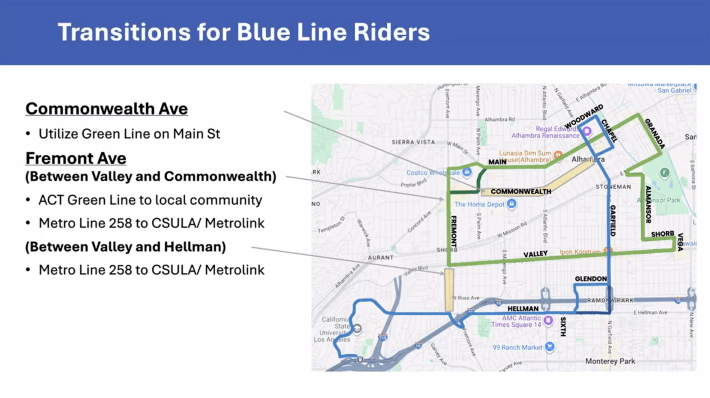
While these changes could be a win for some (the city’s consultant, Kimley-Horn, projects a 19% ridership growth overall), there were concerns among Blue Line commuters that extra time spent walking to different stops and taking transfers from the Green Line or Metro 258 could make people late to work.
Dixon Wong told the council that several Los Angeles County workers whom he knows from his commute are worried about the change.
“They take their commute to Union Station, to Cal State L.A., and then the ACT Blue Line,” Wong said. “If you make the changes, taking Hellman Avenue straight east and then going north on Garfield Avenue, they would have to catch another ACT Green Line all the way back to Fremont, which makes them 20 minutes late every day for work. They already expressed it to their boss, and when that happens, their boss is not going to like it.”
Wong – among others – also pushed for all day service on the Blue Line.
Another gentleman who identified himself as Hong shared skepticism about trying to connect to the Blue Line via Metro 258 if Fremont is taken off the route.
“The 258 is actually increasing from 20 minutes – great service – to now 40 minutes,” Hong told the council. “Will I have to be driving now? All of a sudden, we’re adding more cars back on the road.”
Although the altered Blue Line would provide seniors access to the medical facilities on Garfield (a point raised in the presentation), Hong said with the line’s limited hours, seniors are better off using the city’s Dial-A-Ride program.
On the other hand, a group of students from San Gabriel High School (located just outside Alhambra in the city of San Gabriel) gave comments that seemed to support the reconfigured Green Line, even if it wasn’t exactly what they hoped for.
Brian Kwon and Maria Vargas spoke to the council as a pair. Their campus group, Transformative Justice, surveyed the student body and found that almost 400 students live in Alhambra. In their research, they learned that transit was a common concern for their classmates, and it deters them from taking on afterschool activities.
Like SGHS senior Madeline Morales, who spoke after them.
“On days where I have to walk to school or walk home, it can take as long as an hour to reach my destination,” Morales said.
And with ICE raids ramping up in Los Angeles again, that’s a particularly worrying proposition.
“Nowadays, walking to school or walking home isn’t even safe in our community.” Morales’ voice broke. “This week, I have to walk to school, and all I can think about is, what if I don’t make it?”
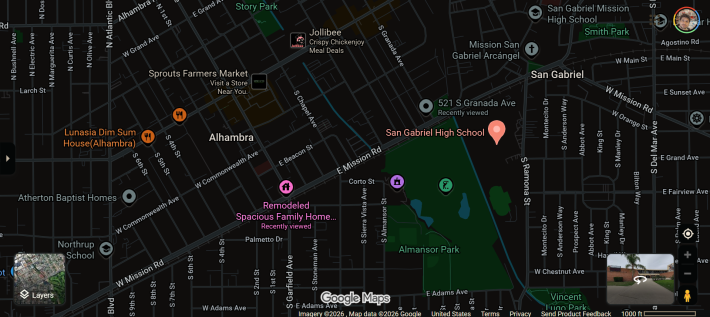
Currently, the nearest Green Line stops to SGHS are at Chapel Avenue & Bay State Street and Almansor Street and Corto Street. Google estimates both as 20+ minute walks.
Under the new pilot, the Green Line would have a stop going each way at the corner of Garfield and Mission Road. This shrinks the walk to about 10 minutes.
Five students from San Gabriel High School came out to the meeting, and they all wanted a bus stop that comes as close to their school as possible, ideally right in front of it. City staff informed them that this idea had been studied, but the turnaround for the bus was not deemed safe.
Perhaps in the future, an additional bus line could service just Alhambra Unified School District’s five high schools.
After public comment for the item finished, council members began giving remarks on the bus routes. Adele Andrade-Stadler and Noya Wang got through theirs, sharing the sentiment that the plan isn’t perfect, but is worth trying. When Katherine Lee spoke up the audience quickly lost patience with the proceedings.
The council chambers on Monday (January 26) had been a packed house, not because of the ACT bus, but due to an incident which took place a week before where a local activist who was tailing Border Patrol agents on the road was pulled over by Alhambra Police. This followed with a brief confrontation by Border Patrol before the two parties were separated without arrests occurring.
The heated crowd forced the council to temporarily table all agendized matters and resume public comment. See a short report from ABC 7 here, and the full Alhambra City Council meeting here.
About two hours later, the council returned to the agenda and Lee finished expressing her skepticism for the proposed bus routes, based largely on local complaints about stops and turnarounds on residential streets.
Councilmembers Ross Maza and Jeff Maloney quickly noted their support for the pilot program (and its hopeful expansion), and the item passed 4-0 with Lee abstaining.
Streetsblog’s San Gabriel Valley coverage is supported by Foothill Transit, offering car-free travel throughout the San Gabriel Valley with connections to the A Line Stations across the Foothills and Commuter Express lines traveling into the heart of downtown L.A. To plan your trip, visit Foothill Transit. “Foothill Transit. Going Good Places.”Sign-up for our SGV Connect Newsletter, coming to your inbox on Fridays!

Read More:
Streetsblog has migrated to a new comment system. New commenters can register directly in the comments section of any article. Returning commenters: your previous comments and display name have been preserved, but you'll need to reclaim your account by clicking "Forgot your password?" on the sign-in form, entering your email, and following the verification link to set a new password — this is required because passwords could not be carried over during the migration. For questions, contact tips@streetsblog.org.