Will Metro and Caltrans 405 Freeway Widening – through Carson – Really Mean Cleaner Air?

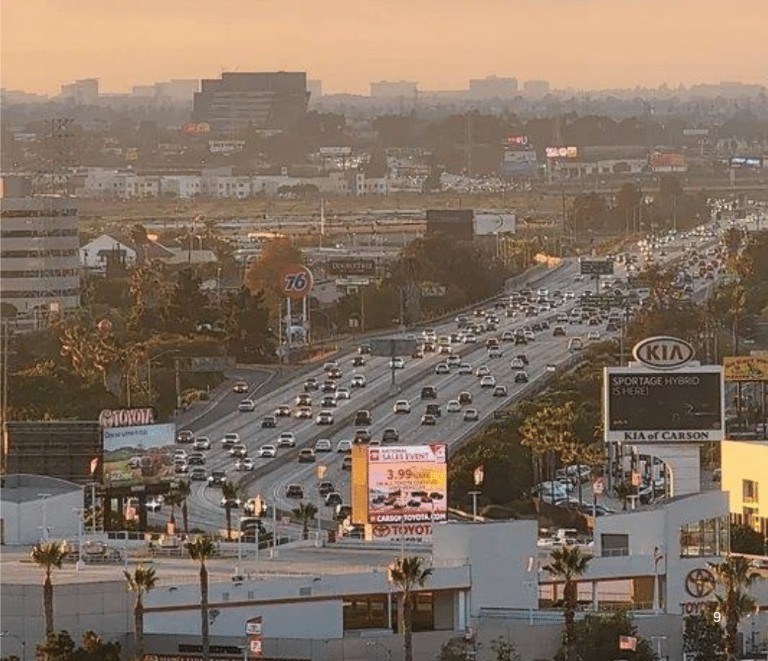
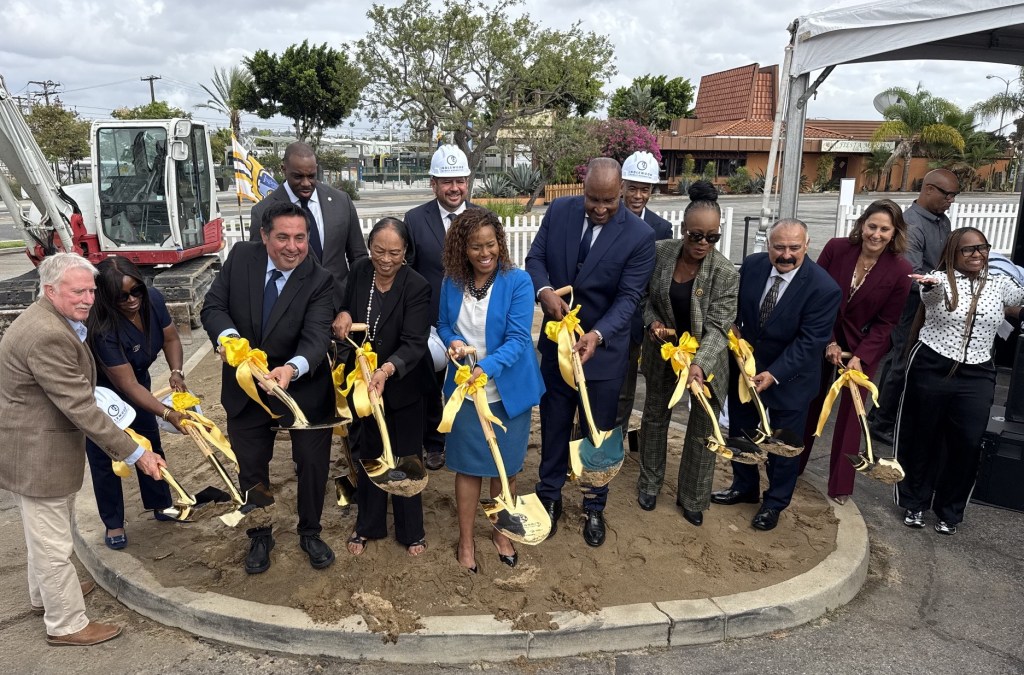
Metro and Caltrans plan to spend $120+million to add two more lanes to the 405 Freeway through much of the city of Carson. Learn more and give your public comment on the project by attend an in-person Metro hearing tonight at from 6-7:30 p.m. at Carson Events Center at 801 East Carson Street.
Metro released the 405 Freeway Wilmington Avenue to Main Street Improvements Project Draft Environmental Impact Report (DEIR)/Environmental Assessment (EA) earlier this month, on August 5. The agency is accepting DEIR public comments for 45 days; submit yours by Monday, September 21. The DEIR documents, how to submit comments, and additional project and meeting information can be found at Metro’s project page.
In September 2024, Metro hosted scoping meetings for the Carson 405 project.
The DEIR includes three alternatives:
- No-build
- Freeway widening (with modest bike/walk features – see below)
- TSM (Transportation System Management) and TDM (Transportation Demand Management), respectively programs to make the freeway more efficient and incentives to encourage people not to drive.
The project that Metro and Caltrans hope to build – alternative 2 – would add four new auxiliary lane segments totaling about two new lane-miles. Auxiliary lanes are lanes that extend from one on-ramp to the next off-ramp. Freeway builders seem to love to build new auxiliary lanes because, although they add freeway capacity, there is a state loophole that exempts short “aux lane” projects from environmental scrutiny.
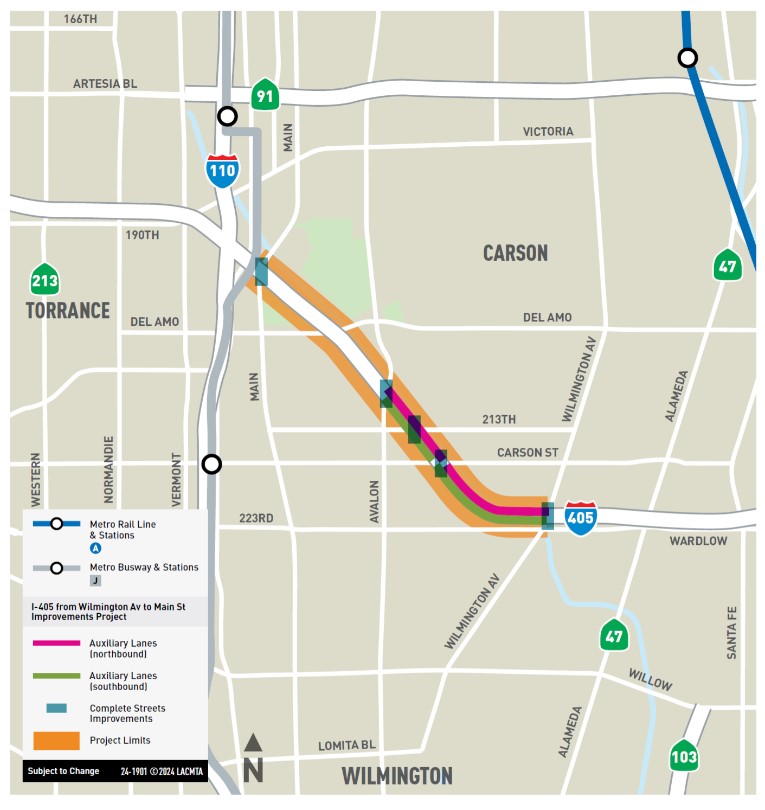
The loophole applies to aux lanes less than a mile long, and this project has lots of those. Metro plans to widen the 405 freeway in four stretches, each less than a mile.
- Northbound 405 from Wilmington Avenue on-ramp to Carson Street off-ramp: ~0.7 mile
- Northbound 405 from Carson Street on-ramp to Avalon Boulevard off-ramp: ~0.3 mile
- Southbound 405 from Avalon Boulevard on-ramp to Carson Street off-ramp: ~0.4 mile
- Southbound 405 from Carson Street on-ramp to Wilmington Avenue off-ramp: ~0.5 mile
The 405 project DEIR invokes the state loophole (section 3.4, page 508), asserting that the widening is “not likely to lead to a measurable and substantial increase in VMT [Vehicle Miles Traveled]… [Because] the individual length of the auxiliary lanes… as well as the combined length of the auxiliary lanes in either direction of travel, is less than 1 lane mile.” The DEIR goes on to assert that, because of the auxiliary lanes (plus bike/walk and TSM/TDM), the project can skip an induced demand analysis and VMT assessment.
The aux lane loophole assumptions get carried into various other analyses, including air quality impacts. The DEIR (section 3.3.3.1, page 498) acknowledges that widening the freeway “would increase roadway capacity” but then claims that “because the proposed Project would not increase the number of travel lanes on I-405, no increase in VMT would occur.”
The DEIR (section 2.3.6.3, page 343) asserts that widening the 405 would lead to cleaner air.
For air quality, the document first declares that widening would be equivalent to no-build “Because VMT is not expected to increase under Alternative 2 when compared to the No-Build Alternative, higher levels of MSAT [Mobile Source Air Toxins – basically tailpipe air pollution] emissions are not expected from Alternative 2 [widening] compared to the No-Build Alternative.” Then, the analysis maintains that “Alternative 3 [TSM/TDM] would not materially change traffic volumes, travel demand, or fleet mix relative to the No-Build conditions.” Then the EIR states that, for all three alternatives, “emissions would likely be lower than present levels” in 2050, because the federal EPA will make cars emit less pollution.
The DEIR (section 3.3.3.1, pages 498-503) further asserts that widening the freeway will make traffic flow more smoothly, which will decrease tailpipe emissions – a myth called “traffic smoothing.” It claims that adding more lanes “aims to improve freeway operations that would reduce congestion-related emissions.”
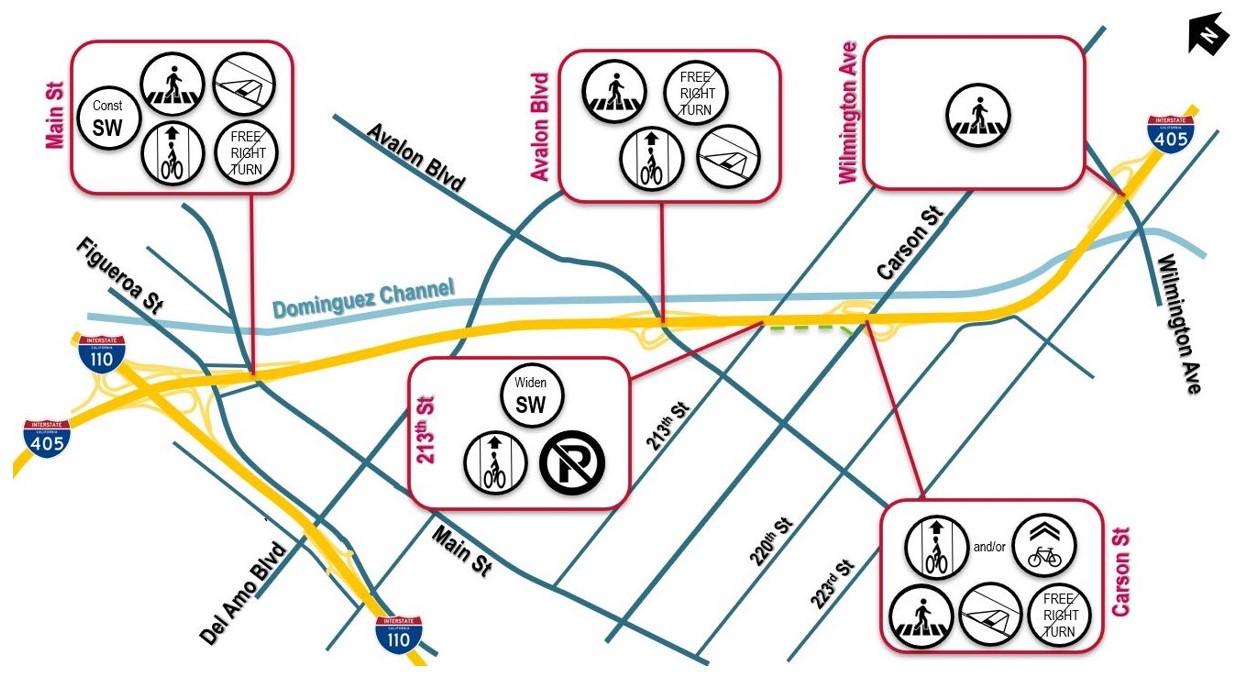
The 405 project also proposes to includes a handful of complete streets features.
For walking, the project would add about a third of a mile of sidewalks at Main Street, where pedestrians currently walk in dirt. The proposed scope would also widen existing sidewalks at 213th Street. At ramps, existing basic two-stripe crosswalks would be upgraded to zebra crosswalks.
The project would also add just over half a mile of new unprotected bike lanes, mostly under and on either side of the freeway (see detailed diagrams in project appendix 5):
- Wilmington Avenue: no bicycle facility
- Carson Street: add ~0.1 mile of bike lanes
- 213th Street: add ~0.1 mile of bike lanes
- Avalon Boulevard: add ~0.07 mile of southbound-only bike lane (an existing wide sidewalk would be designated a bike path for northbound cyclists)
- Main Street: add ~0.3 mile of unprotected bike lanes. The bike lanes stop on the south bank of Dominguez Channel, roughly 250 feet short of a connection to the existing Dominguez channel bike/walk path, which runs on the north side of the waterway.
This Carson project is one of more than a half-dozen 405 Freeway widening projects – from LAX to the Orange County limit – Metro and Caltrans are planning. They recently completed a ~2-mile $65+million 405 Freeway expansion project in the city of Torrance.
Learn more and comment at tonight’s public hearing. Submit your own DEIR comments by September 21; instructions at Metro project webpage.
Streetsblog has migrated to a new comment system. New commenters can register directly in the comments section of any article. Returning commenters: your previous comments and display name have been preserved, but you'll need to reclaim your account by clicking "Forgot your password?" on the sign-in form, entering your email, and following the verification link to set a new password — this is required because passwords could not be carried over during the migration. For questions, contact tips@streetsblog.org.