The Benefits of Congestion Pricing

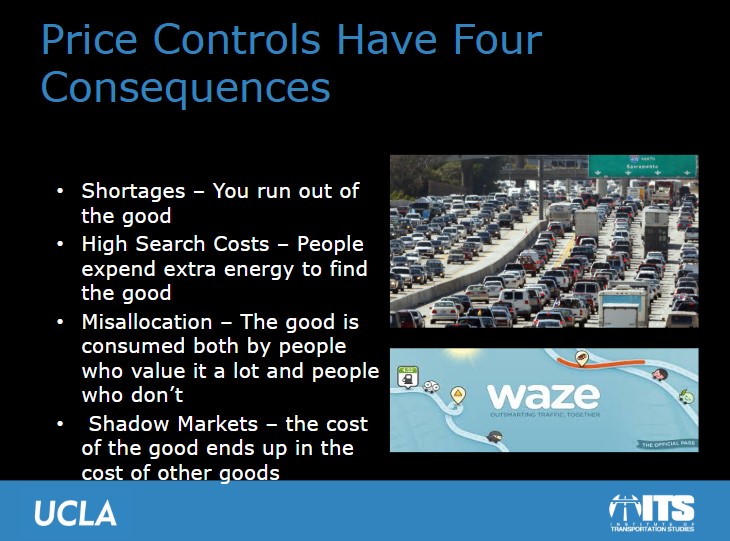
At today’s meeting of L.A. Metro’s Congestion, Highway and Roads Committee, UCLA professor Michael Manville made a convincing case for implementing congestion pricing.
Last month, the board heard from CEO Phil Washington that congestion pricing would be one approach to raising the revenue needed to accelerate projects for the 2028 Olympics. Metro staff estimate that congestion pricing could raise between $12-$100+ billion through 2028.
Manville’s presentation emphasized congestion pricing’s many important benefits, even before any revenue is spent. He likened the current under-priced road congestion to Black Friday crowds every day. When a valuable resource is provided for free to users, then it will be in short supply.
Manville explained the well established fundamental law of road congestion: road widening doesn’t reduce congestion. When a road is widened – or even when new transit opens (drawing some people who formerly traveled by car) – driver speed increases, at first. Faster speed means less time cost for driving, hence effectively the speed means driving is cheaper. This then draws drivers from other routes, other times, and other modes – in what Manville called a triple convergence. Within a few months, the widened road returns to its original level of congestion.
Manville cited congestion pricing success examples from London, Singapore, and Stockholm: “where it’s used, it works.”
Metro committee members expressed concerns about equity. Road pricing represents an additional cost paid by drivers, some of whom are low-income.
Manville acknowledged that congestion prices are regressive, but cautioned the committee against selectively applying that criteria. Manville pointed out that the entire transportation finance system – gas taxes, sales taxes, registration fees – is regressive. As are other infrastructure systems – water meters, electric meters, etc. Manville stressed that the current system subsidizes people with enough resources to afford a car.
Manville stressed congestion pricing’s tremendous benefits to transit riders. Road pricing creates a virtuous cycle of more people riding transit, more revenue, faster bus speeds – all benefits to low-income populations. All these benefits accrue even before funding is invested.
Manville recommends that a Metro congestion pricing program further address equity concerns by using some revenue to offset costs for poor people, similar to utility lifeline programs.
Metro CEO Phil Washington spoke positively of congestion pricing, stating that it would send a message to the world that Los Angeles is “doing something about congestion.” Washington stated that he will bring Metro staff recommendations to next week’s full board meeting. He didn’t give details, but said that the plan would be to pursue some sort of congestion pricing pilot, as well as feasibility studies. Washington said that he is taking road pricing seriously, stressing its potential for “saving humankind.”
What might be most remarkable is new Caltrans District 7 Director John Bulinski’s responses. Bulinski stated that it is “obvious” that widening is not a solution to address congestion. This contradicts what his staff are doing on the ground. Caltrans and Metro are spending billions to widen freeways and claiming these projects will reduce congestion. Bulinski further expressed that Caltrans would partner on Metro’s efforts to study and pilot congestion pricing, which he described as viable and valuable.
Read More:
Streetsblog has migrated to a new comment system. New commenters can register directly in the comments section of any article. Returning commenters: your previous comments and display name have been preserved, but you'll need to reclaim your account by clicking "Forgot your password?" on the sign-in form, entering your email, and following the verification link to set a new password — this is required because passwords could not be carried over during the migration. For questions, contact tips@streetsblog.org.