Metro Board Unanimously Advances K Line North Light Rail Extension
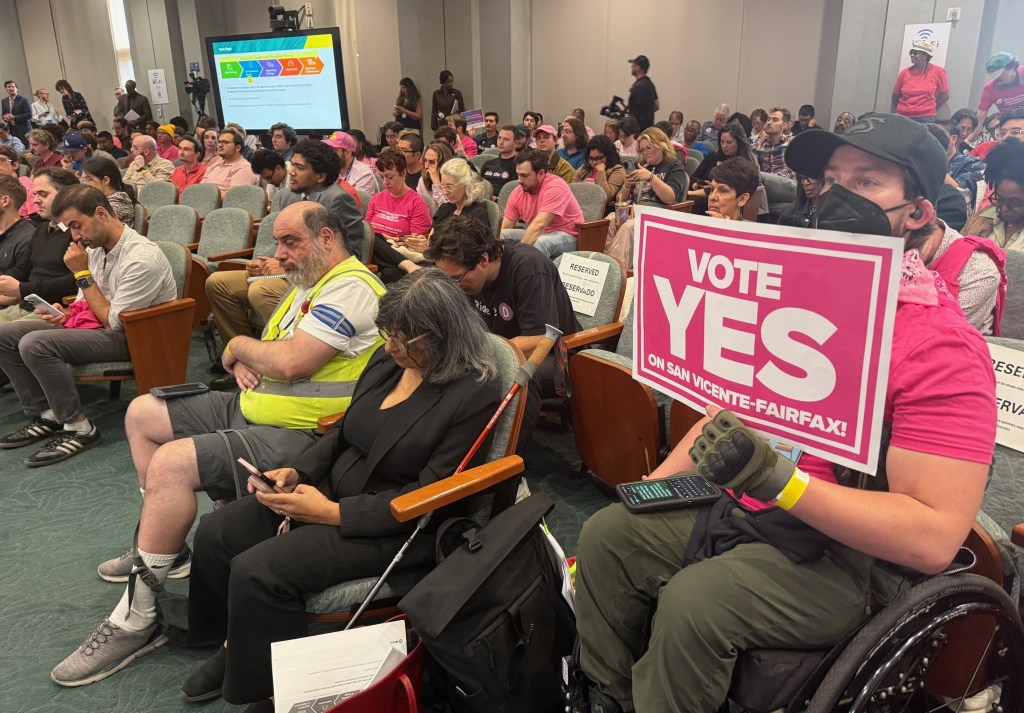
This afternoon, the Metro board unanimously approved most of the route to extend K Line light rail northward. The approval came as the result of a compromise in which L.A. Mayor Karen Bass backed off of her push for indefinite delays requested by some mid-city residents opposed to tunneling under their homes. Today’s winners were K Line champions: Supervisor Lindsey Horvath, the city of West Hollywood, and transit advocates.
Overall the K Line Northern Extension (KNE) will be a key north-south light rail subway that will greatly increases Southern California rail network usefulness by tying together the Metro B, D, and E Lines. The extension will serve relatively population dense central neighborhoods, with plentiful job, retail, and entertainment destinations.
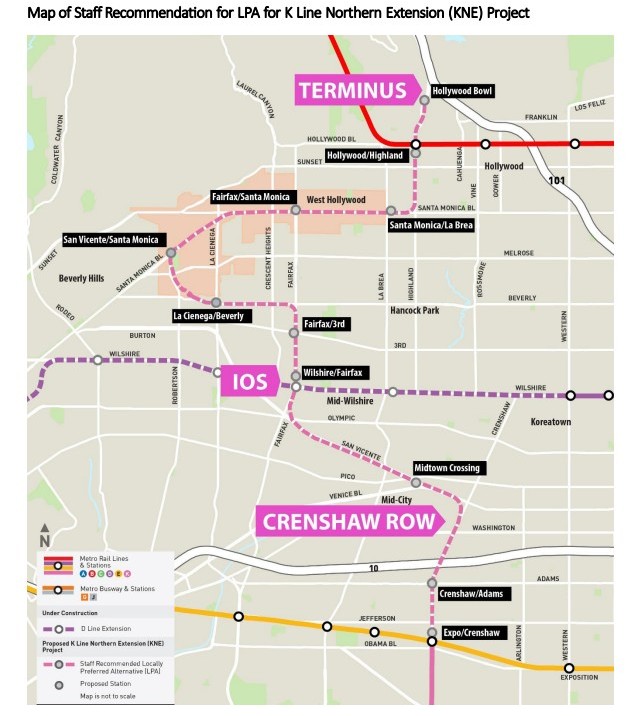
The board selected the San Vicente-Fairfax alignment as the “Locally Preferred Alternative” (LPA). Metro is currently considering three alignments in the project’s environmental studies (Environmental Impact Report – EIR). The alignment selected is the one championed by West Hollywood.
The preferred alignment is roughly ten miles long with nine stations. It extends from the current K Line terminus at Exposition/Crenshaw, connecting to the D Line at Wilshire/Fairfax, and to the B Line at Hollywood/Highland. The project includes six stations in the city of Los Angeles – in Mid-City, Fairfax and Hollywood – and three stations in the city of West Hollywood. (Extending the line to a tenth station – at the Hollywood Bowl – was also approved, but may not be included in early project phases.)
The first phase (the initial operating segment – IOS) of the K Line North extension is expected to extend about four miles from the E Line to the D Line.
The extension has just over $2 billion dollars worth of Metro Measure M sales tax funding, but those construction funds are not scheduled until 2041. West Hollywood is pushing to accelerate the project, including paying for a quarter of the capital costs. West Hollywood plans to contribute $2.5 billion to the project via an Enhanced Infrastructure Financing District (EIFD). Many cities (including the city of Los Angeles portion of the D Line) have balked at Metro’s 3 percent local match requirement.
After a Metro board committee failed to approve the K Line extension last week, transit advocates were concerned that L.A. Mayor Karen Bass and her board appointees were pushing to kill (or indefinitely delay approving) the project. Ultimately Bass and Horvath co-authored the amended motion that was approved.
Speaking at today’s board meeting, Bass noted that she, Horvath, and Metro CEO Stephanie Wiggins had negotiated the final terms late last night.
The final Bass/Horvath wording is mostly the same as Bass’ initial motion wording (shared by Streets for All). Bass delivered anti-K Line nimbys another year of tunneling studies before finalizing a mid-city alignment. Metro already spent millions of dollars studying this since late 2024. Those studies led to Metro proposing a new tunnel path away from historic homes (that revision makes for a somewhat worse project for the transit-riding public; it costs more for slower train trips.) K Line opponents still oppose the new tunnel plan. Will “an independent third party peer technical review” change any mid-city minds?
Initial Bass wording appeared to potentially delay the project indefinitely. The final wording limits that delay to just one year, and removes further K Line planning work being “contingent upon funding availability.”
During that year, other parts of the project proceeded. The motion directs Metro to work with West Hollywood as it proceeds with forming the EIFD. Metro staff will evaluate starting construction at the north end of the line, where Metro will investigate possibilities for less expensive cut-and-cover tunneling.
In her statements today, Bass compared Metro rail impacts to the massive harms that freeway building wrought on South L.A. neighborhoods. (Bass is critical of freeway expansion that took place in the past, not so much in the present. Bass has repeatedly voted to support current Metro-led freeway expansion, including as recently as the October 2025 approval for Metro widening the 105 Freeway through South Los Angeles.)
Bass and her Metro board appointee Jacquelyn Dupont-Walker were heavily criticized by transit advocates, including Nick Andert and Streets for All. Andert reported that Dupont-Walker’s Lafayette Square home is located essentially on top of what had been Metro’s initial proposed K Line tunnel alignment. As a property owner there, Dupont-Walker has a conflict of interest and by law must recuse herself from influencing the K Line vote. Dupont-Walker left the room for committee and board K Line discussion and votes, but LAist reported that the Mayor and Dupont-Walker together attended K Line community meetings. Andert termed Dupont-Walker’s K Line involvement “corruption.” Bass did not name Andert, but stated that video accusations and misinformation were leading to doxxing and “compromising people’s safety.”
Transit advocacy won the day. But this K Line project will face several further Metro board approval hurdles in the years to come.
Streetsblog has migrated to a new comment system. New commenters can register directly in the comments section of any article. Returning commenters: your previous comments and display name have been preserved, but you'll need to reclaim your account by clicking "Forgot your password?" on the sign-in form, entering your email, and following the verification link to set a new password — this is required because passwords could not be carried over during the migration. For questions, contact tips@streetsblog.org.