Dallas and Seattle Ride the Dockless Bike-Share Rollercoaster

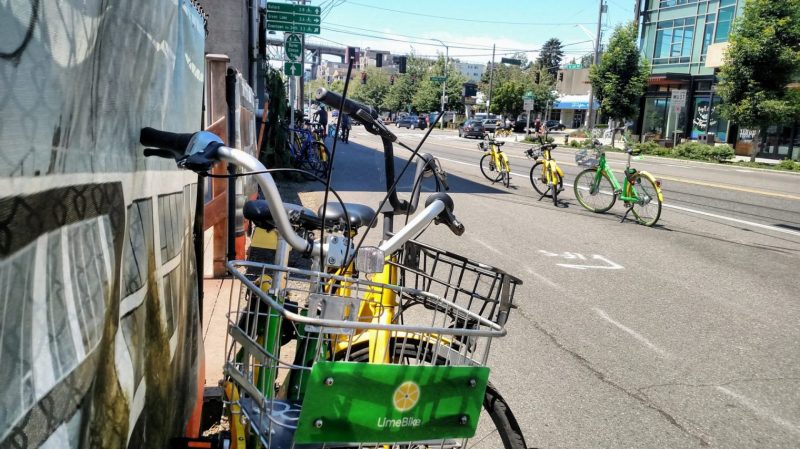
The two U.S. cities with the largest dockless bike-share fleets — Dallas and Seattle — are now on different paths.
Bike-share companies are pulling bikes out of Dallas and eyeing a transition to electric scooters, while Seattle finalizes legislation that would double the potential size of dockless bike-share fleets in the city.
In Dallas, the Chinese bike-share start-up ofo is leaving, reports Robert Wilonsky at the Dallas Morning News. The company at one point had a fleet of 5,000 bicycles in the city.
Along with Spin, which ran a smaller fleet of 700 bikes, ofo is winding down its bike operations in Dallas. Both companies may maintain a presence with electric scooter fleets instead. An ofo manager cited the city’s new fees on bike-share operators as a factor in its decision, but the company is retreating all over North America, as well as in Europe, India, and Australia.
To help cover costs the city incurs to keep the bike-share fleets orderly, Dallas is charging $18 per bike annually plus a nominal registration fee for each company. Three other bike-share companies — Mobike, Spin, and VBikes — did not object to the fees and appear to be staying on.
Meanwhile, Seattle is one of the few American cities where ofo will continue to operate. After a year-long pilot phase, transportation officials are preparing to double the size of dockless bike-share fleets permitted citywide to 20,000 bicycles, divided between four companies.
In addition to ofo, Lime and Spin are operating in Seattle, and JUMP is expected to join in the near future.
As part of the expansion, Seattle will implement fees to cover the cost to the city of adding bike parking zones and managing the private operators, reports Stephen Fesler at the The Urbanist. Each company will pay $250,000 for an annual permit, which works out to $50 per bike.
While Seattle’s bike-share fleet is poised to grow, performance indicators have not been encouraging. Newly released data shows that with 10,000 bikes across all fleets citywide, ridership averaged about 7,000 daily trips in May and June, or 0.7 trips per bike per day.
One reason for the lackluster usage may be that many bikes are not actually available, depleting the capacity of bike-share and diminishing reliability. Testers with the Seattle Times found that nearly a third of the 206 bikes they spot-checked were unrideable, either because of “obvious damage” to the bike or glitches with the app-based unlocking mechanism.
The ability of the venture capital-backed bike-share companies to keep their fleets in workable condition has always been one of the big unknowns hanging over the business model. In Seattle, it’s still an open question.

Read More:
Streetsblog has migrated to a new comment system. New commenters can register directly in the comments section of any article. Returning commenters: your previous comments and display name have been preserved, but you'll need to reclaim your account by clicking "Forgot your password?" on the sign-in form, entering your email, and following the verification link to set a new password — this is required because passwords could not be carried over during the migration. For questions, contact tips@streetsblog.org.