What the Amtrak 501 Derailment Says About America’s Failure to Prevent Train Crashes

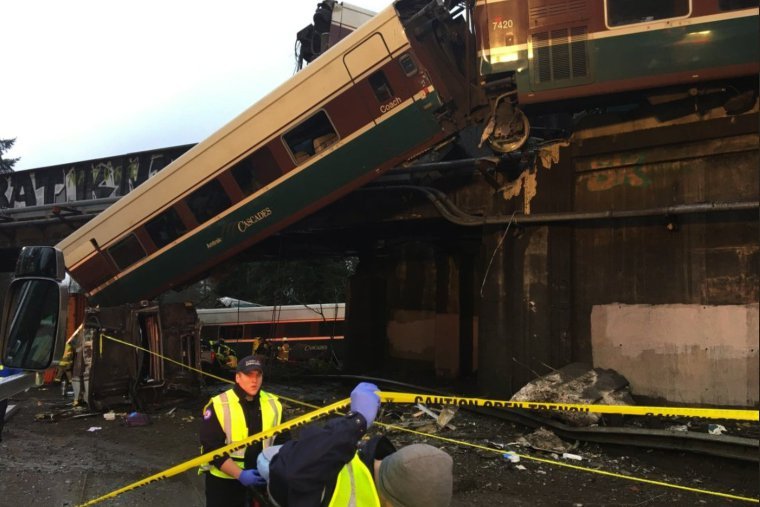
When an Amtrak train derailed yesterday near Tacoma, Washington, killing at least three and injuring dozens, none other than Donald Trump jumped right in with a tweet about his long-rumored infrastructure plan. It was ironic, to say the least, considering the GOP tax bill is expected to punish transit and passenger rail budgets.
But funding alone doesn’t account for what happened. Amtrak was running its first passenger train along an upgraded route from Seattle to Portland. The service is now shorter and more direct thanks to $180 million in federal stimulus funding.
While the investigation is just beginning, initial reports indicate that the train entered a tight curve at too high a speed. Sandy Johnston at Itinerant Urbanist puts the crash in context with a look at the American rail industry’s failure to prevent speed-related crashes:
Though I discourage speculation about root causes, it’s impossible not to note the scary parallels between this crash and two other recent overspeed crashes, Amtrak 188 at Frankford Junction, Philadelphia in 2015 and Metro-North at Spuyten Duyvil in the Bronx in 2013.
Amtrak 188 entered a 50 mph curve at 106 mph; in a situation eerily similar to today’s the Metro-North train entered a 30 mph curve at 82 mph. We still don’t really know the root cause of the Frankford Junction crash, though most theories have centered around the engineer (who is suffering from amnesia from the accident) losing attention somehow, without his recollections it’s impossible to know for sure. At Spuyten Duyvil the engineer suffered from sleep apnea and was apparently asleep as the train went around the curve (the same issue has come up in several other, more minor commuter rail incidents recently, including at Hoboken and Atlantic Terminal). Whatever the cause, overspeed incidents are all too common on American railroads.
Positive train control technology, mandated by Congress after a 2008 train crash, could have prevented these derailments. On the Cascades route, PTC is supposed to go live in 2018.
While the lack of any dedicated funding for PTC has played a role in lagging adoption, Johnston says the core problem is Amtrak’s dysfunctional safety culture:
Jason Laughlin of the Philadelphia Inquirer just published a piece yesterday (literally not kidding) building off of the NTSB’s scathing assessment of Amtrak’s “safety culture,” stemming from yet another fatal crash, this one at Chester, PA in 2016. Let’s just take a moment to appreciate that the two maintenance-of-way workers killed in the crash and the train engineer involved all tested positive for drugs, and yet that was not found to be a necessary contributing factor to the crash. Similar assessments of commuter railroads have been, while perhaps not as bad, not encouraging either.
American railroading has a lot of pathologies — a reactionary culture; toxic labor-management relations; an inability to accept innovation or new ideas — but few have the potential to affect riders as directly as the dysfunctional attitude that it sometimes seems everyone from the top down takes toward safety. It’s a problem that pervades both management and labor, and no one should escape the recriminations, when they come, unscathed. Alex Forrest has a good thread about the cultural contrasts between American and Japanese attitudes toward rail safety; but let’s just say the challenge of 21st century American railroading will be to change a culture where the idea that a train will go on the ground every so often is acceptable rather than unimaginable.
More recommended reading today: Tim Kovach crunches the numbers to show how fare hikes are accelerating a death spiral of declining transit ridership in Cleveland. Urban Milwaukee reports that the city’s streetcar is 90 percent complete. And the Bike Coalition of Greater Philadelphia considers Mayor Jim Kenney’s commitment to Vision Zero.

Read More:
Streetsblog has migrated to a new comment system. New commenters can register directly in the comments section of any article. Returning commenters: your previous comments and display name have been preserved, but you'll need to reclaim your account by clicking "Forgot your password?" on the sign-in form, entering your email, and following the verification link to set a new password — this is required because passwords could not be carried over during the migration. For questions, contact tips@streetsblog.org.