Beyond the Gates: USC Planning Students Build Ties with Communities through Tours
A few weeks ago, I got a phone call asking me to help someone interested in journalism put together a tour in South L.A.
I immediately found myself getting anxious. Tours into lower-income areas can be a touchy thing, depending on who wants to do the tour, what their intentions and expectations are, who leads it, what the focus is, who the group connects with, how interactions are handled, and so forth.
So, when people ask me about getting to know an area, I usually prefer to steer them towards jumping in feet first and doing volunteer work in schools, participating in community events, or just spending time there.
But it doesn’t mean that tours can’t have value, especially if their objective is to make people comfortable enough to begin to build a longer-term relationship with a community.
That seems to be the idea behind the Beyond the Gates program launched in this past spring by Alison Spindler, then-president of the Partnership for an Equitable Los Angeles (PELA), a student organization at the USC Sol Price School of Public Policy.
The PELA students feared that the gates erected around the perimeter of USC following the horrific killing of two international students in April of 2012 would deepen the physical and social disconnect between the university and the surrounding community. Given that that divide was emblematic of the very barriers to equity and social justice they hoped to dismantle through their work in planning, policy, and development, they felt they would have to be the ones to take the first steps toward closing that gap.
Their first tour through Historic South Central was led by organizers from Strategic Actions for a Just Economy (SAJE) and Esperanza, two non-profits based near USC that address housing and health issues for the local community. Having community leaders guiding the tour, students felt, would increase the likelihood that they would hear the kinds of stories and understandings of place not often found in their textbooks or in the media. Specifically, it would help them become familiar with the kinds of community-led efforts that are often marginalized or even erased when these communities are targeted for redevelopment, “revitalization,” or other policy interventions. And it would give students an idea of who they might like to intern/volunteer with, if they wanted to get more involved with community work.
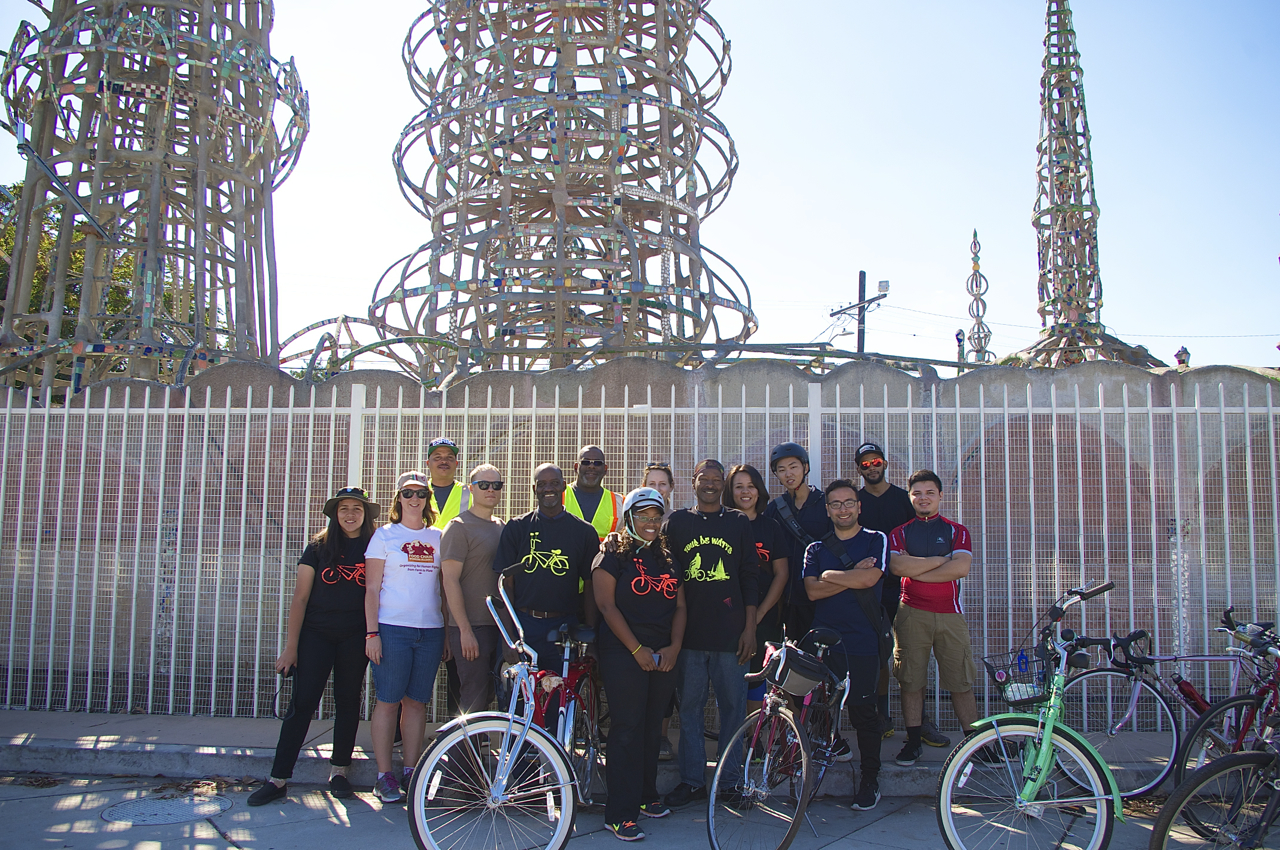
Their latest tour, led by the East Side Riders, took them through Watts and Florence-Firestone.
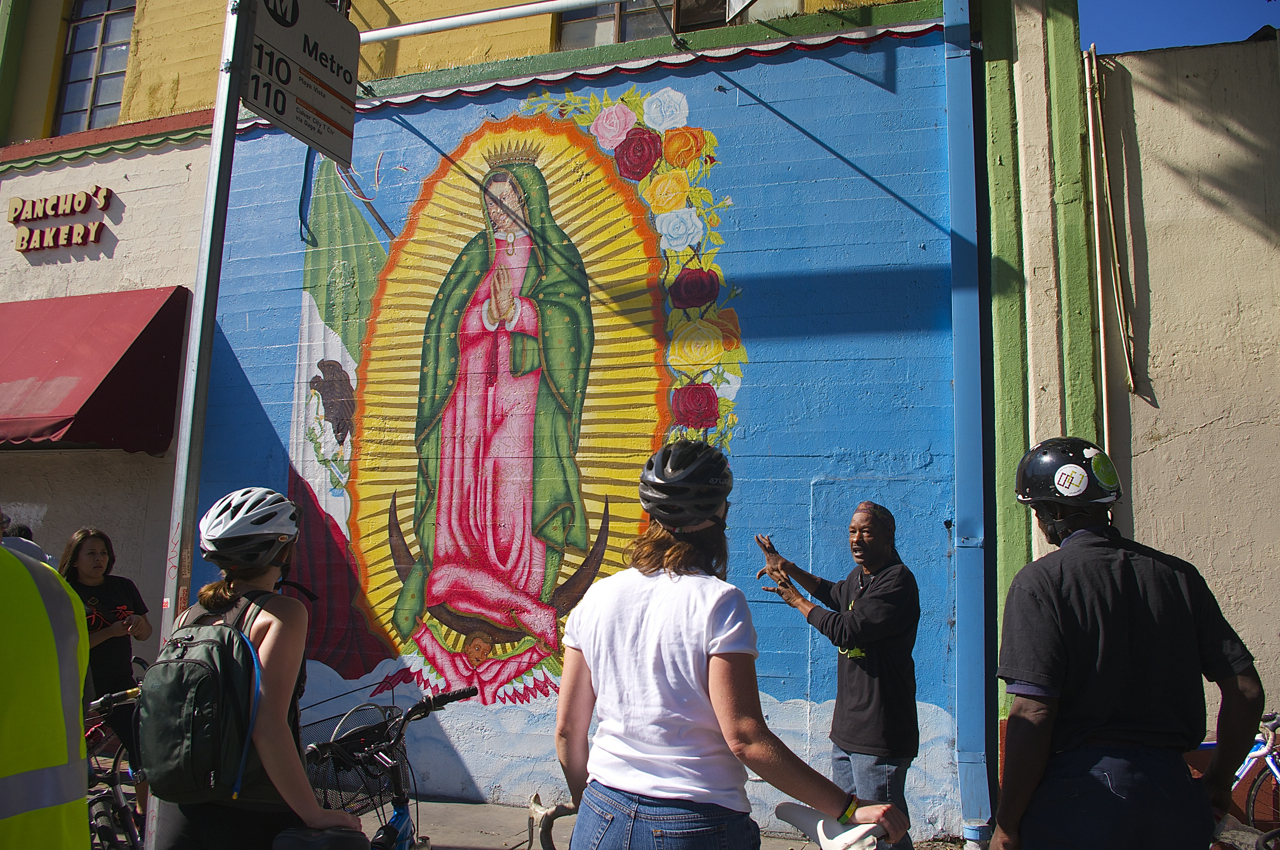
Lifelong resident Fred Buggs, Sr., who recently took over the presidency of the East Side Riders BC from John Jones III, helped students interpret the landscape they were seeing by offering personal stories from his youth. At Pancho’s Bakery, for example (top photo), he spoke both of how well-known they were for having the best cakes and of the times he had stood, hungry, outside it, hoping someone would give him something to eat (they usually did). He also talked about the history of the other businesses around the intersection as well as the mural, its importance to the Latino community, and its role in keeping that corner free from gang tags.
And while such stories may sound like they border on nostalgia, they actually offer an interesting glimpse into the economic and social history of a part of town hit hard by the economic downturn and where, in recent years, black-brown relations have sometimes been complicated.
For the students, it was an opportunity to see Watts — an area that is, for many, synonymous with a plethora of negative stereotypes — through the eyes of community members who know it to be much more than the sum of its flaws.
But Fred and the others let them know that, for the students to really understand Watts, the bike tour would have to be the beginning of their relationship with the community, not the end.
To really get to know the place and be able to enjoy it, Buggs said, “You’ll have to come back.”

Read More:
Streetsblog has migrated to a new comment system. New commenters can register directly in the comments section of any article. Returning commenters: your previous comments and display name have been preserved, but you'll need to reclaim your account by clicking "Forgot your password?" on the sign-in form, entering your email, and following the verification link to set a new password — this is required because passwords could not be carried over during the migration. For questions, contact tips@streetsblog.org.