Editorial: Why Raise Fares When Metro’s Building Even More Free Parking?

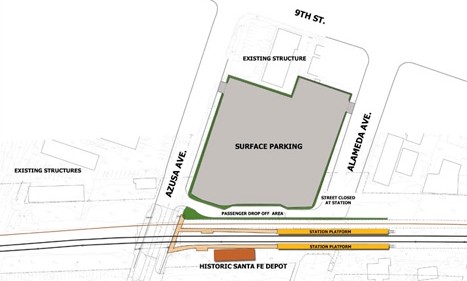
A couple of weeks ago, I posted an editorial asking Why Raise Metro Fares While Giving Away Metro Parking? At the time, I totaled parking for Metro’s BRT and rail lines at 19,450 parking spaces. Despite Metro’s plan to increase transit fares, the agency has no plan to increase parking charges. Metro gives more than 9 out of 10 spaces away for free. I did a conservative estimate of Metro’s parking revenue potential to be at least $3.5 million per year.
Turns out that it gets worse. Or better, depending on your point of view.
Metro’s building lots and lots of lots.
There are 2,435 more Metro parking spaces under construction. When the Gold Line Foothill extension opens in 2015, Metro will break the 20,000 mark with 1,525 new parking spaces. Also in 2015, Expo phase 2 will add 580 new parking spaces. In 2019, the Crenshaw Line will add 330 new parking spaces.
Metro’s overall total rail/BRT parking spaces will climb to 21,885. Using the same very conservative assumptions, I estimate that, with the additional spaces, Metro’s parking revenue potential will be at least $4.3 million per year.
After the earlier article, via Twitter and via the Source, Metro responded with the “doesn’t go far enough” argument:
Of course, $3.5 million doesn’t cover the projected budget shortfalls that Metro is projecting and using to justify the fare increases (the shortfalls begin at $36 million in FY 2016 and then rise).
I’ve always found this sort of assertion to be disingenuous. It’s sort of like being in a boat that’s leaking in five places, and refusing to fix one hole, because it doesn’t fix all of them at once.
Metro is claiming a pretty leaky boat. Paying to build and maintain tens of thousands of free parking spaces is a drain on the agency. It’s inefficient, fiscally irresponsible, and poor public policy.
I reiterate my call for Metro leadership to at least get official data from Metro staff on this issue:
The parking revenue processes might get underway with a board motion directing Metro staff to report on parking revenue. What does it cost to build, operate, and maintain Metro’s parking? How is Metro’s monthly permit program working: how much revenue does it bring in, and how does the program respond to parking demand? Similarly, how about Metro’s Park-by-phone program: revenue, response to demand? What other parking does Metro own, in addition to the rail and BRT lots this article focuses on? Perhaps, as Metro sets its target for fare recovery for operations cost, it can also set a target for parking cost recovery, with phased-in deadlines for meeting targets.
There’s no better time to solve Metro’s parking problem than right now, while the agency faces a stated deficit and is asking riders to pay more. Have drivers pay their fair share, too.
(View my revised spreadsheet calculations here.)
Streetsblog has migrated to a new comment system. New commenters can register directly in the comments section of any article. Returning commenters: your previous comments and display name have been preserved, but you'll need to reclaim your account by clicking "Forgot your password?" on the sign-in form, entering your email, and following the verification link to set a new password — this is required because passwords could not be carried over during the migration. For questions, contact tips@streetsblog.org.