America’s Big Fat Road Problem

America has a fat problem. You knew that, right? But it’s not just the people who are fat. It’s the roads.
That’s the subject of a very insightful post from Streetsblog Network member Tom Vanderbilt, author of the book Traffic and keeper of the blog How We Drive. He makes the connection between the two kinds of fat — on our bellies and on our streets and highways — citing the work of Brian Wansink,
an expert on consumer behavior and the human reaction to food who has
made a particular study of ever-increasing portion size in the American
diet:
Photo by circulating via Flickr.
Wansink suggests the larger the portion size, the less accurate the estimation of calories consumed becomes.
What
does this have to do with the road? There is an interesting story in
how the rise in portion size — often associated (as Wansink notes)
with fast-food restaurants — historically tracks the huge
increase in miles traveled (183% growth in per-person miles from 1969
to 2000, a period in which the number of persons itself increased only
41%), which itself is associated with the rise of those same
restaurants; not to mention the much-debated work linking obesity to
density and travel modes.But
I had a different comparison in mind: The way the size of our roads
affects our behavior in “consuming” them as drivers. This was brought
home to me again in a recent video made by a group called Park Slope Neighbors,
which
is working to reduce the size of streets like Brooklyn’s Prospect Park
West (a five-lane thoroughfare, two lanes of which are dedicated to
parking). As the video below shows, the speeds on the street are
routinely in excess of the 30 MPH limit…One
of the recommendations for Prospect Park West is to put it on a “road
diet,” a deeply suggestive phrase in light of Wansink’s research. A
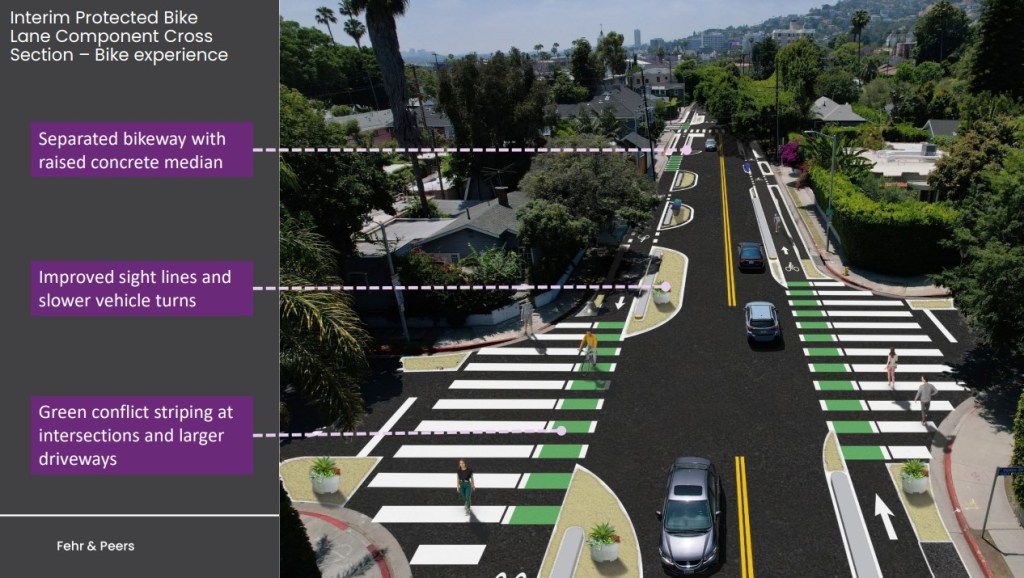
separated bike lane would be a great place to start — and would reduce
the frequent cases of cyclists using the adjacent sidewalk. But
something has to be done to change the context of the street.
Underutilized by cars much of the time, it is an inefficient use of
urban space, and its capaciousness sends a set of powerful signals to
the driver, more powerful than whatever speed limit signs may be
present. It represents, to paraphrase Wansink, “mindless speeding.”
People drive fast because it feels like they should. They see a wide
road, and don’t give themselves much time to see anything else.
Vanderbilt
argues that signs telling people to slow down, PSAs about the dangers
of speeding and even police enforcement of speed limits can’t do what
road diets can. Just the way all the calorie-count posters in the world
can’t stop us from finishing a big bowl of ice cream when it’s put in
front of us. Check out this related post from St. Louis Urban Workshop. Interesting stuff.
Other interesting stuff from the network: Hub and Spokes is talking about “the fight of a generation” for transit advocates, EcoVelo links to a cool video showing the reasoning behind “Idaho stops” for bicycles, and Carfree USA links to a Wall Street Journal article that wonders if Americans are changing their gas-guzzling ways for good.

Streetsblog has migrated to a new comment system. New commenters can register directly in the comments section of any article. Returning commenters: your previous comments and display name have been preserved, but you'll need to reclaim your account by clicking "Forgot your password?" on the sign-in form, entering your email, and following the verification link to set a new password — this is required because passwords could not be carried over during the migration. For questions, contact tips@streetsblog.org.