Report: Gold Line Extension to Montclair Projects to Increase Metro, Metrolink Ridership by 35, 50 percent

The Metro Regional Rail Task Force is finalizing a report detailing a rosy picture for both Metro and Metrolink ridership upon the completion of the future Gold Line extension to Montclair.
The report projects that the Gold Line extension to Pomona, which is expected to be completed by 2025, anticipates adding nearly 20,000 daily Metro boardings and 5,700 Metrolink boardings, a more than 35 and 50 percent increase respectively. If the extension to Montclair is completed, more than 28,100 daily Metro boardings would be added.
In January 2018, the Metro board of directors directed staff to create a staff-level task force to look at ways the Metrolink San Bernardino Line and future Gold Line extension could coexist. The study was initiated after concerns were raised that riders would abandon Metrolink in favor of the Gold Line, which would affect Metrolink ridership, farebox revenue, and agency subsidies.
The report is nearing completion at a time when the Foothill Gold Line Construction Authority began major construction on the 9.1-mile, four-station Foothill Gold Line extension from Glendora to Pomona. Construction began on July 10 and is expected to be completed by 2025.
The Pomona terminus represents a scaling-back of the 12.3-mile six-station plan for the Gold Line phase 2B. In 2019, facing escalating construction costs, the Construction Authority temporarily trimmed back the project to proceed with what could be built with funding in hand. The extension will include Claremont and Montclair stations, but only when additional funding is secured. If additional funding is found by October 2021, the entire 12.3-mile project from Glendora to Montclair will be completed by 2028.
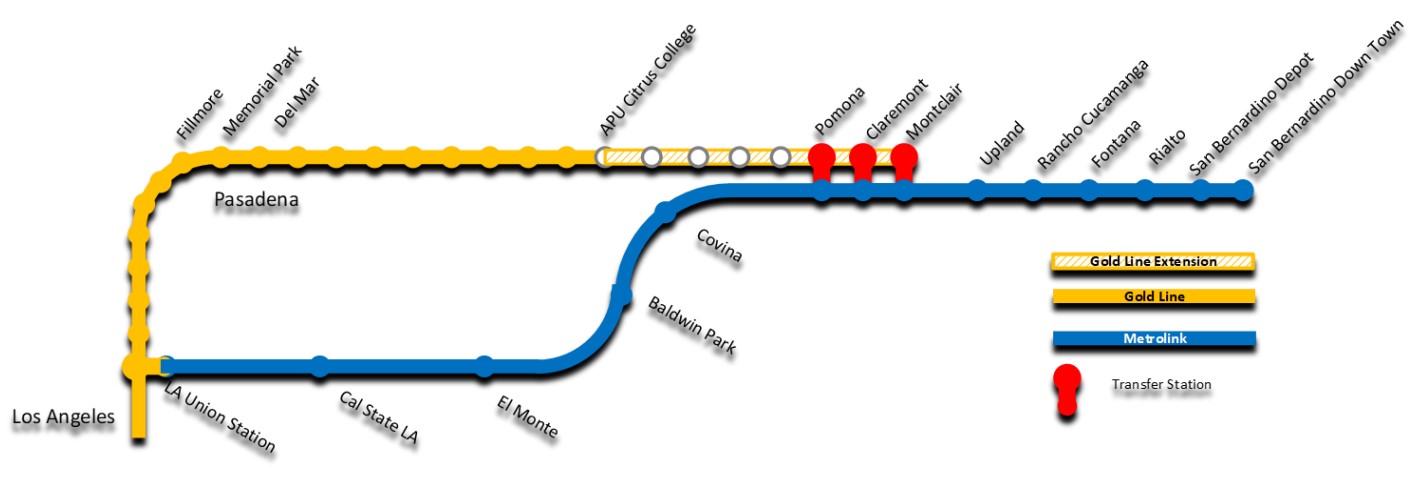
When Gold Line phase 2B is completed, the easternmost portion of the line will overlap with Metrolink San Bernardino Line. Both lines will serve Pomona, Claremont and Montclair Stations – as well as Union Station. This redundancy is needed and welcome, but necessitates some interagency coordination – ie: this report.
The report anticipates increases in Metrolink ridership and Metrolink’s farebox revenues. In 2018, Metrolink SBL farebox revenue was $20.7 million; this is expected to increase by $38.9 million or $37.3 million upon the completion of the extension to Pomona or Montclair. Metrolink SBL annual operating subsidy (operating cost minus fare revenue) would increase from $26.1 million to at most $29.6 million.
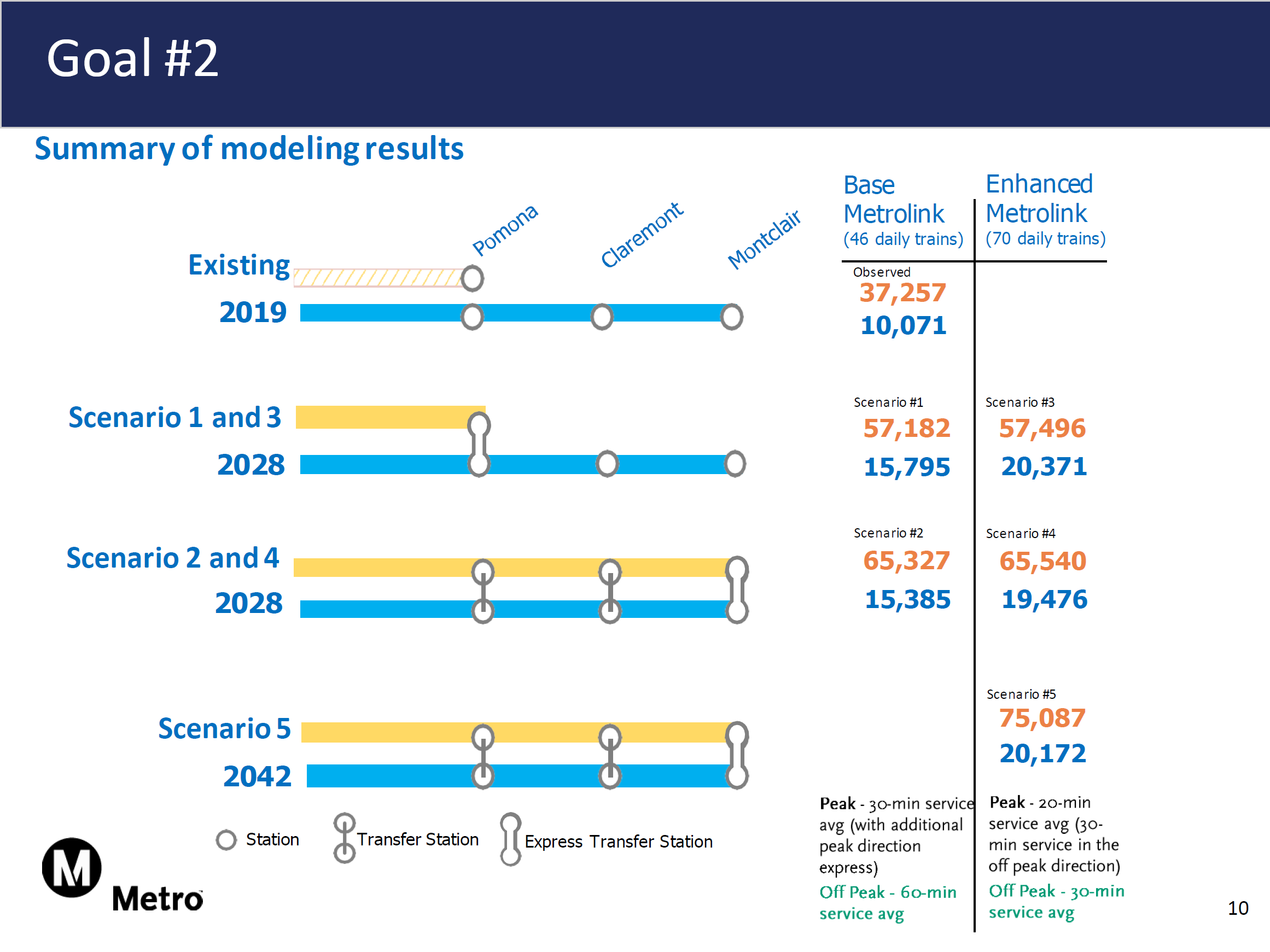
The study expects that the Pomona terminus will see more than 3,000 weekday Metro-Metrolink transfers. With the completion of the Montclair terminus, most transfers would shift to that station with roughly 2,000 transfers, and 120 and 680 transfers taking place at the Claremont and Pomona stations respectively.
Yet, additional work on how best to allow Metro-Metrolink riders to transfer is still needed. Metrolink’s current mobile and paper tickets allow for more seamless transfer to Metro trains and buses, but a Metro to Metrolink transfer is not available. The report recommends creating a Metro ticket or EZ pass that provides a transfer for Metro riders onto Metrolink SBL services, which may include integrating Metro’s TAP Cards for use on Metrolink. Yet, with Metrolink’s distance-based fare structure, any Metro-Metrolink pass would need to include this upcharge.
The study also anticipates that the Metro system does not significantly benefit from planned enhanced Metrolink service improvements. However, by adding the proposed 24 trains per day to the San Bernardino Line, Metrolink ridership increases by more than 5,400 daily boardings.
Among the study’s findings, which looked at ridership impacts to Metrolink when the Gold Line extension is up and running and fare discounts or increases are implemented, final recommendations included design changes to the Claremont and Montclair stations to make transfers between services easier. The design changes at the Metrolink stations would cost an additional $2 to $5 million.
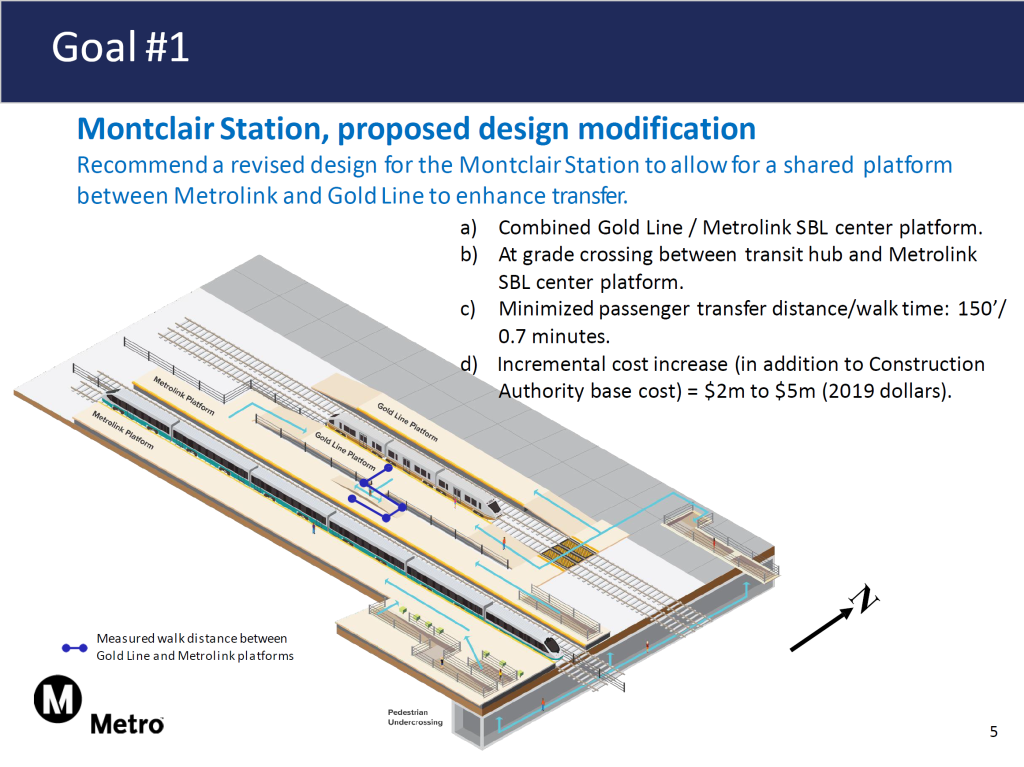
The new design at the Montclair Station would create a shared platform between Metrolink and Gold Line. This would make transferring between the Eastbound Gold Line and the Westbound Metrolink train only 150 feet apart.
The study proposed changing the walking route for riders transferring between the Gold Line and Metrolink at the Claremont station. A new Claremont Metrolink station will be built, relocated east of its current location. The new Claremont Gold Line station will be built at the current Metrolink station location. Between the two stations is a planned parking structure and/or parking lot, with riders snaking through the parking area to transfer between services. The new proposal would create a pedestrian walking route adjacent to the Gold Line, cutting down on walking time by two minutes.
Click here for the task force’s presentation.
SGV Connect is supported by Foothill Transit, offering car-free travel throughout the San Gabriel Valley with connections to the new Gold Line Stations across the Foothills and Commuter Express lines traveling into the heart of downtown L.A. To plan your trip, visit Foothill Transit. “Foothill Transit. Going Good Places.”
Sign-up for our SGV Connect Newsletter, coming to your inbox on Fridays.

Read More:
Streetsblog has migrated to a new comment system. New commenters can register directly in the comments section of any article. Returning commenters: your previous comments and display name have been preserved, but you'll need to reclaim your account by clicking "Forgot your password?" on the sign-in form, entering your email, and following the verification link to set a new password — this is required because passwords could not be carried over during the migration. For questions, contact tips@streetsblog.org.