Win ‘Policing the Open Road’ Book by Sarah Seo

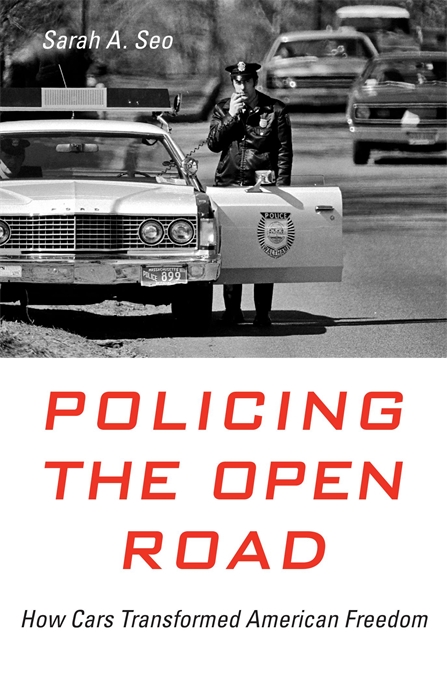
Donate to Streetsblog L.A. this month and you could win one of four great urbanist books! Click here to donate. Click here for contest details. Today SBLA previews Policing the Open Road: How Cars Transformed American Freedom by Sarah Seo. The 340-page hardback is published by Harvard University Press, and has been autographed by the author.
Sarah A. Seo is a legal historian who teaches criminal procedure at Iowa Law School. Her new book, Policing the Open Road, traces 20th century American history to make connections between changing policing practices and the prevalence of automobile transportation. Widespread driving, she argues, has had huge legal and political consequences, especially eroding the 4th Amendment protections from search and seizure – something which has had massive consequences for people of color moving through public places.
Seo’s eye-opening book came to Streetsblog’s attention from her excellent interview on The War On Cars podcast in October.
Policing the Open Road begins with Seo contrasting the 1916 Arizona police killing of Mary Bates with the 2015 Texas police killing of Sandra Bland.
What is the history that can account for the changes from Wiley v. State [the Bates killing case] to Sandra Bland? In the span of a century, towns and cities throughout the country – and not just in metropolitan centers – expanded their forces and professionalized beat cops, turning them into “law enforcement officers.” Figures are hard to come by, but one early report indicated that in the sixteen smallest states, the number of officers as a percentage of the population nearly doubled from 1910 to 1930. In addition to adding manpower, municipalities unified the police function and increased the police’s discretionary authority. Courts then sanctioned that accumulation and concentration of power. The most glaring part of this history, considering that it culminated with mass incarceration by the century’s end, is race. Today, it would be improbable that Mrs. Bates, a white woman sitting in the passenger seat next to her husband of social standing, would be killed in a police shooting, a tragedy that now falls mostly on minority drivers. The statistics bearing this out, as well as stories like Sandra Bland’s, not only reveal a problem of discrimination and implicit bias; they also raise a troubling question about our laws that have enabled racialized policing.
Contrary to what one might expect, the social and legal developments that made the systematic policing of minorities possible did not originate with an intention to do so. This history begins with the mass production of the automobile and the immediate imperative to regulate the motoring public.
Donate today for a chance to win a signed copy of Policing the Open Road.
Streetsblog has migrated to a new comment system. New commenters can register directly in the comments section of any article. Returning commenters: your previous comments and display name have been preserved, but you'll need to reclaim your account by clicking "Forgot your password?" on the sign-in form, entering your email, and following the verification link to set a new password — this is required because passwords could not be carried over during the migration. For questions, contact tips@streetsblog.org.