Neighborhood Council Coalition Approves Neutral Motion Calling for Community Consultation on Road Diets
Note: Metropolitan Shuttle, a leader in bus shuttle rentals, regularly sponsors coverage on Streetsblog San Francisco and Streetsblog Los Angeles. Unless noted in the story, Metropolitan Shuttle is not consulted for the content or editorial direction of the sponsored content.

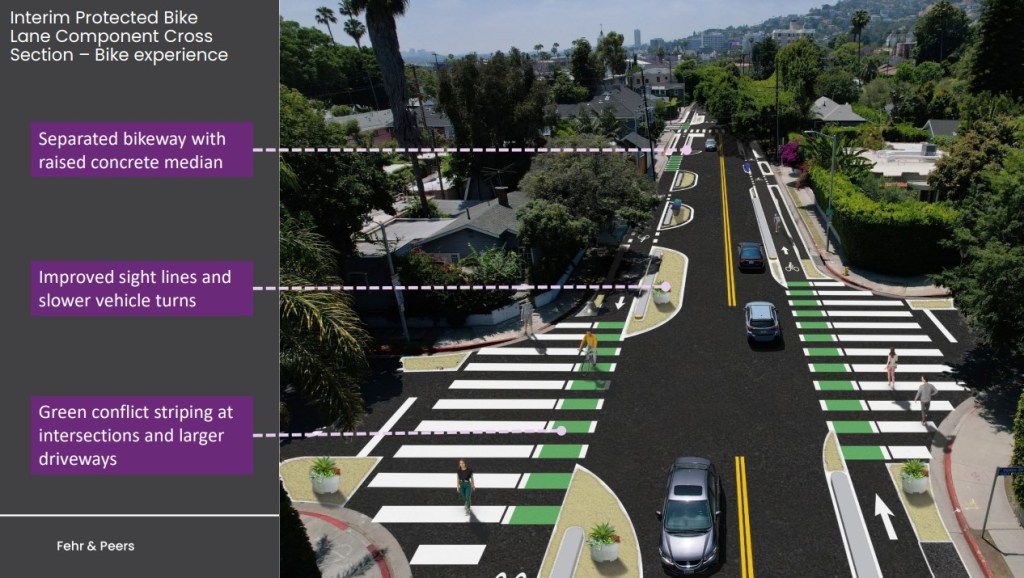
On Saturday, the L.A. Neighborhood Council Coalition approved a motion calling for community input on road diets. This represents a victory for safety and mobility advocates, as the initial version of the motion had been strongly anti-road-diet.
The L.A. Neighborhood Council Coalition (LANCC) is a hybrid group that is neither a governmental body nor an incorporated nonprofit. LANCC members are representatives designated by L.A. City’s elected neighborhood councils. Though there are more than ninety officially elected Neighborhood Councils in the city of Los Angeles, only fifteen designated voting representatives attended Saturday’s meeting. In and of itself, LANCC approval does not make a motion binding or enforceable, but it tends to serve as a springboard to disseminate policies out to various elected neighborhood councils for their approval.
In December, with less than two days notice, LANCC appeared poised to approve a Keep L.A. Moving-supported motion that would have demanded that L.A. “remove all traffic calming measures, including… road diets.” After input from the public, LANCC did not approve the motion, postponing it until its January meeting on Saturday.
By then, LANCC had a very different version of the road diet motion on its agenda. The revised version was more neutral, calling for extensive community consultation and “no blanket prohibition of road diets.” At first it also included language stating that road diets can have “beneficial effects” in some places and “confusing, negative effects” in other places.
Discussion of the motion showed some misunderstanding of just what road diets and traffic calming are. One LANCC member asserted that “traffic calming is elimination of parking lanes.” Some LANCC members were openly dismissive of road diets, asserting they are “stupid,” “causing death,” and adversely impact public safety.
Many safe streets advocates, organized by the L.A. County Bicycle Coalition and including Keep Rowena Safe, participated in public comment and helped cast road diets in a better light. Advocates spoke of the many proven safety benefits of road diets. No road diet critics spoke during public comment. By the end of comments, LANCC President Terrence Gomes was citing Rowena Avenue as an example of a successful road diet.
The proposed motion was amended several times, mostly to clarify language.
Advocates urged the LANCC to strike the qualifying language that found some road diets are beneficial and some are not. That language was struck, with the amendment approved narrowly on a 7-6 vote.
The final amended motion reads:
[LANCC] takes the position that there shall be no blanket prohibition of road diets or other road calming measures. Communities that will be impacted with a potential road diet or other road calming measures, including neighborhood councils, shall be consulted extensively about public safety and other pertinent issues both before the road diet or road calming is proposed and after it is implemented.
This amended motion was approved on a unanimous 15-0 vote.
LACBC’s Organizing Director Jesi Harris called the approval “great news” and credited “vocal members of our community [who] fought hard and spoke inspiringly.”
No one in the room argued against community engagement, but it is worth noting that even the relatively neutral language that was finally approved represents a double standard. For decades the city has implemented pro-car-capacity changes – including peak-hour parking restrictions, added turn lanes, beg buttons, crosswalk removal, etc. – with no or very little community engagement. When drivers are catered to, there has been little call for engagement. But when the city balances safety concerns against driver speed, motorists call for holding the city to a higher standard of community engagement.
Also on Saturday’s LANCC agenda was the mobility bill of rights, though, after some discussion and public comment, that item was postponed to a future meeting.
Streetsblog has migrated to a new comment system. New commenters can register directly in the comments section of any article. Returning commenters: your previous comments and display name have been preserved, but you'll need to reclaim your account by clicking "Forgot your password?" on the sign-in form, entering your email, and following the verification link to set a new password — this is required because passwords could not be carried over during the migration. For questions, contact tips@streetsblog.org.