How to Breathe Cleaner Air While Biking: Ride at 11 MPH

Portland State University Ph.D candidate Alex Bigazzi has been biking around Portland with a $300 homebuilt air quality monitor. His goal: to get a sense of how much pollution he was breathing and how to minimize exposure to harmful fumes. Bigazzi has recently been sharing his findings around Portland.

Michael Andersen at Bike Portland reports today that Bigazzi’s first tip is to not ride very fast:
The biggest contributor to pollution intake, Bigazzi found, isn’t actually how dirty the air around you is. It’s how much of it you breathe.
“Ventilation completely dominates the exposure differences,” Bigazzi said. “The exposure differences are not that big.”
That creates an interesting mathematical puzzle: the harder your body works, the more pollution you breathe in. But the faster you move, the less time you’ll spend in the dirty air.
So assuming you’re headed to a place where the air is cleaner than it is along a roadway (Precision Castparts commuters, take note), here’s a curve Bigazzi constructed that shows the optimum speed to ride for various bikeway slopes. It’s expressed in kilometers per hour; the 17.5 kph “minimum ventilation speed” for a flat 0 percent grade is 11 mph.
That doesn’t mean street-level air quality isn’t important too:
Based on these calculations and Bigazzi’s hard data, he found that biking along a major arterial like Powell Boulevard means ingesting three to five times more traffic-related pollutants than biking on a local street.
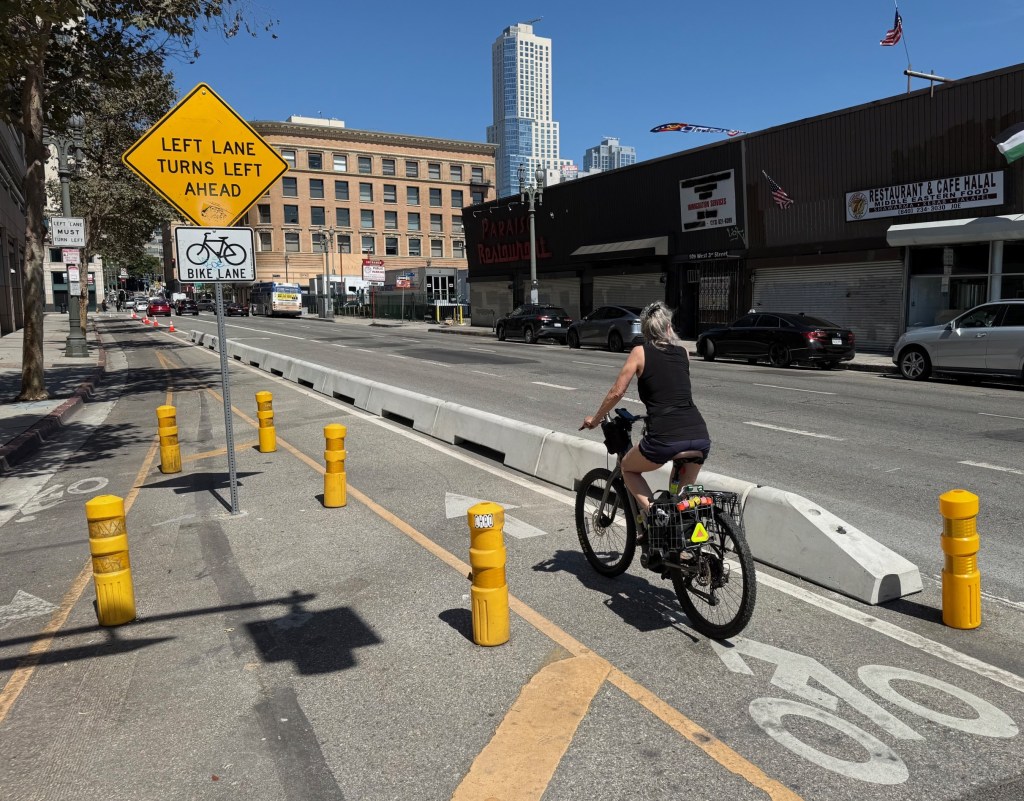
There’s been some study of pollution levels in protected bike lanes, Bigazzi said, and pollution exposure there seems to be “measurably lower than where a bike lane would be on the same facilities for traffic-related air pollution.” He said he didn’t have exact numbers on this phenomenon.
Finally, Bigazzi and Bike Portland offer a reminder that, regardless of speed or street type, the health benefits of biking outweigh the costs by orders of magnitude.
Elsewhere on the Network today: Chuck Marohn at Strong Towns refines his argument that raising the gas tax won’t help reform car-centric transportation policy. Mobilizing the Region explains how land banking can help facilitate equitable transit-oriented development. And Better Institutions says Denver’s terrible highway expansion project probably would have been even worse if it was planned back in the 80s.

Read More:
Streetsblog has migrated to a new comment system. New commenters can register directly in the comments section of any article. Returning commenters: your previous comments and display name have been preserved, but you'll need to reclaim your account by clicking "Forgot your password?" on the sign-in form, entering your email, and following the verification link to set a new password — this is required because passwords could not be carried over during the migration. For questions, contact tips@streetsblog.org.