Pedestrian Donuts in the Sky?
When New York’s Department of City Planning put forth a plan to rezone 78 blocks around Grand Central Terminal this summer, observers questioned whether the imminent arrival of gleaming towers and density would enhance the skyline at the expense of the layers of history of the neighborhoods or the area’s soul.
“Perhaps to palliate our worst Kafka-esque architectural nightmares,” writes Kelly Chan at ArtInfo, the city invited three renowned architecture firms, WXY Architecture + Urban Design, Skidmore Owings & Merrill (SOM), and Foster + Partners, to imagine ‘the next 100 years’ of Grand Central Station (which is fast approaching its 100th birthday) and the surrounding Midtown cityscape.”
Chan continues:
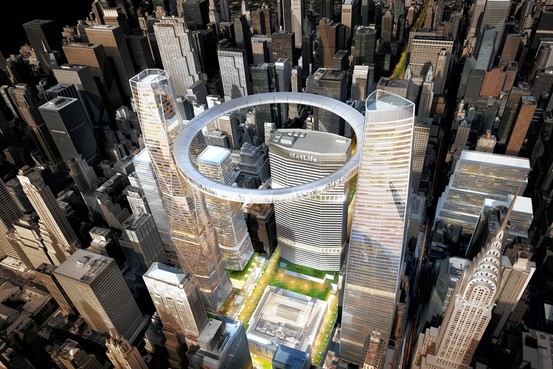
What began as a thoughtful though familiar meditation on connecting the city’s POPS (Privately Owned Public Spaces, which usually take the form of plazas and walkways that developers gift to the city in return for added building height) quickly escalated into an almost outlandishly dreamy proposal for what some are now calling ‘the London Eye turned on its side.’ [SOM NY Partner Roger] Duffy and his team’s suggestion to rezone and generate more POPS at the street level — an idea equipped with its own glittery renderings of avenue-like passageways cutting through corporate skyscrapers — was bumped up in altitude, culminating in a structure ripped from our wildest sci-fi fantasies: a slick, monumental halo, hovering over Grand Central Terminal, serving as a vertigo-inducing observation deck looking out onto Manhattan.
The renderings are amazing, to be sure.
But it also made me wonder about the goals of pedestrian projects like that. When we think about creating space for pedestrians, we tend to think about them in terms of building community and connecting people to the spaces they inhabit. If the objective is to create a dazzling attraction and resource for city-dwellers, this would more than suffice. Elevating and isolating pedestrians from the streets in a sterile enclosure, however, might not go too far in the way of saving the area’s soul.
Still, I can’t imagine not wanting to take leisurely stroll (or bike ride! yes, please!!) above Manhattan.
Your thoughts?
See the full piece here.

Read More:
Streetsblog has migrated to a new comment system. New commenters can register directly in the comments section of any article. Returning commenters: your previous comments and display name have been preserved, but you'll need to reclaim your account by clicking "Forgot your password?" on the sign-in form, entering your email, and following the verification link to set a new password — this is required because passwords could not be carried over during the migration. For questions, contact tips@streetsblog.org.