Streetsblog Interview: Steve Hymon


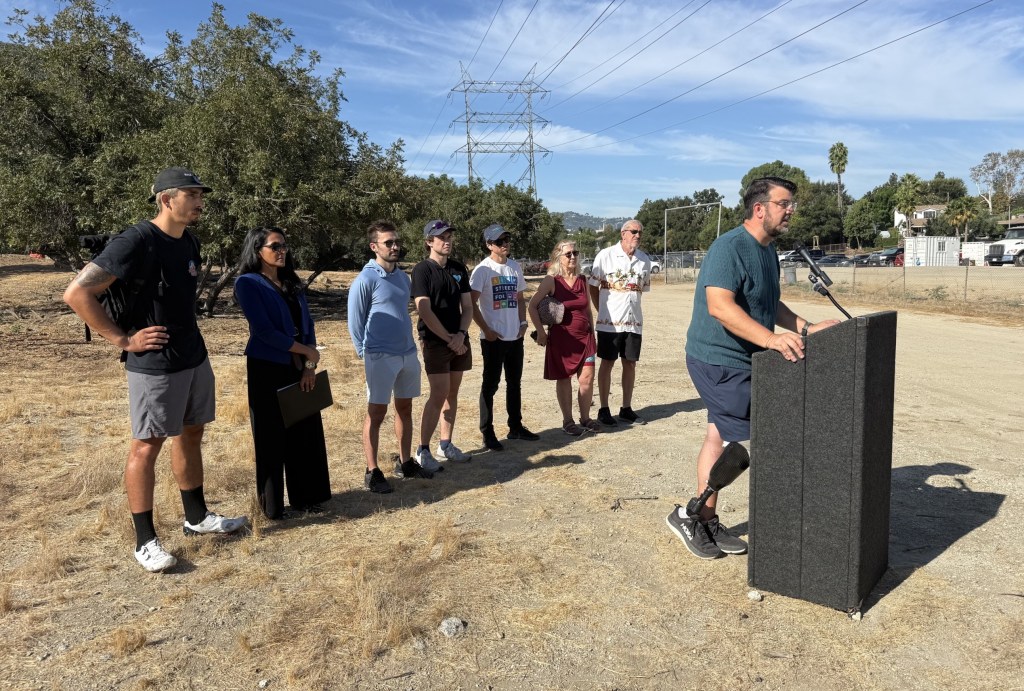
Hymon, Second from the Left, Joins Sue Doyle in Talking to Richard Katz and Asm. Feuer
Does anyone really need me to write an introduction for an
interview with Steve Hymon? If so, I’ll
be brief. He’s the transportation writer
for the Los Angeles Times, making him one of the five most read transportation
writers in the country. On top of that
he managed to revive the moribund Bottleneck Blog to the point that the Times
had to merge it with its flagship blog LA Now.
I sat down with Steve immediately before a City Council
hearing on the Obama stimulus at a Starbucks across the street from the
Caltrans building. The conversation was
relaxed and good-humored, just in case some of the discussion of Steve’s choice
of commute doesn’t seem that way.
Streetsblog: Today
we’re talking with Steve Hymon of the LA Times and the Bottleneck Blog. Well, I guess it’s LaNow/Bottleneck.
Hymon: Whatever it is…
Streetsblog: I’ll make sure we link to it correctly in the
article.
Streetsblog: So…how did you commute today?
Hymon: I knew you were going to ask that, so I came
prepared. I drove! A Subaru Outback 2007. I do drive most days to work. I take the Gold Line occasionally, but I’ll
be quite honest. I find it a lot faster
to drive. I do take mass transit a lot,
but typically during work hours for work purposes. Every couple of weeks I do try and hop on the
Gold Line.
Streetsblog: I knew you took transit at least sometime…you
couldn’t have done it today? I remember
one night you and I were the only people on earth listening to a hearing on one
of Mike Feuer’s bills and you were talking about taking light rail home.
I was expecting Gold Line, just for me,..
Hymon: Nah. Since I
knew I’d be talking to you, I made it a point to drive. I knew you would ask and wanted to be honest
about it.
Look, I have a car. I
can afford to have a car, and I like to have a car. I was thinking about this driving in. Probably, having a car amounts to 5-10% of my
total salary, but it’s worth every penny because I like the mobility it affords
me.
Having the Gold Line out there is great because its an
important alternative to have. While my
girlfriend takes it more often than I do, it’s still a great option to
have. It’s a slower option…but I’ve
ridden it before and I’ll ride it again. And it is getting better overtime.
Even if it gets me off the road every couple of weeks,
that’s better than I would have done if it had never opened.
Streetsblog: Well, if you believe the Metro Board, if we all
did that, everything would be fine.
Hymon: Actually, it’s an easy thing for them to say, but
there might actually be something to it. Intuitively, if you were to take 20% of the people that drive everyday
off the road, that would certainly take the edge off of it. There’s people out there who study the stuff
who say that what you really need to do is get 3-5% off and things would flow a
lot better.
Streetsblog: In Portland, and I’m saying this off the top of
my head without looking it up, I believe they have a 5% mode share for bicycles
and the city has garnered this reputation of being a bikeopolis.
Hymon: And that’s just for bikes. If you look at the 2000 census for the City of Los Angeles, somewhere around
80%, actually I think it’s higher, drive to work alone. That’s really high when compared to Chicago
or New York. Those two cities are a lot
more saturated with transit than we are here.
If you could reduce that 80% by even a few points it would
probably make it a little more manageable.
But back to the Gold Line, I would love to take it more often. But, the fact is that most days I drive to
work it’s about a 25 minute drive, 30 if things are unmanageable. About the fastest I can get on the Gold Line
is 45 minutes and I’ve tried every combination of riding my bike to the
station, taking the city bus, taking an MTA bus to the station, driving to the
station…everything.
I think that’s the big thing. I know people say that you’re gaining quality
time by riding the train even though it takes longer. But, I don’t buy that.
Streetsblog: What
are you going to do read the newspaper
Hymon: Exactly. All newspapers print is more bad news about
newspapers.
Streetsblog: So, you didn’t always cover transportation…
Hymon: For a couple of years I was the City Hall reporter.
Streetsblog: And, lucky you, you still get to spend some
time there.
Hymon: Well, a lot of stuff goes through there. Villaraigosa is a big player in local transit
circles, chairing the MTA Board and such. I don’t have to pay attention to the elephant debate, but there’s still
important stuff that goes on here.
Streetsblog: So what
was the big story of the year for LA County. I’m guessing you’ll say Measure R and everything that happened during
the debate yet there was a decent amount of geographic parity in the results.
Hymon: Absolutely Measure R. At the root of every transportation problem is funding. Now we’ll watch whether those guys are going
to build what they say they’re going to build.
I think another major story was the Metrolink Chatsworth
Crash. ..It seems that the agency is starting to move in the right direction,
but the fact that this sort of thing can happen today is mighty scary.
Streetsblog: I’m happy they started to focus less on just
the engineer and his cell phone.
Hymon: We’re still
waiting for the NTSB’s final report, so
I don’t want to speculate on what happened, but even If the cell phone proves
to be a minor factor, it’s still pretty frightening. You would think that someone in charge of a
three car passenger train would give their full attention to driving the train
regardless of whether it played a key role in him missing the signal or whether
the signal was operating properly.
If we don’t want people texting and driving…we don’t want
people texting and driving a train either.
Streetsblog: Fair enough. Do you have a favorite story for this year? As opposed to a biggest, a favorite?
Hymon: I don’t know
if I’d say it’s a favorite, but one story I’ve wanted to write for a long-time
that I just got to at the end of the year was how poor the traffic light timing
is. In Pasadena, it’s almost comically
bad. It’s as though someone came in and
said, “Let’s see if we can program the lights so that drivers miss every one of
them.
It’s not like I’m saying that I deserve every green light or
you deserve every green light; but in an area where we’re so concerned about
Greenhouse Gases and we know that a car stopping every hundred feet is less
fuel efficient than one that isn’t that we would do this better.
It’s bad pretty much everywhere. We’re way behind where we need to be.
Streetsblog: Ok, two more…Anything that’s going to come up
in 2009 that we should be looking for that might be off the radar right now?
Hymon: I’m going to sort of answer the question. I do think this is on everyone’s radar,
although they haven’t thought about it as much as they should, which is that
the Measure R tax money is going to flow in on July 1, and there’s going to be
an enormous amount of pressure for all of these projects to get some money.
At the same time you have a spending plan that sort of
spells out how we’re going to fund different projects. I think what we’re going to see is discussion
like, “hey, is there a way to ramp up funding for the subway even though it’s
not scheduled yet in the plan” because it’s such a big project. It’s the marquee project for Measure R . It’s potentially 10% of the funds.
Because it’s so expensive the public ‘s going to question
whether they’re going to want to pay for it over 20-25 years, as the plan says
its going to, or start to move it sooner. If we say it’s going to cost $5-$10 billion now, it could cost $20-$30
billion later. Assuming the economy
regains its footing.

So, there’s going to be pressure to spread this Measure R
money in a way that’s fare and honest to what they said they were going to do
but still has a sense of fiscal responsibility.
It’s going to be controversial to. There’s a lot of people wary of that subway
project. Some supported Measure R but
others did not.
Streetsblog: So, now
the standard last question. If you had a
magic wand that could do one thing, transportation related, in the region…what
would it be?
Hymon: Let me think
about that for a second.
Streetsblog: Take your time, there’s no dead air on the
Internet. I will say that we’ve gotten
answers everywhere from “get a new mayor” to “Get rid of ethanol.”
Hymon: If I could do
any one thing it would be to move the clock forward and get some cleaner cars
on the road. I’m of the view that even
with Measure R, even with new transit and record ridership, the way for most
people to get around is going to be by driving. That’s how the development patterns are. Given that’s likely to be true, let’s at least get people moving around
in cars that have less impact.
Most of what you see driving around is still in the 20-25
miles per gallon. If you could greatly
ra
mp that up there would be less smog in the region. People who live here are far more excepting
of smog then they should be.
Getting back to your first question, when I’m driving in to
work I’m acutely aware that what’s coming out of my tail pipe isn’t what most
people would argue is good for the global environment. I don’t like that, and try to control it to
some degree but it would be nice if when I’m shopping for a car if I had more
affordable choices than I do. Most of
the fuel efficient stuff is more than someone like me is willing or able to
spend.
Streetsblog: Thanks a lot, let’s go to our meeting!
Photos: LA Streetsblog, Via Magazine

Streetsblog has migrated to a new comment system. New commenters can register directly in the comments section of any article. Returning commenters: your previous comments and display name have been preserved, but you'll need to reclaim your account by clicking "Forgot your password?" on the sign-in form, entering your email, and following the verification link to set a new password — this is required because passwords could not be carried over during the migration. For questions, contact tips@streetsblog.org.