COVID-19 Outdoor Dining Already Squeezing Walkers

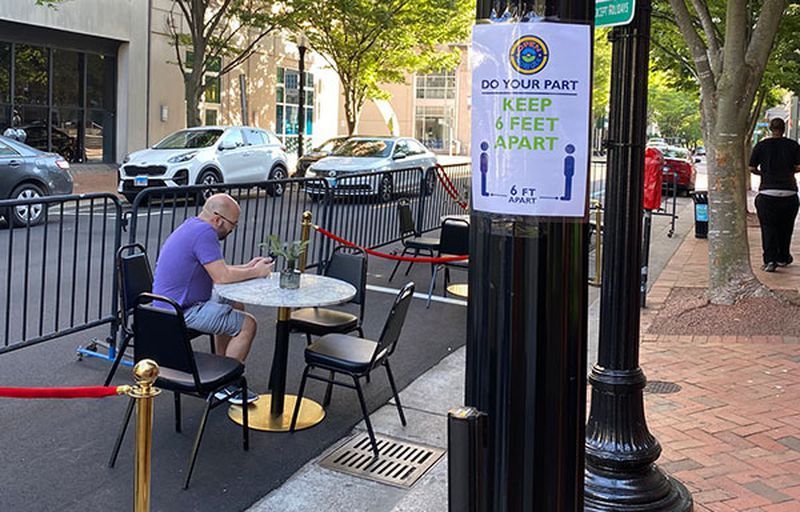
Cities across America are making space for socially-distanced dining on sidewalks — but they’re not all doing a great job of leaving space for socially-distanced walking in the same spaces.
St. Louis, Mo., recently announced that restaurants will be allowed to cannibalize scarce sidewalk space for diners, but specified that eateries can’t touch the parking spaces beyond the sidewalk. The restaurants do have to maintain some unobstructed sidewalk for walkers, but the city is only requiring them to provide a four-foot-wide space — not enough space for social distancing.
(And if your restaurant doesn’t have a sidewalk outside, or if the sidewalk isn’t wide enough for walkers and diners? Tough luck.)
The Gateway City isn’t the only one asking pedestrians to choose between walking in a dangerous driving lane or ignoring crucial CDC recommendations. In Louisville, Ky., restaurants only need to provide five-foot-wide walkways — because that’s the bare minimum for the city to achieve standards set in the Americans with Disabilities Act.
“Most of our sidewalks pedestrian zones are only four to five feet wide because it was designed to comply with ADA,” said a spokesperson for the Louisville Mayor’s office. The representative also noted that he and his colleagues “were certainly familiar with the CDC guidelines and the direction given to us by the Department of Public Health and Wellness,” when they drafted the permit requirements, but did not comment on why they ignored those guidelines and only gave peds five feet rather than six.
Savannah, Ga., is also accepting temporary outdoor-dining permits, but it kept the pedestrian requirements vague. The city is mandating simply that applicants “provide for pedestrian and vehicular safety and convenience,” ignoring the fact that the creation of “pedestrian safety” requires official guidance, especially during a viral pandemic.
Some cities, such as Las Vegas, are giving walkers six feet — but the fact that other cities aren’t on board betrays a lack of strong federal guidelines. The CDC’s recommendations for restaurants and bars endorse outdoor dining as a strategy to mitigate COVID-19 risk, and indicates that tables should be placed six feet apart from one another — but the guidance does not mention how far tables must be placed from walkers on adjacent sidewalks.
Of course, the CDC isn’t staffed by urban planners — and it’s certainly not the agency’s fault that so many sidewalks are too narrow even for single-file walking, much less walking and dining and social distancing. The Federal Highway Administration has long recommended a minimum sidewalk width of just five feet. And that’s just a recommendation, not a requirement; many U.S. roads have much narrower sidewalks, or lack them altogether.
But, as Streetsblog has reported, now that COVID-19 has rendered many of our indoor spaces unsafe and transformed many of our streets into de facto commercial zones, city leaders have an ethical, if not a legal, responsibility to make sure we preserve safe, socially-distanced areas for vulnerable road users, even as sidewalks increasingly serve as cafes. In car-dominated places, there’s no way to do that without removing at least some space from drivers.
Fortunately, tactical urbanism provides us with creative, attractive, and safe ways to do just that — and there’s strong evidence that re-centering streets around people rather than cars can enhance the local economy, despite the fears of business owners. State and local leaders must get up to speed on what the safe-streets community has known for years — especially if the federal government fails to provide strong resources.

Streetsblog has migrated to a new comment system. New commenters can register directly in the comments section of any article. Returning commenters: your previous comments and display name have been preserved, but you'll need to reclaim your account by clicking "Forgot your password?" on the sign-in form, entering your email, and following the verification link to set a new password — this is required because passwords could not be carried over during the migration. For questions, contact tips@streetsblog.org.