What We Can Learn from ‘Latino Urbanism’

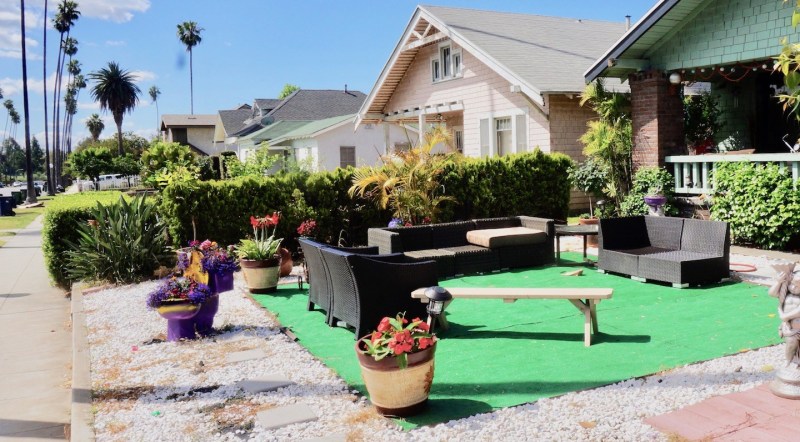
In Latino neighborhoods in Los Angeles and Chicago and Minneapolis, you might notice a few common elements: A front fence, maybe statue of the Virgin Mary, a table and chairs, even a fountain and perhaps a concrete or tile floor.
These are all elements of what planner James Rojas calls “Latino Urbanism,” an informal reordering of public and private space that reflects traditions from Spanish colonialism or even going back to indigenous Central and South American culture.
Rojas, who coined the term “Latino Urbanism,” has been researching and writing about it for 30 years. His Los Angeles-based planning firm is called Place It!
We conducted a short interview with him by phone to find out what the wider planning field could learn from it. (The below has been lightly edited for space and clarity.)
Streetsblog: What would you say are the key principles of Latino Urbanism?
Rojas: Latinos have different cultural perceptions about space both public and private. They bring that to the U.S. and they retrofit that space to those needs.
They will retrofit their front yard into a plaza. We don’t have that tradition in America. But they change that into a place to meet their friends and neighbors.
What distinguishes a plaza from a front yard?
The front yard kind of shows off American values toward being a good neighbor. It’s really more decorative. Generally it’s not really utilized. Maybe there’s a garden or a lawn.
Latino plazas are very utilized and are sites of a lot of social activities a lot of different uses.

Like commercial uses?
Sometimes it might be selling something from their front yard like a tag sale.
Is there a specific history that this can be traced back to?
This goes back to before the Spanish arrived in Latin America. The indigenous people had tianguis — big market places where they sold things.
This practice of selling has deep roots in Latin America before the Spaniards. They’ve always had that kind of market tradition.
Can you describe a little more what a front yard plaza conversion might look like?
I think a lot of it is just how we use our front yard. They’ll put a fence around it to enclose it. Maybe they’ll put a shrine and a table and chairs. It’s very informal. They’ll host barbecues.
In Mexico, a lot of homes have interior courtyards, right? So the housing style is different.
Right. You’ll see front yards now in L.A. that are paved.
So it’s more emphasis on the front yard versus in maybe white neighborhoods the emphasis is more on the back yard?
I think a lot of people of color … these neighborhoods are more about social cohesion. Your family and neighbors are what you’re really concerned about. Where I think in these middle class neighborhoods, they’re more concerned about property values.
In low-income neighborhoods, they’re renters and that’s not the driving force behind how they use their space.

So where might you see some better examples of Latino Urbanism in the United States?
Chicago, Brownsville (Texas), Los Angeles, parts of Oregon. It’s all over the country, Minneapolis, the Twin Cities. Small towns, rural towns. It’s mainly lower-income neighborhoods.
So do you think these principles would be beneficial for more communities to adopt?
I see it as being more sustainable. You’re using space in a more efficient way. A lot of it involves walking and changing the scale of the landscape from more car oriented to more pedestrian oriented.
In a place like Los Angeles, Latino Urbanism does more for mobility than Metro (the transit system).
The street vendors do a lot more to make LA more pedestrian friendly than the Metro can do.
What I think makes Latino Urbanism really unique is it really focuses on the micro. We can move people from place to place, but what are we doing with them when they get there?
So it reduces the need to travel very far?
It’s more urban design focused. A lot of Latinos don’t have cars. You reframe the built environment around you to support that kind of mobility.
Do issues often come up where authorities, maybe with cultural biases, try to ban Latino Urbanism on the basis of zoning or vending licenses?
A lot of it is really kind of done in the shadows of government. In an informal way. It’s very DIY type urbanism.
In more traditional tactical urbanism, they put their name to it. Latino do it in the shadows. Because it’s more of a community effort, nobody can put their name to it.
Can you give examples of places where these ideas were formalized by city government or more widely adopted?
The county of Los Angeles, they loosened up their garage sale codes where people can have more garage sales as long as they don’t sell new merchandise. So you could have a garage sale every week.
Meanwhile the city of Santa Ana cracked down on garage scales.
A lot of it is based on values. As a Latino planner, our whole value towards place is, “How do you survive here?” I think more planners grew up more in places of perfection. If you grow up in communities of color there is no wrong or right, there’s just how to get by.
There’s a whole litany of books on this topic. It’s really hard to break into the planning world because it’s so much based on right and wrong. But now you’re really seeing some more tolerance in the planning world to cultural difference. Before they were totally intolerant. Taco trucks, for example, now they see it as reviving the street.
It was always brick and mortar, right and wrong. Now planners are embracing more and more these kind of DIY activities.

Read More:
Streetsblog has migrated to a new comment system. New commenters can register directly in the comments section of any article. Returning commenters: your previous comments and display name have been preserved, but you'll need to reclaim your account by clicking "Forgot your password?" on the sign-in form, entering your email, and following the verification link to set a new password — this is required because passwords could not be carried over during the migration. For questions, contact tips@streetsblog.org.