Streetcars and Development: It’s Complicated

Critics of modern streetcars say they are more a development tool than a practical mobility service. But are streetcars even good at spurring residential construction? Not so much.
A new study [PDF] of the Portland and Seattle streetcar systems — which are among the nation’s oldest of the current crop of light rail networks — found that the development impacts were ultimately were mixed as a development booster.
The first phase of the Portland streetcar — a 3.9-mile line which was completed in 2001 — increased residential and commercial building permits 45 percent compared to similar areas of the city, the study found. But the second phase — which extended the system to seven miles in 2012 — had no significant effect on development, authors Jeffrey Brown and Joel Mendez wrote in the San Jose State University and Mineta Transportation Institute study.
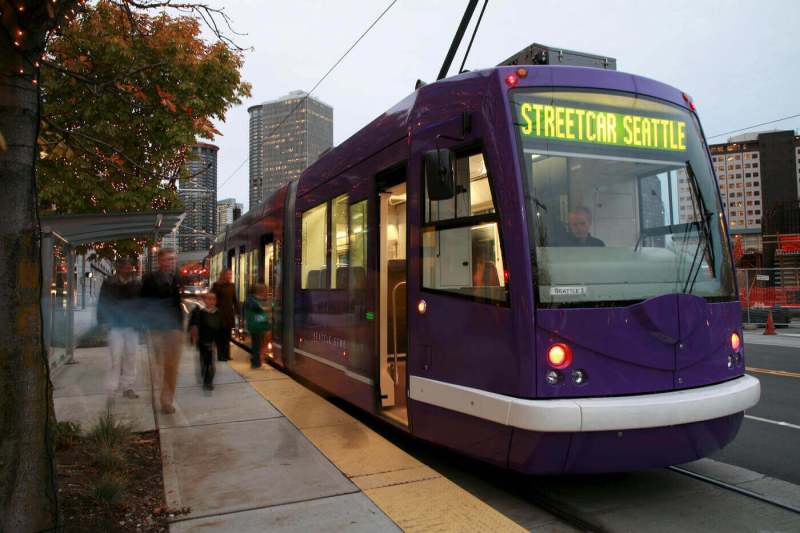
In Seattle, the effects were also uneven. The authors found that in the areas surrounding Seattle’s two separate, disconnected streetcar lines, commercial building permits increased 50 percent. Residential building permits, however, were 59 percent lower than the rest of the city.
The lesson for cities is that there are better incentives to spur development than simply using the “If we build a streetcar, they will come” approach, said Brown and Mendez.
Above all, the success of the streetcar as a form of transportation will affect development outcomes. They note, for example, that Portland’s 7.2-mile system is well integrated into the larger transit network and has strong ridership. By contrast, Seattle’s system — like many of the new generation streetcar systems — has had trouble attracting riders. Short modern systems — often operating without their own rights of ways —may not offer any obvious benefit over the bus, and indeed might be worse because of their limited reach.
“The lesson from Portland’s experience seems to be that the more effective a streetcar is as a transportation service, and the more it is used by patrons, the more likely it is to have development effects,” Brown and Mendez wrote. “Simultaneously, a streetcar alone is not a guarantee of positive outcomes, as other factors such as a healthy real estate market, land availability, development-supportive zoning and other policies also need to be present.”
By contrast, Seattle’s “two disconnected lines” “do not seem to be attracting very many regular users because of their inherent limitations with respect to speed, reliability, and geographic reach,” they wrote.
Seattle is poised to begin a new phase of streetcar construction that will connect the two lines into a much more functional system. Authors say that bodes well for development prospects around the line.
“Attracting residents to development along the streetcar is easier when the system can meet their transportation needs,” they wrote.
The study comes at a time when there has been a surge in interest in building modern streetcar systems. More than a dozen — in Kansas City, Cincinnati and, most recently, St. Louis — operate today, with more on the way. Some of the systems, like Atlanta‘s, have been disappointing from both a ridership and development perspective, while others, like Kansas City’s, seem to be performing better.
In New York City, Mayor de Blasio is keen on developing a $3-billion streetcar along the waterfront in two boroughs across the river from Manhattan. Those areas are already in the midst of intense residential and office development, so in this case, the mayor is seeking additional transportation to handle the quickly rising population in western Brooklyn and Queens.
But critics say his BQX streetcar would be no better than express buses on dedicated lanes.

Read More:
Streetsblog has migrated to a new comment system. New commenters can register directly in the comments section of any article. Returning commenters: your previous comments and display name have been preserved, but you'll need to reclaim your account by clicking "Forgot your password?" on the sign-in form, entering your email, and following the verification link to set a new password — this is required because passwords could not be carried over during the migration. For questions, contact tips@streetsblog.org.