The Problem With Lazy Local Coverage of Highways and Transit

Why is coverage of highway infrastructure so lazy?
There are exceptions of course. But for the most part, local newspapers write about highway projects as foregone conclusions, dutifully and uncritically repeating the marketing pitch from the state DOT.
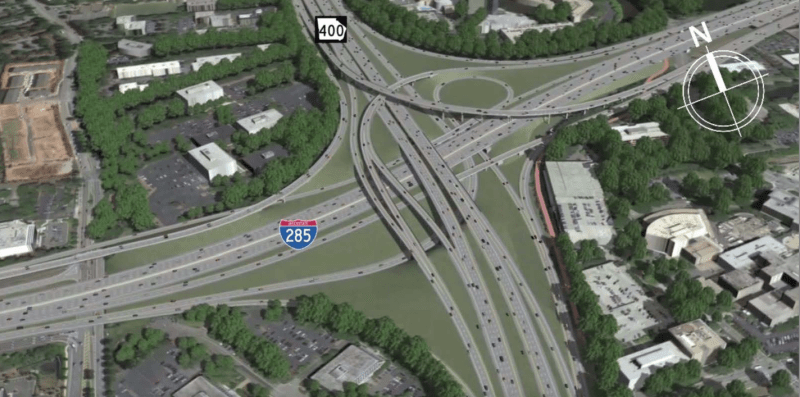
That’s what’s happening now with a highway mega-project in Atlanta, the $800 million overhaul of the Georgia 400 and I-285 interchange. A recent article in the Atlanta Journal Constitution basically reprinted the Georgia DOT press release, asserting that the project would be a “fix for one of metro Atlanta’s worst traffic bottlenecks,” “make commuting easier for hundreds of thousands of people,” and “carry more vehicles.”
Mountains of research have shown that all these claims should be met with serious skepticism. But reporters only go looking for opposing points of view when the subject is transit, writes Darin Givens at ThreadATL, and they usually don’t turn to the most credible sources:
If this article was about rail-transit expansion, the AJC would’ve likely gotten a quote from some anti-rail quack like Randal O’Toole as “balance” for the issue, as if we can’t just accept new high-speed public transportation as a good thing. Or maybe they’d have gotten one from David Hancock, chairman of the United Tea Party of Georgia, about the expense of transit. Or one from noted rail-transit critic Wendell Cox.
But since it’s about highway expansion for cars, this article basically a press release for the Georgia Department of Transportation, without a single mention of the induced demand effect.
In 2015, California’s DOT admitted a fact that had become more and more supported by data: congestion relief on major roads is a dubious pursuit, in which added capacity for cars induces more car trips.
The fact that the AJC didn’t mention it is a demonstration of another one of the little ways we express favoritism toward driving. (Notable: a Google search on AJC.com shows that the only time “induced demand” has ever showed up in the text of a post is in the comments section.)
If the AJC wanted to do some real reporting on this project, there are local experts right under their nose who’d be happy to weigh in. Ryan Gravel, an originator of the BeltLine concept, spelled out the downside of the interchange expansion:
More recommended reading today: Transportation for America reports that Congress is cutting infrastructure funding as part of its unpopular tax reform plan. And Reno Rambler shares the findings of a new study showing that people who bike are better drivers.
Happy Thanksgiving! Streetsblog USA will be offline for the holiday and back to publishing on Monday.

Read More:
Streetsblog has migrated to a new comment system. New commenters can register directly in the comments section of any article. Returning commenters: your previous comments and display name have been preserved, but you'll need to reclaim your account by clicking "Forgot your password?" on the sign-in form, entering your email, and following the verification link to set a new password — this is required because passwords could not be carried over during the migration. For questions, contact tips@streetsblog.org.