A Big Opportunity to Reform the Vicious Cycle of Highway Expansion

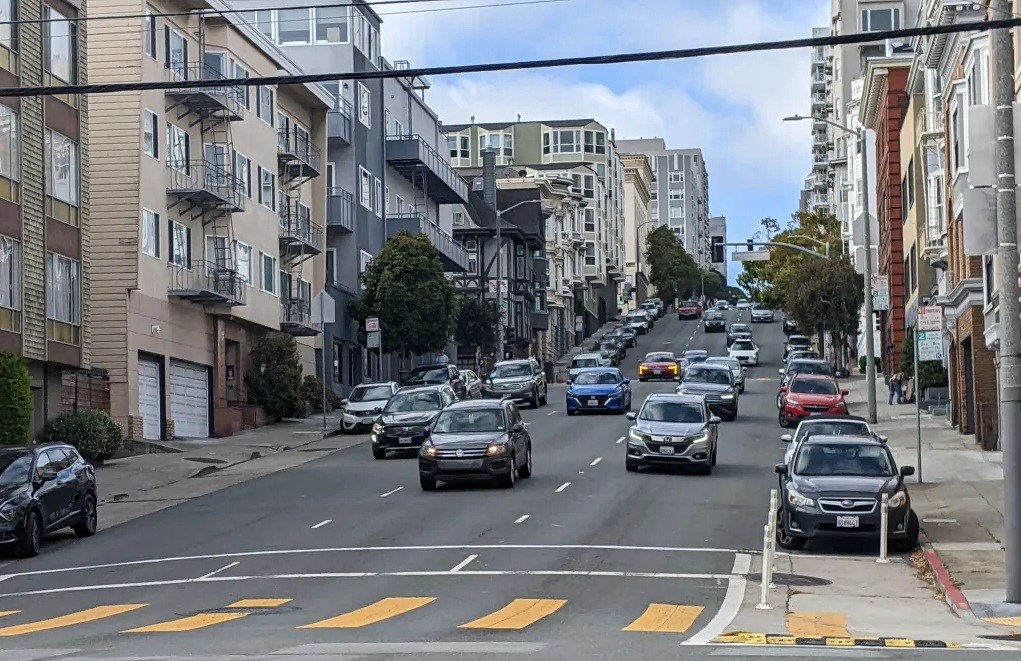
Transportation Secretary Anthony Foxx made headlines recently with a speech about how America needs to rethink its approach to urban highways. But U.S. DOT’s influence is limited. States have the real power when it comes spending federal transportation funds, however, and a lot of states are still stuck in the cycle of addressing traffic congestion by widening highways, which generates more traffic, and the cycle repeats ad infinitum.

But here’s an opportunity for Foxx and U.S. DOT to make a tangible impact. The agency is currently writing up new rules about how state’s should measure traffic congestion, as required by the MAP-21 transportation bill.
Stephen Lee Davis at Transportation for America writes that the current methods of assessing congestion have failed:
How USDOT instructs states and metro areas to measure congestion will have huge impacts on communities of all sizes. Why? Because there’s a direct connection between how we decide to measure congestion and the resulting strategies for addressing it. And we need a measure that rewards solutions like aggressively investing in additional travel options, eliminating trips, reducing trip length, creating more places to live close to jobs or more effectively managing travel demand.
One of the most commonly used methods for measuring congestion today (and how proposed transportation projects would improve it or make it worse) is incredibly narrow and generates major criticism: roadway delay.
Every year, the Texas Transportation Institute releases their annual Travel Time Index congestion report that generates tons of news coverage across the country. Our piece from last year explained the limitations of comparing average rush-hour speeds to empty roads in the middle of the night, as TTI uses those middle-of-the-night speeds as their baselines for comparison. And then as a direct result of how congestion gets measured, many agencies attempt, at enormous price tags, to build enough road capacity to keep traffic moving at free-flow speeds during rush hour, usually bringing limited benefits (a few seconds of savings per commuter) at enormous costs.
Roadway delay, typified by TTI, also rewards places with long average commutes that happen at a high rate of speed, dinging places where people spend less time commuting or commuting shorter distances — just because they travel at slower speeds compared to that baseline of average travel speeds at the middle of the night.
Another major shortcoming is that roadway delay focuses only on drivers — not commuters as a whole, ignoring the millions of people opting out of congestion entirely by using various other options like transit, walking or biking or skipping the trip by telecommuting. Under a roadway delay measure, if a city has made investments like these that allow a large share of its commuters to skip roadway congestion entirely, it can be rated the same as another city where the average delay on the roads is the same, even if 100 percent of that second city’s commuters are stuck in traffic.
Delay is also blind to how many people a corridor is actually moving — it only looks at the number of vehicles. Should two similar corridors, where the first moves three times the amount of people as the second because of a carpool requirement or a lane dedicated to high-capacity transit, have the same scores for delay just because the travel speed is the same?
Davis says early indications are that U.S. DOT is not planning to totally overhaul the emphasis on vehicle delay. But that could change. During an earlier rule-making process, walking and biking advocates prevailed on U.S. DOT to require performance measures of pedestrian and cyclist safety. When the final rules were released, the request was honored.
Transportation for America expects U.S. DOT to unveil its congestion rule very soon. That’s when people who care about cities can weigh in and shape the final version. Stay tuned — that process should begin any day.
Elsewhere on the Streetsblog Network today: Broken Sidewalk considers how Louisville can repair its award-winning parking crater. Seattle Transit Blog says one mark of a great transit system is that it becomes an unremarkable part of everyday life. And Plan Philly shares some cringe-worthy quotes about parking policy from City Council President Darrell Clarke.

Read More:
Streetsblog has migrated to a new comment system. New commenters can register directly in the comments section of any article. Returning commenters: your previous comments and display name have been preserved, but you'll need to reclaim your account by clicking "Forgot your password?" on the sign-in form, entering your email, and following the verification link to set a new password — this is required because passwords could not be carried over during the migration. For questions, contact tips@streetsblog.org.