Is Your City Making Full Use of Existing Transit Investments?


Chicago’s rail transit infrastructure has a lot of unused capacity, Yonah Freemark wrote last week on the blog of the Metropolitan Planning Council, and making use of it might be cheaper and easier than expanding the system.
Some of Chicago’s most transit-accessible neighborhoods are barely growing, but rents are rising fast, Freemark reported, an indication that additional transit-oriented housing could be supported. Unfortunately, zoning laws limit new construction in these areas, says Freemark, so countless would-be transit riders move to the suburbs or other regions, outside the reach of transit service.
Inspired by that article, David Levinson at Streets.mn looked at how much additional capacity there is on Minneapolis’s new Green Line — one of the biggest transit success stories of last year — which carries about 38,000 riders daily. Depending on how you calculate capacity, there’s actually quite a bit to work with, says Levinson.
This measures capacity in terms of daily boardings. Daily miles traveled is another measure, and is independent of the length of trips. To calculate this we use the following equation:
Capacity = (Hours of Operation)*(Trains/Hour)*(Cars/Train)*(Capacity/Car)*(Stations – 1) * (Trip Length) * (Directions Operating).
At any rate, the attached table shows some surprisingly high numbers, up to 7 million (under the admittedly silly unconstrained scenario (A) where people only ride the train for 1 stop before alighting, trains run for 24 hours a day, and people are standing at near crush capacity), with more plausible numbers in the 255k territory, assuming everyone gets a seat, but you can run at 5 minute headways (C). Here we are limited by capacity in one section (downtown Minneapolis), which does run at 5 minute headways, but splits the capacity between the Green and Blue lines.
The main point is that there is a lot of capacity on the Green Line yet to go, even if you only run 18 hours a day, and you expect everyone to have a seat, and run at today’s 10 minute headways (which is all today’s fleet can support, to increase headway we either need to increase speed greatly or add vehicles), and assume the average trip is 7 stations (Aaron Isaacs informs me it is 3.5 miles, which at 1/2 mile spacing is about 7 stations) (83,314 – scenario D). At the other end of the spectrum, if everyone expected a seat and was riding from Union Depot to Target Field, the capacity would only be 32,400 with today’s frequencies.
Since Minneapolis has additional capacity on its new rail line, and there’s a lot of developable land along the corridor, Levinson wonders: “Why are new corridors being subsidized for development?”
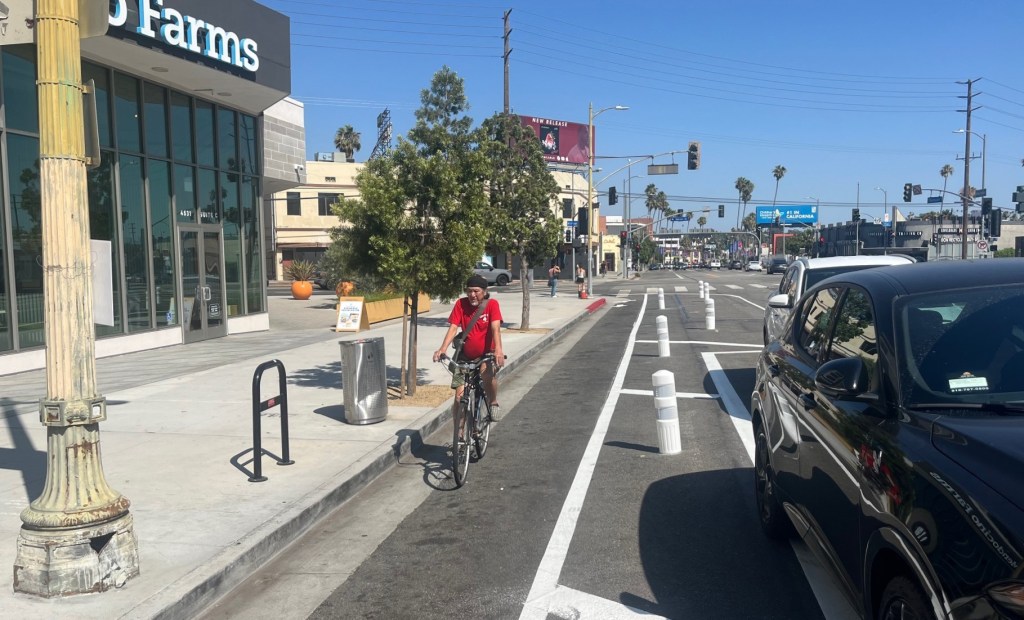
Elsewhere on the Network today: The Wash Cycle shares a photo from San Francisco showing how a bump-out makes a handy spot for a bike corral. BicycleLaw.com discusses the stubborn resistance to bike transportation in Georgia. And Prince George’s Urbanist evaluates efforts to make a rail hub at New Carrolton, Maryland, more urban and transit friendly.

Read More:
Streetsblog has migrated to a new comment system. New commenters can register directly in the comments section of any article. Returning commenters: your previous comments and display name have been preserved, but you'll need to reclaim your account by clicking "Forgot your password?" on the sign-in form, entering your email, and following the verification link to set a new password — this is required because passwords could not be carried over during the migration. For questions, contact tips@streetsblog.org.