Study: To Keep Bicyclists Outside the Door Zone, You Need a Buffer

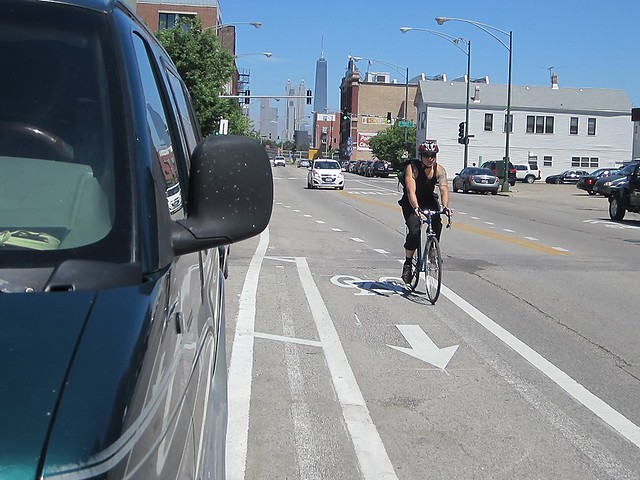
A new study has found that bike lanes with a buffer next to the parking lane are better than conventional bike lanes at encouraging bicyclists to ride outside the door zone.
The study, recently published by the Transportation Research Board, concludes that wider but un-buffered bike lanes aren’t necessarily better than narrower lanes in encouraging bicyclists to ride outside the door zone. If there’s enough space to make a wider bike lane, the authors conclude, that extra space should be used to install a “narrower bicycle lane with a parking-side buffer,” which “provides distinct advantages over a wider bike lane with no buffer.”
Researchers reached their conclusions after observing thousands of cyclists using various bike lane configurations in Chicago and Cambridge, Massachusetts. On one Chicago street, for example, few bicyclists rode outside the door zone when the bike lane had no buffer, then after a two-foot buffer was striped, 40 percent rode outside the door zone.

That’s because the door zone is four feet wide, and riding in the center of a six-foot-wide bike lane still doesn’t give a cyclist enough clearance.
The on-street tests demonstrated that a six-foot-wide bike lane offers no advantage over one that’s five feet wide, or even four feet wide. Regardless of the width, bicyclists still ride in the center of the lane — within the radius of a typical car door swinging open. Dooring crashes are common in urban areas like Chicago: In 2012, the last year for which data is available, 18 percent of reported bike crashes were doorings.
The researchers were studying different types of bike lanes, and how people use them, in order to refine recommendations in the American Association of State Highway and Transportation Officials’ “Guide for the Development of Bicycle Facilities.” The guide recommends five-foot-wide bike lanes and says four-foot-wide bike lanes can be used in other situations — but it was based on trial and error, not scientific research.
While protected bike lanes weren’t studied in this research, the authors’ observations show how proximity to moving traffic contributes to doorings. For instance, the study concluded that, “as traffic volume increases, bicyclists move away from vehicles in the travel lane and position themselves closer to parked vehicles or the curb.” Researchers observed the same response as truck traffic increased. This leads bicyclists to ride in the door zone — but with protected lanes, cyclists don’t have to ride next to motor vehicle traffic, and this isn’t a problem.

Read More:
Streetsblog has migrated to a new comment system. New commenters can register directly in the comments section of any article. Returning commenters: your previous comments and display name have been preserved, but you'll need to reclaim your account by clicking "Forgot your password?" on the sign-in form, entering your email, and following the verification link to set a new password — this is required because passwords could not be carried over during the migration. For questions, contact tips@streetsblog.org.