CA High-Speed Rail Authority Certifies EIR for Fresno-to-Bakersfield Segment

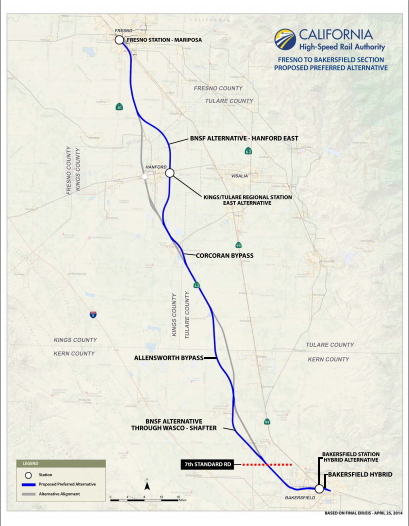
The California High Speed Rail Authority (CAHSRA) Board voted unanimously today to certify the Final Environmental Impact Report (FEIR) for the project segment between Fresno and Bakersfield in the Central Valley. This section of CAHSR can now move to the “final design” stage that precedes construction.
This is the second segment of the project to have its individual FEIR approved; the segment between Modesto and Fresno was certified in May of 2012.
The two-day board hearing in Fresno featured some contentious and emotional comments from the public, both in support and in opposition to the project. Local farmers who would be directly affected by construction or operations of the system worried that they would not be fairly compensated for loss of their land. Several board members expressed sympathy for those individuals, but then went on to talk about the “greater good” presented by high-speed rail.
Board member Tom Richards pointed out that the project would mean the loss of “less than 1/10 of 1 percent” of agricultural land in the valley. In contrast, said Chair Dan Richard, the state estimates that “over 33,000 acres will be lost to future development within the counties of King and Tulare.”
High-speed rail “will be a tremendous boon for the Valley,” said Richard, “and the benefits tremendously outweigh the costs.”
Several Fresno State University students spoke in support of high-speed rail through the valley, including one student who said her original plan had been to earn a degree and move away. Now, “because of high-speed rail, I plan to stay,” she said. Her testimony and that of another student who called high-speed rail the “next logical progression for transportation in California” were highlighted by board members in their closing remarks.
Some speakers raised concerns about valley fever, a sometimes serious illness contracted by inhaling spores that normally live in the soil in the Central Valley, but can become airborne when construction or farming activities disturb the soil.
Richards proposed an amendment to the EIR that would incorporate several construction design safety features to protect workers.
Construction plans include requirements to control “fugitive dust emissions,” according to Andrew Bane, the environmental manager on the project’s program management team. To keep dust to a minimum, construction must be suspended if the wind exceeds 25 mph, the construction sites will be sprayed with water to keep dust down, and trucks will be washed when they leave the site.
Air quality in the areas around Fresno and Bakersfield is among the worst in the country, due to a wide range of factors including particulate matter from diesel trucks and farm equipment. Although the construction health safety plan proposed in the amendment would provide some measure of safety for workers, it’s unclear whether it would also protect others.
When board member Thea Selby asked whether the plan would protect local school children, Bane reassured her that the construction plan contains a “net-zero” emissions goal during construction, with any emissions, including for “fugitive dust,” to be mitigated near the areas that are impacted. He did not provide details in his testimony about what those mitigations would include or how they would be applied “in proximity to the impacted area.”
Next up for approval is the draft environmental impact report for the Central Valley Wye, a junction near Chowchilla from which high-speed trains would head west, north, and south.

Read More:
Streetsblog has migrated to a new comment system. New commenters can register directly in the comments section of any article. Returning commenters: your previous comments and display name have been preserved, but you'll need to reclaim your account by clicking "Forgot your password?" on the sign-in form, entering your email, and following the verification link to set a new password — this is required because passwords could not be carried over during the migration. For questions, contact tips@streetsblog.org.