When the State DOT Stands in the Way of Local Progress

There should be a special term for the all-too-common phenomenon of a state DOT putting the kibosh on a promising local project. DOT-blocking! (Yes, it’s pronounced “dot-blocking.”)

And have we got a good DOT-blocking story for you today. Ohio Department of Transportation regulations are essentially making it impossible for Cleveland to act upon its recent, hard-won complete streets policy, reports Marc Lefkowitz at local blog Green City Blue Lake. On Twitter yesterday, Walkable City author Jeff Speck called this a “perfect example of how DOTs are the prime enemy of progress.”
Lefkowitz reports that ODOT’s design guidelines, coupled with its general refusal to grant exemptions, essentially force Cleveland to build highway-width traffic lanes through urban neighborhoods. And that means there’s no room for bikes.
A few early projects serve as examples, Lefkowitz explains:
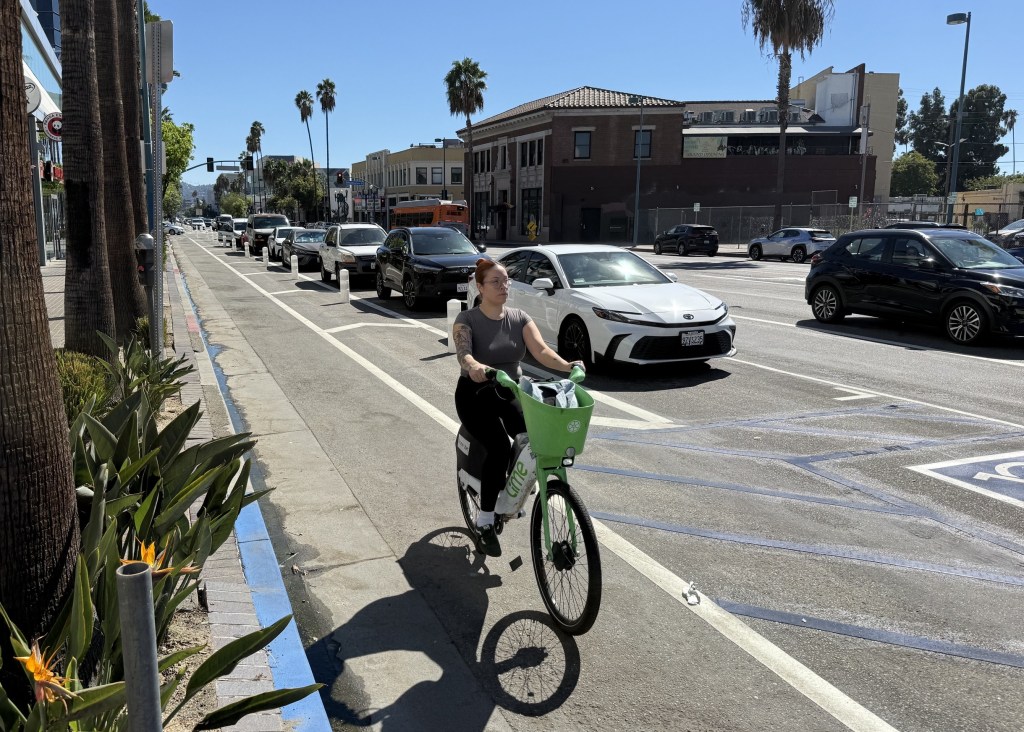
A rule has been cited by ODOT that has removed bike lanes from the W. 65th Street plan, because it would narrow lanes to 10 or 11 feet rather than the standard issue 12 feet. [Here ODOT is adhering to its own design guide for state highways, which requires at least one 12 foot lane in each direction, wider even than the accepted national guide from American Association of State Highway and Transportation Officials, which itself can be considered overly rigid and old-fashioned]. With on-street parking, it is admittedly a challenge to fit a five-foot-wide bike lane on W. 65th Street [pictured above].
But FHWA has a guideline for bike lanes with on-street parking, if cities are really interested in having both. FHWA notes that narrowing lane widths is within road engineering standards, especially on streets that have moderate traffic. It’s why FHWA routinely sees cities apply for exemptions to these federal edicts. The Feds grant these exceptions because they recognize that in urban areas, the context of the street should hold greater value. Because they defer to cities that want to fulfill goals of calming traffic, improving safety and comfort for all users on the road.
What does that mean for W. 65 Street? A more common sense and more cost effective solution—bike lanes on the roadway—are being ruled out.
Here’s the really outrageous part: Because the city of Cleveland doesn’t think it can get the Ohio Department of Transportation to grant an exemption, it is planning to install an off-road trail instead, at great expense to this struggling city, Lefkowitz says:
It costs around $1 million per mile to build a bikeway. The stretch of West 65th Street from Denison to Detroit avenues under the plan is 2 miles, and with the city [policy limiting its total per-project investment in] Complete and Green Streets projects at $1 million, something will have to give.
So here’s the question that’s been gnawing at me: Why would the Ohio Department of Transportation, which is fast running out of money, require wider lane widths than the feds? Might it have something to do with the fact that this agency is literally headed by a former asphalt industry lobbyist?
Elsewhere on the Network today: Bike Portland reports there’s a bill in the Oregon legislature that would allow the state to spend gas tax revenues on bike projects. The Tri-State Transportation Campaign notes that car-oriented Staten Island is seeing its population stagnate, while walkable, transit-oriented Brooklyn is booming. And Human Transit wonders whether redistribution should be a goal of federal transit programs.

Read More:
Streetsblog has migrated to a new comment system. New commenters can register directly in the comments section of any article. Returning commenters: your previous comments and display name have been preserved, but you'll need to reclaim your account by clicking "Forgot your password?" on the sign-in form, entering your email, and following the verification link to set a new password — this is required because passwords could not be carried over during the migration. For questions, contact tips@streetsblog.org.