Metro Considers Construction Jobs Policies to Ignite Economies in Lower Income Areas

In September of last year, the Metro Board of Directors ordered staff to create a program to insure that Los Angeles’ most disadvantaged workers and disadvantaged communities benefit economically from the Measure R construction projects. In response, Metro negotiated an agreement with the Building Trades Council that will apply to all Metro construction projects.
The agreement sounds simple. Forty percent of all workers on the projects have to be from areas where the median household income is below $27,500 and another 10% from communities where the median household income is below $40,000.
The motion, championed by Mayor Antonio Villaraigosa and Supervisor Mark Ridley-Thomas was partially the result of community pressure brought by communities surrounding the future Crenshaw Light Rail project.
The motion will be heard at Thursday’s meeting of the Metro Board of Directors.
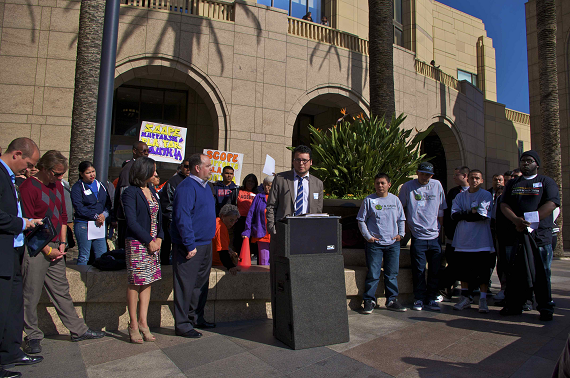
A coalition of community and labor organizations have thrown their support behind the proposed Construction Careers Policy including the Los Angeles Alliance for a New Economy, Transportation for America (T4A), La Causa Youth Build, and Strategic Concepts in Organizing Policy & Education. Last week at a press conference in front of Metro Headquarters organized by LAANE, a parade of workers testified how the program could change their lives by offering them an opportunity for a middle class job that might otherwise be impossible.
According to LAANE’s analysis of similar policies at other agencies such as the Port of Long Beach, the Expo Construction Authority (for Phase II) and the Community Redevelopment Agency (CRA), this program could provide job access for 27,000 Los Angeles County residents of lesser means.
Supporters of Measure R and other transit project have made the argument that job creation is one of the major reasons that L.A. County residents support the transit sales tax and transit expansion in general. Supporters of the Construction Careers Policy that Metro is proposing point to this program as a needed step to make sure that the created jobs have the biggest impact in a county with a 13% unemployment rate.
“For our national economic recovery to take hold and lead to sustainable economic growth we have to look beyond simple unemployment numbers,” writes Ryan Wiggins, Southern California Field Organizer for T4A. “We must create good jobs that provide career pathways for those hardest hit by the recession. As we work to establish similar programs on the federal level we will once again look to Los Angeles, and this program, for inspiration.”
(Kris Fortin and Sahra Sulaiman contributed research to this story.)

Streetsblog has migrated to a new comment system. New commenters can register directly in the comments section of any article. Returning commenters: your previous comments and display name have been preserved, but you'll need to reclaim your account by clicking "Forgot your password?" on the sign-in form, entering your email, and following the verification link to set a new password — this is required because passwords could not be carried over during the migration. For questions, contact tips@streetsblog.org.