Eyes on the Street: Law Enforcement Takes the Lane
Usually when I’m writing about the questionable behavior of law enforcement, I’m looking at how racial profiling and the harassment of people of color can negatively impact those folks’ mobility.
But sometimes the hampering of mobility comes in more physical forms.
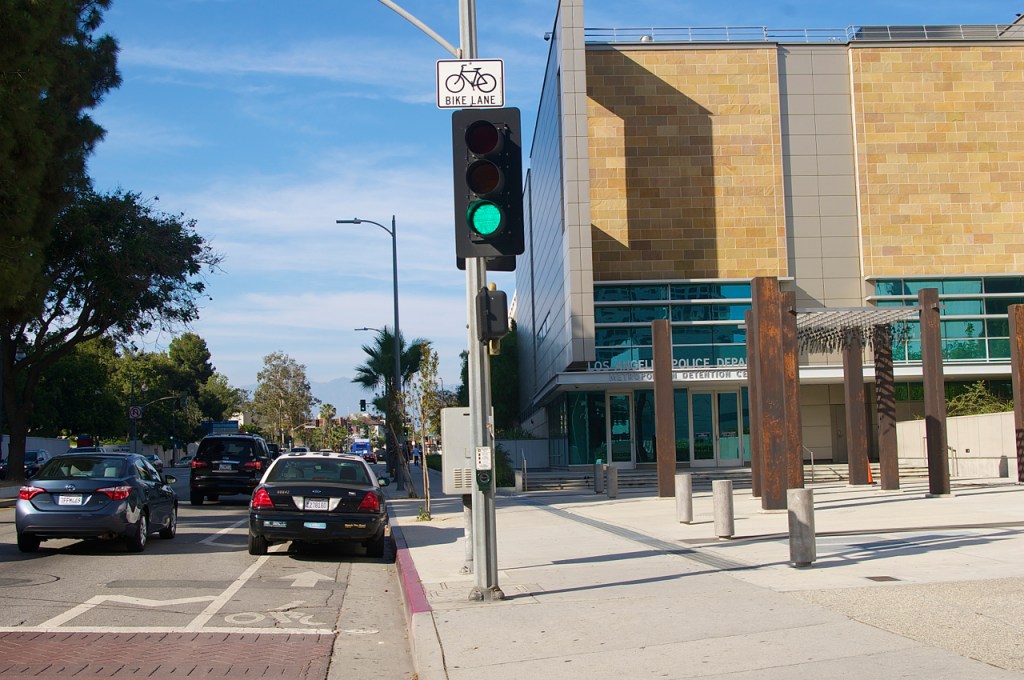
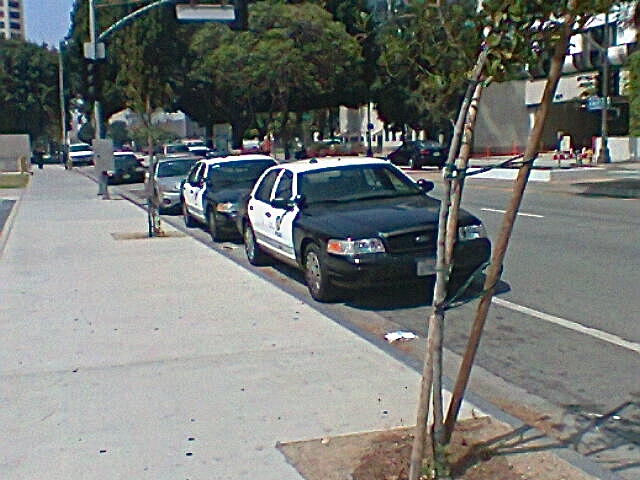
Yesterday, it materialized in the form of a fleet of vehicles parked in the buffered bike lane on Los Angeles St. in front of the Parker Center Police Dept. building in Downtown L.A.
In the event you are wondering if perhaps it was just that the lane was not that well marked, behold the clearly buffered lane as it runs in front of the police buildings in a Google Maps view from March of 2015.
And lest you think perhaps there was a major emergency and the vehicles had been parked there in haste, behold the Google Maps shot from a little farther up indicating that, no, this is just common practice.
And not only is it not a fluke, some officers apparently give little thought to the protection of the good people of Los Angeles from fires during this terrible drought, as evidenced by the vehicle below, blocking the fire hydrant like a boss.
And just because Homeland Security is not one to be outdone, three of their vehicles parked in the bike lane on the same street one block up (just north of Temple).
When I first spotted them at around 11 a.m., Los Angeles St. was kind of quiet and it wasn’t that hard to get around them safely. But the situation was much different and far more problematic at rush hour, as cars couldn’t easily enter the right lane to turn onto the freeway (causing traffic to back up at an angle) and making it more dangerous for both cyclists and drivers looking to continue north on Los Angeles.
And, no, as you might have guessed, this is not the first time they have either parked in the bike lane…
…or blatantly ignored the red curbs and visible and well-placed “No Stopping at Any Time” signs.
If we take a “broken windows” approach to these infractions — “broken windows” being the LAPD’s own approach to enforcing the law on quality-of-life issues (graffiti, actual broken windows, sidewalk loitering, sleeping in parks, street vending, etc.) in order to keep minor lawbreakers from feeling emboldened to commit more serious crimes in a neighborhood — then we can see we have a serious problem on our hands.
A student of that approach could not help but ask, “If law enforcement is so nonchalant about regularly parking illegally in marked travel lanes and blocking fire hydrants in the middle of a very busy downtown neighborhood, what is to keep them from committing more serious infractions when they think no one is looking? Like profiling black cyclists as criminals and beating up innocent people or harassing them for participating in Martin Luther King Day festivities?” Oh, wait, my bad. They already did that.
We ask an awful lot of law enforcement – we want them to act as protectors, counselors, mediators, problem solvers, and knowledgeable and justice-oriented enforcers of the law – and we neither give them the support they need to carry out those tasks nor do we reward their performance when they do. Much within the institution and how we, as a society, conceive of and implement policing needs to change.
But starting with the basics can help put everyone on better terms. It is hard for people to feel trust in law enforcement officers who feel completely free to violate city and traffic codes while cracking down on invented infractions, like pedestrians crossing streets within a designated walk period, or cracking heads in lower-income communities of color.
Making it look like the department has at least a modicum of visible respect for the rule of law might be a good first step in that direction.

Read More:
Streetsblog has migrated to a new comment system. New commenters can register directly in the comments section of any article. Returning commenters: your previous comments and display name have been preserved, but you'll need to reclaim your account by clicking "Forgot your password?" on the sign-in form, entering your email, and following the verification link to set a new password — this is required because passwords could not be carried over during the migration. For questions, contact tips@streetsblog.org.