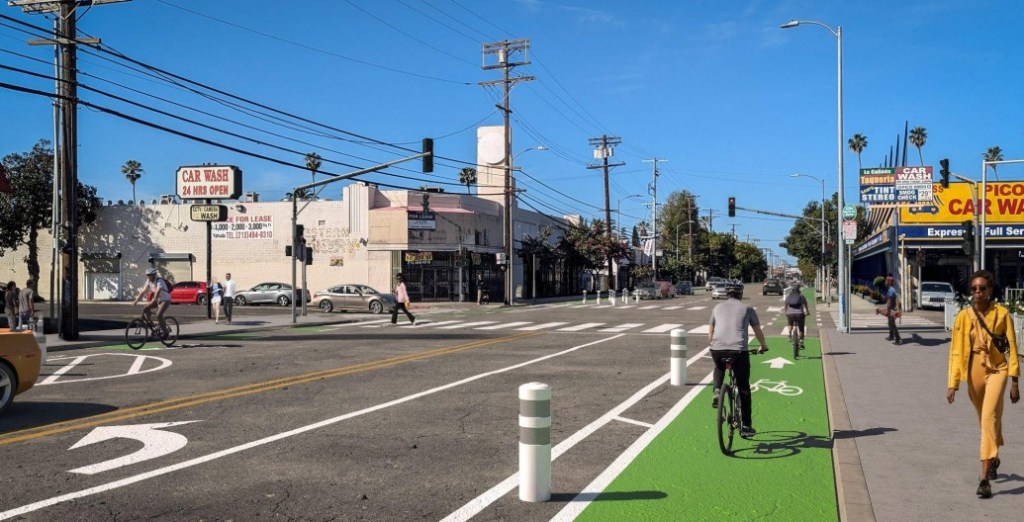
City Planning’s Opportunity to Re-make Los Angeles’ Streets

 Bicycle-friendly Street from New York City’s Street Design Manual
Los Angeles’ Department of City Planning (DCP) is working on a study
that has the potential to change the way that the city does
streets. DCP’s “Street Classification and Benchmarking Study” is lead
by city planners Claire Bowin and Jane Choi and their consultant,
Fehr and Peers’ Jeremy Klop. The $55,000 study is funded by the
Southern California Association of Governments (SCAG.) There’s
apparently no information on the study online yet, though briefings on
it were presented at the recent StreetSummit and to the Green L.A. Transportation Work Group. Dorothy Le reported on the GLATWG briefing at the Bike Coalition’s blog.
DCP is responsible for the city’s General Plan, which includes
various components. The main part of the plan that codifies street
specifics is the Transportation Element, most recently updated in 1999 and available on-line.
The language in the transportation element is actually not bad.
It plans for many features that Streetsblog readers favor, including
“[making] the street system accessible, safe, and convenient for
bicycle, pedestrian, and school child travel” and a “comprehensive
program of multi-modal strategies” and more.
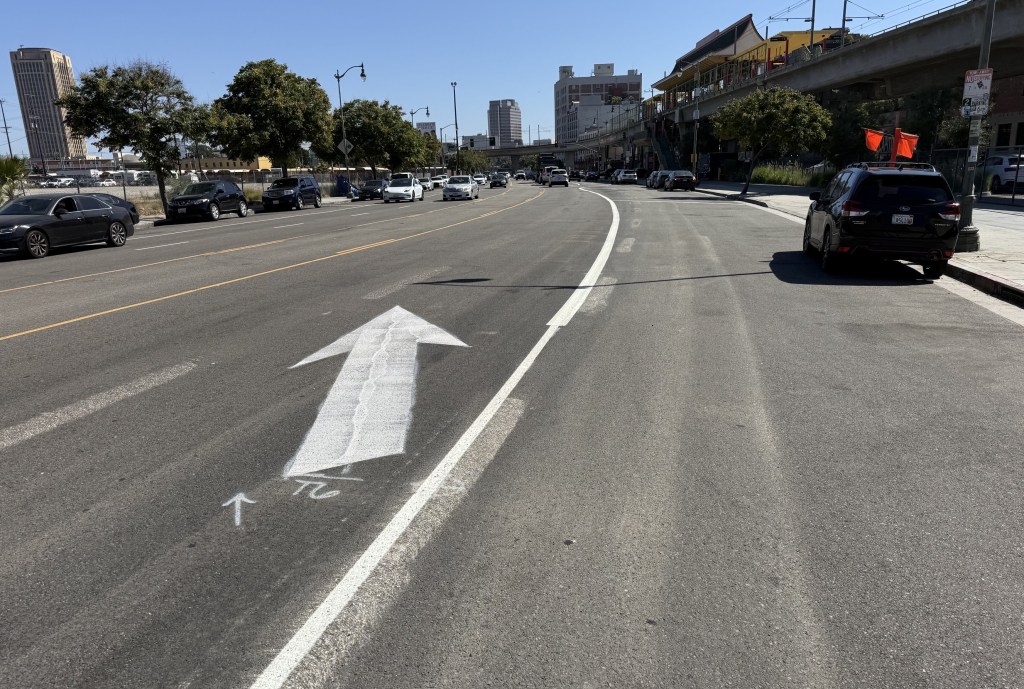
 Bicycle-unfriendly Streets from Los Angeles’ Current Street Standards
Unfortunately quite a bit of transportation element ends up boiling down to a 1-page Standard Street Dimensions sheet –
on which the words “transit” and “bicycle” do not appear. The street
dimensions specifications show standard cross-sections for all the
types of streets that L.A. designates: Major Highway, Collector Street,
etc. Bike/Ped planning consultant Ryan Snyder calls these street
specifications the “DNA” of our streets. Whenever there’s a new school,
new park, new building, etc. the city consults the 1-pager and then
generally mandates that the street be widened to its specified
capacity. Check out the link – it’s one page and it’s instructive of why L.A. streets look the way they do.
Under the leadership of General Manager Gail Goldberg, DCP has been
starting to chip away at the city’s sadly suburban street standards.
DCP’s Urban Design Studio created a great new street plan for Downtown Los Angeles,
which keeps in place the existing road-widths and the existing
character of our no-setback downtown buildings. On 7th Street, the
downtown plan actually specifies a road diet (reducing car lanes) to
create bike lanes. DCP has other promising multi-modal pilots in the
works, including the Cornfield Arroyo Seco Specific Plan. But there’s still the matter of those suburban street standards being applied throughout the city day in day out.
DCP hopes to update the Transportation Element of the General Plan
in the next few years. Planner Claire Bowin speaks of renaming it the
Mobility Element, and planning L.A.’s transportation systems into
something truly multi-modal. Unfortunately, for the last few years, the
new likely-multi-million-dollar
few years off. With the city’s current budget crisis, it’s not in the
workplan for this fiscal year. Doesn’t appear likely next year either.
DCP’s Bowin got the idea to get a jump on the Mobility Element by
seeking funding for studies that would get portions of it done. One of
the first of these is the Street Classification and Benchmarking Study.
Through this study the city will review best practices from other
municipalities, and come up with ideas for modifying L.A.’s street
classification system.
Bowin anticipates including expanding the way L.A.’s streets’
performance is measured. Currently the city evaluates its streets using
a metric called Level of Service (LOS.) LOS just measures vehicles,
with no accounting for pedestians, cyclists, or transit.
The street classification approach favored by DCP and their
consultant is to come up with a “Layered Network” – what appears to be
essentially a finer-grained version of the existing street standards,
which would include not just the current single type of each street.
For example, in addition to today’s “Secondary Highway”, the new plan
would be to have various types: Transit-Priority Secondary Highway,
Bike-Priority Secondary Highway, etc. This would generate a network of
streets geared to each mode: a Transit-Priority Network,
a Bike-Priority Network, a Pedestrian-Priority Network, and, yes, even
an Auto-Priority Network. (Doesn’t L.A. already have one of those?)
While the Layered Network approach is likely to be a step in the
right direction, especially in the light of today’s car-monoculture
standards, it’s not quite a complete streets approach. Shouldn’t all of
Los Angeles be safe for walking? Early drafts of the
study includes grating descriptions like this one of a Major Highway
Class I: “Bicycle travel is not typically on this roadway. Bicycle
priority streets should be designated on parallel facilities.” Is this
the kind of designation that the current Department of Transportation
regime is likely to favor?
A shortfall of this study as currently scoped is that it’s just a
study. DCP states that it will have no specific recommended ordinances
to be adopted. Any changes in the streets DNA will have to wait a few
years before they can be adopted. Even then, Bowin characterizes the
new standards would be a “greater toolbox” that would be available “for
use in Community Plans.” The Community Plan process is an exceeding
slow and labyrinthine tool for adopting new street standards. It sounds
like it would be another at least 2-3 years for the new toolbox to be
approved in the Mobility Element, then another 2-3 years before a
specific new standard could get approved for a specific street in a new
Community Plan. With this approach, a fast-tracked change would be
around 2015, if we’re lucky. WWJSKD?
At the study briefing that this author attended, Stephen Box, Glenn
Bailey, Ryan Snyder and others called for specific policy
recommendations that could be made in a study like this:
– Minimize lane widths: Most of the revised classifications still
call for excessive 11-foot-wide travel lanes. For pedestrian-priority
and bike-priority streets, lane width should be the minimum: just
10-foot-wide
– Suspend Road-Widening: When DCP reviewed its downtown street
standards, it suspended the roadway-widening for the downtown area.
While DCP is reviewing its standards that apply citywide, it should
place a moratorium on road-widening citywide.
– Suspend Other Unsafe Practices: Similar to road-widening, the
report could recommend a moratorium on other practices that create
unsafe incomplete streets. End speed limit increases. End crosswalk
removals and the city’s current practice of incomplete crosswalks at
interesections. Halt new bike- and pedestian-unfriendly peak-hour
parking restrictions for increasing car capacity.
– Add New Place-based Classifications: The proposed layered approach
is still car-centric. New street designations could include: Main
Street, Shared Space, Promenade, etc. – safe places where Angelenos
would really want to go to, not just go through.
– Add Sidewalk Standards: Safe walkable places start with
well-designed sidewalks with clear functional zones. Even on the newly
proposed “Pedestrian Priority Streets” the road has clearly designated
lanes, and the sidewalks get what’s left over. The new standards should
be exactly the reverse.
– Learn From Others: Many other cities have adopted great,
comprehensive, complete streets standards. Look to progressive
examples, including New York City’s Street Design Manual.
L.A.’s next generation is counting on the Department of City
Planning to do real planning. It’s a good sign that DCP is re-examining
the DNA of Los Angeles’ streets. This study is a great opportunity to
step away from streets that are car-centric wastelands and step toward
health safe livable places.
Streetsblog has migrated to a new comment system. New commenters can register directly in the comments section of any article. Returning commenters: your previous comments and display name have been preserved, but you'll need to reclaim your account by clicking "Forgot your password?" on the sign-in form, entering your email, and following the verification link to set a new password — this is required because passwords could not be carried over during the migration. For questions, contact tips@streetsblog.org.