BRU: How About a Stimulus for Bus Riders?

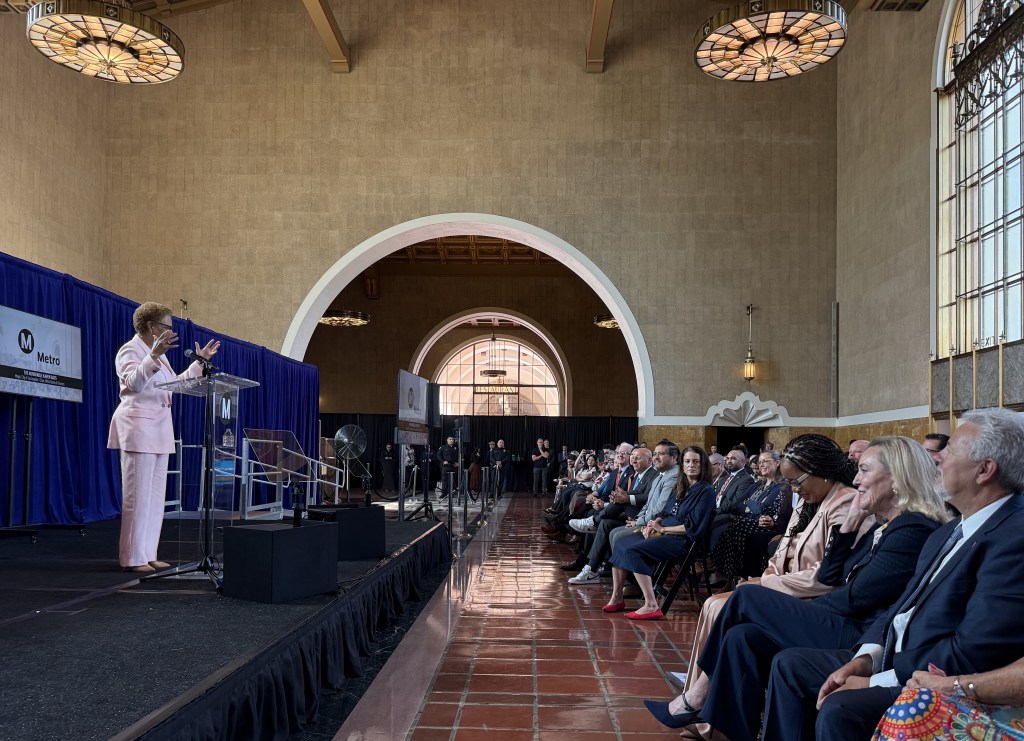
 Tae Soon Jeon Speaks at Today’s Rally. Photo via Bus Rider’s Union
This morning, the Bus Rider’s Union, including members from South and East L.A., and civic leaders from Koreatown gathered to ask the MTA to support the
BRU’s Clean Air and Economic Justice Plan. Their plan calls for increased funding and expansion of Metro’s bus fleet and a rollback fo the 2007 fare hike by using Measure R and federal stimulus dollars over time. They also pointed out that while Metro staff had released a report earlier in the week that called for some short-term improvements, there was also language in the report that called for fare hikes in the next couple of years and long-term cuts in bus service as different rail projects come online.
The BRU’s Jude Redman explains the need for expanded bus service and how it can stimulate the economy:
In
these tough economic times it is even more crucial that we have an
expansion of the bus system to get people to and from desperately
needed jobs, and allowing for those seeking employment to be able to
accept jobs that aren’t traditionally 9-to-5: hospital workers,
food preparers, security guards, refinery workers, custodians and
airport personnel who work late nights and weekends. I
have had to turn down many a job because there was no service
after a certain hour, or it would mean I had to stand on a corner,
for up to an hour, at night. Expanding 500 buses will not only
create more frequent service and less wait time for us but it will
also create 2,875 more unionized green jobs in LA alone.
After the jump you can see what the Bus Riders Union Clear Air and Economic Justice Plan would have for K-Town.
500 New Expansion Buses –Buy and operate
500 new buses for LA County. In K-town reducing overcrowding is a high
priority where some of the most overcrowded bus lines run like Wilshire,
Vermont, Western, and Olympic. For many Korean elders frequenting local
businesses in Koreatown improving mid-day and weekend service on local lines
means reducing waiting times, often at shelter less bus stops. In an era
of high unemployment, expanding mobility to jobs, schools, clinics and
recreation centers for bus riders also creates over 2, 875 new green jobs in L.A. alone.
Reverse the 2007 Fare
Increase – What
bus riders really need is a $20 monthly bus pass! We believe that the MTA
Board can begin this by reversing the 2007 fare increase, including restoration
of the $52 monthly bus pass. It could save a
bus rider at least $120 a year, and hundreds more in a family with multiple bus
riders. Measure R guarantees a one-year fare freeze for regular
fares and ongoing freeze for seniors and disabled riders. But in these hard
times, when families are forced to make hard choices to keep afloat, reducing
fares is the only sensible thing to do. Furthermore
many families in Koreatown are starting to take advantage of the buses because
of the economic downturn and lowering fares is the
most effectiveway to attract new ridership and maintain the ones who are using
it. In fact, as the LA Times reported earlier
this week, MTA ridership peaked two-years ago prior to the July 2007 fare
increase.
$150 Million Bus Only
Lane Program –
Bus-Only Lanes are the present and the future and we should have them on major
street corridors and freeways throughout the county. They speed up bus
service. They prioritize public transportation, pedestrians and bikes over
single passenger automobiles and of course reduce greenhouse gases and improve
public health.With limited space for cars (already 2/3 of LA is dedicated
to them!), traffic, and global warming, cars can no longer be the primary mode
of transportation in Koreatown.
No Service Cuts
– Expansion, Not Reductions! – Given that L.A. residents will
be paying close to 10-cents per taxable dollar (including three separate
transit sale taxes), L.A.
residents and bus riders need service expansions, not reductions. New bus lines
and improved service in South LA, Southeast LA, and the San
Fernando Valley (historically with least service and targetted for
MTA service cuts) would allow more access for elders visiting their families
living outside of Koreatown and central LA.

Read More:
Streetsblog has migrated to a new comment system. New commenters can register directly in the comments section of any article. Returning commenters: your previous comments and display name have been preserved, but you'll need to reclaim your account by clicking "Forgot your password?" on the sign-in form, entering your email, and following the verification link to set a new password — this is required because passwords could not be carried over during the migration. For questions, contact tips@streetsblog.org.