Street by Street, DC Builds Out a Center-City Protected Bikeway Network

Bike advocates from all over the country are in Washington right now for the League of American Bicyclists’ annual Bike Summit. Among other things, it’s a chance for out-of-towners like Jonathan Maus at Bike Portland to appreciate the city’s progress on bike infrastructure.
Maus reports that there are now nearly 16 miles of protected bike lanes in the center city, and that DC is “well on its way to making a connected network that people can use to zip around on bikes with the same (if not better) ease and convenience as other modes.”
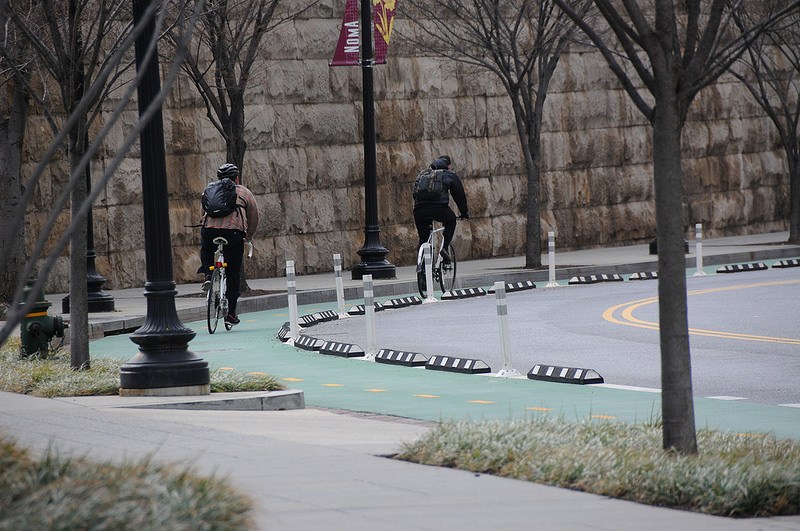
Maus toured the First Street NE protected bike lane in the NoMa neighborhood, which is just 0.6 miles long but used by 1,500 cyclists each day:
Since D.C. has relatively good (for the United States) transit options (including one of the nation’s best bike share systems), a large majority of NOMA residents live without a car. [NoMa Business Improve District’s Galin] Brooks said 80 percent of of them either walk, take transit, or use a bike to get around.
Because of this high non-driving mode share, business owners in the NOMA area have been very amenable to reconfiguring streets with improved access for bicycle users. “They just get it,” Brooks said.
As a result, DDOT was able to re-allocate 10-13 feet of road space on First St NE for 0.6 miles for the exclusive use of bicycles. The design is a two-way, green-colored bikeway with five-foot wide lanes and varying degrees of separation throughout.
For more on the First Street bike lane, check out this Streetfilm breaking down its three types of physical separation.
More recommended reading today: Doggerel looks into the persistent gender wage gap in the design professions, explaining the important role played by implicit bias. Tim Kovach says transit can help address inequality in job access, but it can’t solve the problem on its own in a sprawling, segregated place like Cleveland. And Streets.mn questions what people really mean when they talk about “neighborhood character.”

Read More:
Streetsblog has migrated to a new comment system. New commenters can register directly in the comments section of any article. Returning commenters: your previous comments and display name have been preserved, but you'll need to reclaim your account by clicking "Forgot your password?" on the sign-in form, entering your email, and following the verification link to set a new password — this is required because passwords could not be carried over during the migration. For questions, contact tips@streetsblog.org.