Metro Board to Consider $547M Multi-Agency Transit Policing Contract

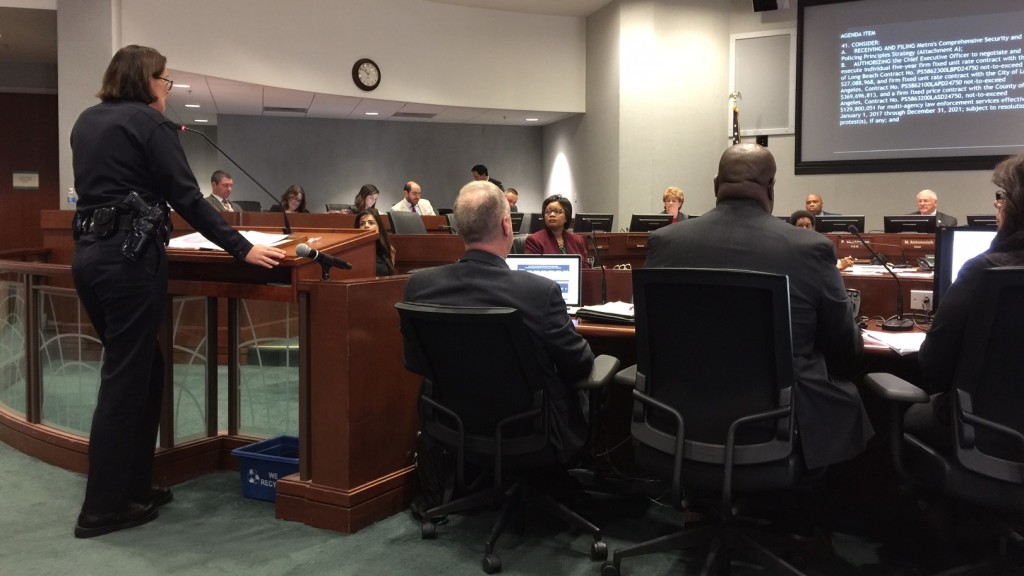

This Thursday, Metro’s Board of Directors will consider a new contract for policing the agency’s transit systems.
Metro bus and rail policing is currently done by the L.A. County Sheriffs Department (LASD). The LASD transit policing has received criticism, especially in a 2014 audit that found numerous irregularities and shortfalls. The oft-extended LASD contract is set to expire at the end of next month.
Metro staff has recommended a five-year multi-agency policing proposal totaling $547 million. The multi-agency proposal would split policing between the city of Los Angeles Police Department, LASD, and the city of Long Beach Police Department:
- L.A. Police Department – $370 million – 68 percent
- L.A. County Sheriffs Department* – $150 million – 27 percent (*potentially involving other local agencies)
- Long Beach Police Department – $27 million – 5 percent
During last week’s operations committee, Metro CEO Phil Washington characterized the proposed multi-agency contracts as “more security for less dollars.” The $547 million proposal represents an $80 million cost savings over the LASD’s proposed $627 million sole-agency contract. The contract would begin January 1, 2017, but would include a 6-month transition while LAPD trains and ramps up.
One possibly troubling factor is that LAPD, at least initially, plans to fill Metro policing shifts using officers who are working overtime on their off days. This overtime approach is unlikely to be the best policing bargain, nor does it create a consistent workforce specialized to handle transit system issues.
The proposal was heard at two Metro board committees earlier this month. L.A. County Sheriff Jim McDonnell testified that a multi-agency contract would “create seams” where agencies might not communicate smoothly, and thereby allow potential incidents to fall between jurisdictions.
Contract proponents pointed out that these seams exist today throughout much of L.A. County, where a rider exits a bus or train and enters a city policed by local law enforcement. Cities and county law enforcement routinely collaborate as crimes pass through southern California jurisdictions today.
Boardmember and County Supervisor Sheila Kuehl pointed out McDonnell’s inconsistency. When serving as Chief of Long Beach PD, McDonnell had supported increased contracting with local police agencies.
Last week’s Metro board committees were somewhat split on the proposal, so it goes to the full board this week with no recommendation.
All things considered, it is not clear what the implications are for transit policing that best supports the Metro system. Boardmembers, press, and others have brought up surveys that show that many former Metro riders asserted that a perceived lack of security influenced their decision to stop riding Metro. Overall, however, the Metro system remains safe. Getting more bang for the buck can contribute to somewhat more effective transit by reducing pressure on Metro’s fiscal bottom line.
The policing problem that has received little attention in the current debate is a Metro’s commitment to community policing and impacts on people who currently ride the system. LASD dragged their heels on their contractual obligation to develop a community policing plan. Both LASD and LAPD have questionable records in working in communities of color. The current proposal does not emphasize a more community-minded approach.
One potential hopeful development is boardmember and County Supervisor Mark Ridley Thomas’ motion to plan to “decriminalize fare evasion amongst youth transit users.” That motion will also be decided at this week’s meeting. Many transit agencies around the world are moving to de-emphasize fare enforcement and improve speed. Success stories from San Francisco (all-door boarding), Oslo, and London show good results from a “focus on customers who want to pay instead of keeping out the people who don’t.” That strategy can potentially save money and increase the speed of the entire system.
Whether multiple agencies or a single agency polices the Metro system, it will be critical to do policing in a way that keeps the system safe, and to improve the ways that Metro contributes to the well-being of the communities it serves.
Streetsblog has migrated to a new comment system. New commenters can register directly in the comments section of any article. Returning commenters: your previous comments and display name have been preserved, but you'll need to reclaim your account by clicking "Forgot your password?" on the sign-in form, entering your email, and following the verification link to set a new password — this is required because passwords could not be carried over during the migration. For questions, contact tips@streetsblog.org.