Skip to content

Posts from the "Road Diet" Category

13 Comments

Bikelash on Motor Avenue Bike Lanes? Palms Neighborhood Council, Koretz Will Get an Earful Tonight

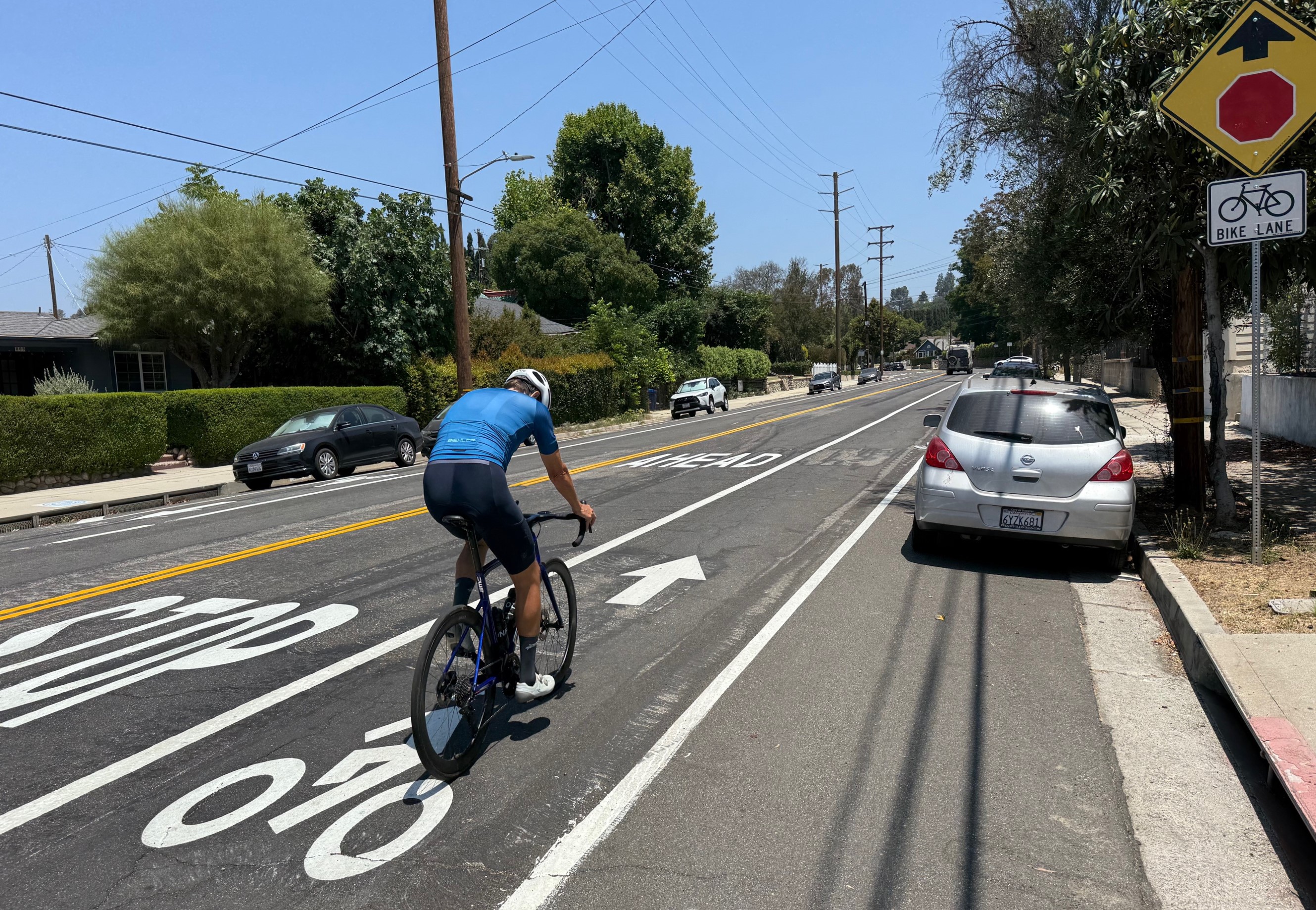
You're motoring...What's your price for flight? Photo: Jonathan Weiss

Amidst all the election news comes word that there is a small Bikelash brewing on the Westside from residents worried that the diet is creating spillover traffic jams on other local streets. The good news is that the proposed solutions seem to be about improving traffic calming measures on the streets parallel to Motor Avenue. The bad news is the complaints will be heard at tonight’s meeting of the Palms Neighborhood Council which will feature local City Council Member Paul Koretz. The agenda for tonight’s hearing is here.

Jonathan Weiss, a member of the city’s Bicycle Advisory Committee and regular commuter on Motor Avenue notes that it’s not the bike lanes that are causing spillover traffic.

I’ve never seen more cyclists than I do now, and, with theExpo train coming to Palms in about 2015, the community soon could be transformed into one of the bike-friendliest around.  Meanwhile, the morning traffic stacking up in Palms does so because the northbound traffic trying to make its way to Century City and Beverly Hills via Cheviot Hills is “metered” (choked off and redirected) at National Boulevard per the Century City Neighborhood Traffic Management Plan, a City Ordinance obtained by residential communities in response to Century City area commercial development.

The bike lanes are part of a road diet  a three quarter mile stretch of mixed residential and commercial development on Motor Ave. The diet was put in place with the support of  the LADOT, the Motor Avenue Improvement Association, and the Palms Neighborhood Council.  More Palms-area bike lanes are planned, including a connection to the pending Palms Expo Light Rail station, in accordance with the City of Los Angeles’ Bike Plan.

The Palms Neighborhood Council meets tonight at  7:00 p.m. at the IMAN Center, 3376 Motor Avenue. The community letter that hints at the Bikelash is after the break (with names redacted, these aren’t public figures.) If it’s looking as though Motor Avenue is going to turn into another Wilbur Avenue, we’ll let you know.

Read more…

10 Comments

Economic Review of York Boulevard Road Diet Shows Bike Lanes Don’t Cause Loss of Business

All images via York Boulevard: The Economics of a Road Diet. A poster presentation made at Pro Walk Pro Bike is available at Scribd.

A recent report by Cullen McCormick uses a road diet in Northeast Los Angeles as a case study to examine the economic impacts of reducing mixed-use travel lanes and increasing bicycle lanes. Despite the traditional opposition of local businesses when diets are proposed in front of their stores, McCormick’s case study finds there was little difference in the hyper local economies after a portion of York Boulevard underwent a road diet in 2006.

Click on the image to go to the full report.

McCormick chose a 2.2 mile stretch of York Boulevard between Eagle Rock Boulevard and Figueroa Street because of the on the ground conditions. “”The socio economics are the same between Eagle Rock Boulevard and Figueroa Street,” McCormick explains, “except part of it has a bike lane and road diet, and part of it doesn’t.”

In 2006, the City of Los Angeles put 1.1 miles of York Boulevard on a road diet. They narrowed the street from four mixed-use travel lanes to two mixed-use lanes, a turn lane, and two bicycle lanes between Eagle Rock Boulevard and Avenue 52, dividing in half the corridor McCormick would study in 2011 and 2012.

McCormick is aware of two competing ideologies when it comes to the issue of bikes, bike lanes and retail profit. On one hand, retailers around the world fear a change in the status quo and often fight against changes to the existing transportation infrastructure. On the other “bikes are good for business” has been a mantra for bike advocates, especially with the launch of the Bike Friendly Business District model in Long Beach that is catching on around the country.

“I wanted to come into it with as neutral a stance as possible,” McCormick explains.  ”I was curious to see what the data had to show.” Read more…

1 Comment

It’s Official. Main Street in Venice Is on a Diet.

The goal of the Road Diet, a street that works for all users. Off to a good start. All Pics by Joe Linton

The first time I biked down Main Street in Santa Monica and then into the Venice Neighborhood of Los Angeles was the summer of 2008.  I was following Santa Monica Critical Mass and part of the comically over-aggressive antics of the SMPD included herding cyclists into the lane by buzzing groups of cyclists on motorcycles and cruisers until we passed into Los Angeles.  When we crossed the border two things vanished, the police presence and the bike lane.

Fast-forward three and a half years and the situation has changed.  While Santa Monica has sporadic Critical Mass rides, they don’t draw near the number of riders or police presence their predecessors dud.  And as of Friday night, the transition from Santa Monica to Los Angeles on Main Street is seamless for bicyclists.

At long last, the Main Street Road Diet is in place.  The former five lane configuration has been re-striped to have three through travel lanes, including a turn lane, two bicycle lanes and two lanes of car parking.  The road diet connects Windward Circle at the south end to the Santa Monica border, just North of Rose Avenue.  The diet is .8 miles long.

There are many reasons to consider “putting a road on a diet” by reducing the capacity for cars and increasing capacity for everyone else.  Usually, diets are completed on streets with lower traffic volumes and higher than average bicycle and pedestrian use.  By giving more space to bicyclists, diets don’t just benefit cyclists but also pedestrians who benefit from a better walking environment and car drivers who get to drive in a safer environment.

After other road diets drew opposition from neighborhood groups and ABC 7, LADOT met twice with the Venice Neighborhood Council.   The feedback they received was requests that the Diet either give more space to cyclists or abandon the diet for a series of traffic calming and Sharrows.  In response, LADOT increased the width of the bike lanes by six inches so that the bike lane and adjacent parking weren’t both the minimum widths.  The “compromise” plan didn’t leave critics happy, but at least made the project better than “minimum width for bikes, maximum space for cars.”

Joe Linton reviewed the lanes over the weekend for the Eco-Village Blog.  Some more of his pictures are available after the jump. Read more…

4 Comments

Venice Neighborhood Council Approves LADOT Plan for Main Street Road Diet, Bike Lanes

Some Neighborhood Council Members wanted separated bike lanes, similar to the ones pictured here, for Main Street in Venice. LADOT wouldn't commit to that design, and the NC gave a conditional go ahead to go forward with standard bike lanes.

Last night, the Venice Neighborhood Council agreed  to the Main Street Road Diet/Bike Lanes plan proposed by LADOT.  The new road striping ought to be on the ground “in the next couple of weeks.”  Despite its approval, the Neighborhood Council had some concerns with the project and wanted LADOT to return with more safety measures to protect cyclists and calm traffic.  The Road Diet will run on Main Street from Navy St. to Windward Circle, and will extend the Santa Monica bike lanes and road diet into Venice.

There was a minor change from the original plan.  Currently, Main Street has four eleven foot through travel lanes with seven feet on each side of the street for car parking.  The original road diet changed the configuration to two eleven foot travel lanes, one eleven foot turn lane, two 5 foot bike lanes and two seven foot car parking areas.  Some cyclists, notably Alex Thompson at Bikeside, complained the new configuration had cyclists planted squarely in the door zone, especially since many vehicles in today’s world are larger than seven feet wide.

LADOT  responded that eleven feet was the minimum for the car travel lanes because Main Street is a regularly traveled route for both the Santa Monica Big Blue Bus and Metro buses.  However, the new design does take a foot out of the turning lane to make the bike lanes five and a half feet larger.  This 10% increase will give cyclists more room to maneuver when car doors are (illegally) opened in their path, but doesn’t completely solve the problem of door zone bicycle lanes.

As we saw back in January, the debate over the plan was because members of the Neighborhood Council wanted a more progressive plan for Main Street than LADOT was willing to provide.  Questions about extending the lanes all the way south to the Venice Street Bike Lane or separating the lanes as they did on 3rd Street and Broadway in Long Beach and in Portland were dismissed.  The Main Street Road Diet is designed to link up with the three lane with bike lanes configuration of the road north on Main Street. Read more…

16 Comments

Venice Neighborhood Council Will Discuss Main Street Road Diet/Bike Lanes Tomorrow

The LACBC prepared this graphic to show the road configuration and potential changes.

Tomorrow night, the Venice Neighborhood Council will debate, and possibly approve or reject a proposal by the Los Angeles Department of Transportation to remove travel lanes on Main Street in Venice in an effort to calm traffic and create space for bike lanes.

The LADOT’s plan for the area would basically match the layout of Main Street in Santa Monica which already is a three-lane road with bike lanes and street parking.  However, if you’re riding south on Main Street in Santa Monica, the road loses its bike lane at the border with Los Angeles.  If LADOT gets their way, and they won’t without the support of the Venice Neighborhood Council, Main Street in Los Angeles would go from four lanes to two with a turning lane in the middle.  Car parking would remain, and a pair of 5 foot bike lanes would appear on the street.

Colin Bogart has been working on the Main Street Road Diet project for the LACBC now that he’s not full-time in Glendale believes the Road Diet is a natural extension of the road configuration already on the ground North of Venice in Santa Monica.

“Main Street is great for cyclists and pedestrians in Santa Monica. We see extending the same road configuration to Windward Circle as continuing an already successful complete street that encourages healthy, active lifestyles and is simultaneously good for business and safer for everyone.”

Not that the plan doesn’t have critics.  When the diet was first discussed, some members of the Neighborhood Council expressed concern that the new configuration would create more car congestion on local streets while others worried that the street would actually be less safe for cyclists.

The proposed bike lanes run adjacent to the car parking with little to no buffer between the cars and the bikes.  The bike lanes are only 5 feet wide and some cyclists, notably Bikeside President Alex Thomspon, worry that the “door zone bike lanes” create a hazard for cyclists. Read more…

12 Comments

Eyes on the Street: Oh, Wilbur…

All pictures by Glenn Bailey

Traveling Southbound on Wilbur

Have you ever tried to brake on pine needles?

If the newly-restriped .3 mile area of Wilbur Avenue was supposed to be a compromise between the LADOT, City Council Office, advocates of fast moving car traffic, bicyclists and residents, it appears the LADOT put the politics of the situation over the road diet ahead of responsible engineering.

Glenn Bailey, a mayoral appointee to the city’s bike advisory committee, snaps these three pictures of the restriped area, each of which presents its own problems.

The first picture is clearly the oddest.  Bailey snapped this picture of a “cars in the right hand lane must turn right,” which makes little sense as the “right hand lane” is supposed to be a bike lane.  If cyclists are proceeding south and motor vehicles are required to turn right from their lane across the path of cyclists, this is inherently dangerous and a potential liability for the City.

The second picture places the bike lane on the other side of the right-hand turn lane, which is inconsistent with the first photo.  To make matters worse, there is no signage designating the turn lane at the next intersection.

Last, we’ve already noted that the new bike lanes have been moved to the gutter, are covered in slippery pine needles, and that nobody is taking responsibility for keeping the lanes clean andsafe.  That situation remains unchanged.  To make matters worse, the “Mayall Merge” that Don Ward refers to in his videos is a high-speed merge.  When you combine high speed cars and bikes that lose control on the pine needles, what was once a “road diet” becomes a death trap waiting to happen.

7 Comments

Chalk on the Ground, Bike Lanes in the Gutter, Faster Cars: A Wilbur Ave. Update

When we last checked in on the embattled Wilbur Avenue Road Diet, Councilman Greig Smith had ordered asked the LADOT to move forward with a “compromise” proposal that would maintain continuous bike lanes along the 2.3 mile diet but would return the northern .3 miles of the old diet to a four lane road. The merge will occur just south of the lighted intersection at Devonshire where four lanes will go to three and the reduced diet will begin

Defying most standards, part of the Wilbur Avenue Bike Lanes have been pushed in to the gutter. Photo: Don Ward

At the time, we only had an engineering sketch of what the new configuration would look like. Today, the “undieted” area of Wilbur Avenue has been chalked for four lanes, with more permanent paint going on the ground any day now, and we can say with certainty this is one ugly piece of road.

The most obvious issue is with the bike lanes.  Not only is half of the new bike lane situated in the gutter, in conflict with federal safety guidelines for lane design, but much of that gutter is routinely covered in pine needles which could force some cyclists out of the lane and into traffic.  Because of the presence of the lane, cars wouldn’t expect cyclists to merge into “their” lane and conflicts could occur.

The second issue is one that is more apparent to residents of Wilbur Avenue than to visitors or even commuters.  Don Ward, a resident of Wilbur Avenue and author of the website Safe Streets Northridge, explains.

…the proposed solution to the back up problem at Devonshire is to create a 2 lane merge immediately south of Devonshire to shift the peak traffic backup. However, anyone and everyone who has looked at this plan can see the induced drag race scenario that will play out with every green light at Devonshire south as traffic crazed parents and commuters will suddenly find themselves having to compete for position right up to the Mayall intersection. Some drivers will be slowing to make a right turn while other drivers will just be settling into their merged position, while still others focused on their left side mirrors and traffic behind them will have less attention to pay to what’s in front of them.

More recently, Ward has posted a YouTube video showing how speeding cars are changing Wilbur for the worst as a result of the new merge.

Read more…

4 Comments

Wilbur Road Diet Debate Reaches Its Conclusion, Again

The heated debate over the Wilbur Road diet is back in the news as Councilman Greig Smith has asked the LADOT to move forward with a compromise proposal that it presented to a joint meeting of the Northridge West and Porter Ranch Neighborhood Councils last month.  The Council’s had sent representatives to a “Wilbur Working Group” who helped LADOT devise the compromise, however neither the communities that wanted Wilbur returned to its faster design of yesteryear nor the community that applauded the calmed traffic was happy with the compromise.

From C to B the diet will remain. From B to A it's going away.

Thus, at the joint meeting, the two Neighborhood Councils “rejected” the compromise by a vote of nine in favor, three opposed, and seven abstentions.  For purposes of this debate, the “abstentions” were counted as “no” votes.  However, the Neighborhood Council’s role was advisory to Smith’s office’s role, which is advisory to the LADOT’s plans for the road.

Some backstory.  Last August, the LADOT re-striped Wilbur Avenue for 2.3 miles between Nordhoff Street and Chatsworth Street and put the street on a road diet in response to safety concerns.  The four lane road was shrunk to a road with two travel lanes, a left hand turn lane and two bicycle lanes.  The diet became a battleground pitting the drivers who use the street against the people that live on the street with the city’s bicycle community playing a secondary role.  The faceoff culminated at a contentious and raucous community meeting that ended with the vote to reject a compromise proposal crafted by LADOT and the Wilbur Working Group.

The compromise plan will return half of the road diet to a four lane street, with the bike lanes remaining.  The original diet stretched for 2.8 miles, and under the compromise plan 1.3 miles of the plan from Chatsworth Street to just South of Devonshire Street.  There will be no changes to the current street configuration from Devonshire Street to Nordhoff Street. Read more…

36 Comments

Against All Odds, the Wilbur Road Diet Is Staying (for Now)

For eight months now, the LADOT has been taking shots in the Valley over the a two mile road diet on Wilbur Avenue.  Between Nordhoff and Chatsworth, Wilbur went from two lanes in both directions to one lane in each direction, a left turn lane, and bike lanes on both sides.  Last night, representatives of the Northridge and Porter Ranch Neighborhood Councils, in an official and deciding vote, voted to leave the current road configuration as it was instead of repainting the road to a compromise plan created by the LADOT and a Wilbur Working Group.  There’s a lot of potential headlines from this meeting, so I’ll do my best to give each of them their due.

A packed house. Many of the estimated 450 people in attendence were of the "give us back our road" or "we pay taxes, bicyclists don't" variety. Photo:LA Streetsblog/Flickr

Roughly 450 people packed in to the auditorium at Noble Middle School.  A guess as to the allegiance of the audience would be a 65/35 split in favor of ending the entire diet at the peak of the meeting.  When the audience shrunk by the end to about a third of the original audience, it was probably a 65/35 split the other way.  While emotions ran high throughout the evening, a hand tally on my computer showed that speakers in favor of the Diet were four times as likely to be interrupted by booing, catcalls, and shouting than those opposed.  Let’s be clear, the majority of the audience was well behaved, whether they agreed or disagreed with the diet.  However, the hottest of the hotheads seemed to be on one side of the debate.

There was also a clear geographical divide in the audience.  Most of those in attendance lived in the Porter Ranch Neighborhood, located North of the diet, with a minority from the area effected by the diet.  At one point a commented asked for a show of hands for who lived South of Chatsworth, where the Road Diet started.  I would estimate 15-20% of the audience, and two or three Neighborhood Council Members raised their hands.  To their credit, the Porter Ranch Neighborhood Council worked hard to pump up attendance with multiple-emails on the meeting going out daily and robo-calls reaching those without email addresses on file.

You can read about the LADOT’s compromise plan here or see a rendering of it here.  Basically, the compromise plan would have restored the four lane configuration north of Devonshire and have the diet return 650 feet south of the Devoshire/Wilbur intersection.

Headline #1 Strange Public Process Leads to Strange Result

While it’s certainly true that the joint Council meeting voted to preserve the diet instead of the LADOT’s plan, it’s equally true that given a chance to vote straight up or down on preserving the diet or to go back to its original unsafe and speedy four lane configuration, they would have chosen speed over safety in a heartbeat.  As Tom Johnson, president of the Northridge Neighborhood Council stated before the public comment period, “We have a major consensus that the road should go back to four lanes.” Read more…

24 Comments

Economics Professor Takes Aim at Bike Lanes at City Watch

In last Friday’s City Watch, Cato Institute Adjunct Scholar and economics professor at Cal State University Northridge Dr. Shirley V. Svorny penned, People Who Want More Bike Lanes Need a Reality Check, an attack on on another City Watch piece, What a Difference a Few Years Makes, by Stephen Box.  Box’s piece celebrated the passing of the city’s bike plan.  Svorny’s piece is a rather uninspired attack on bicycle planning.

Dr. Shirley Svorny

Svorny seems to have “moving people” confused with “moving cars” as she repeatedly talks about the purpose of roads “moving people” yet slams the city’s efforts to provide people options on how to move themselves from A to B.  After the jump, we’ll look at Svorny’s article and respond.  The purpose of this article isn’t to single out Svorny or City Watch, but to help everyone get prepared because as more and more bike lanes and other bike infrastructure are placed on streets, these same arguments will pop up over and over.

CityWatch columnist Stephen Box cheers the new Los Angeles Bike Plan. (Link)   I’m glad someone is happy about calming our road to make bike paths because I don’t see it that way at all.  The economist in me sees roads taken out of use, a huge loss of a capital investment (the city has fewer lanes for cars). “Traffic calming” and “road diet” are terms used by people who want fewer cars on the road. They seem unable to face the reality that their efforts will only increase congestion and pollution (as cars get backed up).

It’s ironic that Svorny uses her background as an economist to try and make her point that “roads taken out of use” as “a huge loss in capital investment.”  Did you know that if you google the term “economic argument for bike lanes” the first thing that comes up is an article from the Economist, published earlier last week, that demolishes bolsters the idea that having public roadways designated exclusively for car use is a colossally bad idea.  From the Economist. Read more…