Skip to content

Posts from the "Car Culture" Category

No Comments

Times Victory: Trio of Bills Take Aim at “Buy Here Pay Here” Car Dealerships

A trio of state legislators have introduced legislation aimed at “Buy Here Pay Here” dealerships in California.  These dealerships, where used cars are sold at a marked up price with loans that have abnormally high interest rates, are often used by people of lesser means as a last resort to get a car.   These dealerships not only sell cars, but provide their own financing, creating two ways to benefit from the overpriced sale of a used car.

My favorite "Buy Here Pay Here" promotional picture.

Last year, Ken Bensinger at the Los Angeles Times wrote a three part series exposing some of the business practices of these dealerships that create extra hardship for disadvantaged car buyers.  This year, he has continued to follow-up on the issue as these bills were introduced and begin to move in the legislature.  Here is a brief explanation of each piece of legislation:

A.B. 1447, Introduced by Assemblyman Mike Feuer (D-LA)

A.B. 1447 would actually change three parts of the business strategies of Buy Here Pay Here dealerships.  First, dealers would be required to post the selling cost of the vehicle on the body of the vehicle.  This would prevent dealers from setting prices at the negotiating table based on their estimate of what the seller could afford.  The legislation also prohibits Buy Here Pay Here dealers from hasassing references for the buyer after the sale, requiring cash payments in person from drivers and disabling and tracking cars with GPS systems of payments are late. Read more…

7 Comments

Metropolis II and the Enduring Delusions of Car-Centric Cities

Metropolis II, a kinetic sculpture of a futuristic city by artist Chris Burden that will soon start operating for view by the public, raises some interesting questions about the role of cars in cities.

I saw the sculpture, with its elevated roads wrapping around skyscrapers and other structure, sitting still when I visited the museum over the winter break. It might be worth checking it out in action to see 1100 toy cars and 14 train sets whiz and wind their way through the buildings. Metropolis II is a cool contraption and interesting piece of art, like a matchbox car track, erector set, and lego city mashed together and pumped up to gigantic size.

Ordinarily I wouldn’t want to burden such a nifty assemblage with political or planning baggage. But the sculpture’s prominent position in a major museum is drawing lots of attention to the work and the possible future it represents.  The artist’s comments about Metropolis II place it in line with some earlier visions of a vertical, car-dominated Los Angeles that had real influence on the shape of the city today. And I think what Peter Plagens wrote about art critics engaging in urbanism when he reviewed Raynar Banham’s influential book Los Angeles: the architecture of four ecologies, still applies:

” if he wanted to run out and paint pictures of the Roller derby or the Stones it’d be O.K. because it’d be innocuous …  But when you get into architecture it’s big casino, real people’s real lives … and here we go with another strangling round of MacDonald’s, freeways, and confectioners’ culture palaces.” Read more…

Streetsblog DC 17 Comments

Getting Young People Back Into Cars Is Auto Industry Job #1

Maybe Kia could have been just a little less transparent about marketing cars to kids than this Super Bowl ad from last year. Photo: AutoEvolution

While the choked parking lots at many suburban high schools might mislead you, young people today are less interested in driving and owning cars than their counterparts in previous generations. This is happy news for environmentalists and complete streets advocates, who see fewer vehicles on the road as key to a healthier, wealthier society. For the global auto industry, though, it is an existential threat not to be ignored.

Generation Y’s reluctance to embrace car culture may be temporary, reflecting merely the tough economic times, especially for those burdened with college debt. But studies show teens now maintain connectivity through the internet, not though cars, and teen driving rates have been in steady decline since the late seventies. So young people’s lack of interest in driving may presage a more fundamental shift in how we connect with other people, where we choose to live and work, and how we construct our identities. Either way, the auto industry isn’t taking any chances. Here are just a few tactics car makers are employing to take back the future.

Ratcheting up marketing to kids. Marketing cars directly to children pays off big for car companies even though they won’t be driving or buying their own for years. American children in particular hold real sway over family purchases: more than half of parents surveyed by JD Power said their children had meaningful input in choosing the family vehicle.

Read more…

1 Comment

Carlos Morales: Cut Out Buy Here Pay Here Dealerships with Community Car Share

(This is part two of our series on reader’s response to last week’s series on Buy Here Pay Here used car dealerships.  Earlier, Streetsblog published the comments  of Joe Linton, Roadblick, Adrian Martinez, Damien Goodmon and Allison Mannos.  Yesterday, Streetsblog published a more detailed response from Occidental College Professor Mark Vallianatos.  Today, we feature a piece by Community Voice Newspaper Editor and Eastside Bike Club President Carlos Morales.  Stick with this story until the end, it’s worth it. – DN)

My take on proving a solution to this problem would be to create a communal car pool system.

Large corporations are the only companies that I am aware of that have formed and utilize carpools to gain tax credits for both the employee and employers.  Employees use this incentive to save on their gas expenses and parking fees while employers utilize it gain another tax shelter.

If families or community participants can pull their money together set up a “Cundina” or “Tanda” which is interest free way of saving money (it is their own money.)  This systematic lottery is very common in Mexico and seems to have started in Puebla Mexico in the late 1800′s modeled after Chinese workers came to Mexico with the “Hui” a communal rotating credit association.  This practice has crossed and spread over to other communities across this country.

Here is how the cundina works:  A group of trusted friends / family members / neighbors get together decide on a leader, which will be in charge of the collection and distribution of money.  The group decides on the amount of money to be collected and how often the pot is awarded (each week, month or other pre-arranged time frame.)

It starts by each participant pulling a number which is written on a piece of paper that has been placed from a bowl, a hat or a box.  The amount of numbers are determined by the amount of participants, if there are ten participants for example the numbers will range from one thru ten.  The person who pulls number one gets the first distribution of funds, then number two the next time and so on. Read more…

1 Comment

Update: Villaraigosa/Garcetti/Englander Plan Would NOT Apply to Used Car Dealers

I just received an update from the Mayor’s Office on the proposal to eliminate business taxes for car dealerships.

The motion submitted by Councilmen Eric Garcetti and Mitch Englander for city staff to draft a motion that would exempt car dealerships from city business taxes applies only to new car dealerships, so our concerns about providing incentives for “Buy Here Pay Here” car dealerships to move to the city are alleviated.  Streetsblog still has some concerns with the proposal, but it’s good to know that one unintended consequence that we raised yesterday is off the table.

No Comments

Vallianatos: Policy Shifts Towards Walkable Communities Anathema to “Buy Here Pay Here”

(This is part two of our series on reader’s response to last week’s series on Buy Here Pay Here used car dealerships.  Yesterday we summarized the statements of Joe Linton, Roadblick, Adrian Martinez, Damien Goodmon and Allison Mannos.  Today we bring a more detailed response from Occidental College Professor Mark Vallianatos.  Tomorrow, we’ll have a response from Voice Newspaper Editor Carlos Morales. – DN)

To reduce the inequity of low-income people being trapped by usurious loans because that’s the only way they can get a car, we need to prioritize improving the places we live in so no one needs to own a car to survive. While places are changing, we should also be improving public transportation and opportunities to walk and bike. Making our lives less auto-dominated will take time, so in the short term we can provide ways to share rides so less people are chained to buying and paying for a car.

There are already places with enough of a mix of homes and businesses and ways to get around that a resident doesn’t need to own a car. Since these places already exist, we should prioritize allowing more people, especially lower income people, to live there. So we need more housing and more affordable housing near job centers and in walkable neighborhoods.

Much of the development that happened in the past 70 years was designed around automobiles. We need to densify and ‘repair’ suburbs in urban areas and revitalize towns in rural areas to transform more places into walkable areas.

From a policy perspective this means: Read more…

Streetsblog DC 14 Comments

The Hypocrisy of Chrysler’s “Imported from Detroit” Campaign

I’ll admit it: I love the Chrysler ad campaign “Imported from Detroit,” which debuted in February’s Super Bowl spot starring Eminem.

What can I say? I’m a sucker for hometown pride. I was born about 60 miles downriver from the Motor City in Toledo, Ohio, a town sometimes known affectionately as “Little Detroit.” I remember when it was considered treasonous to drive a foreign car.

That’s the brilliance of these ads. They appeal to our inner urge to root for the underdog, our nostalgia for simpler days. Those flashes of a grand-looking Woodward Avenue. The water tower that proudly shouts “Birmingham, Michigan.”

It’s also very telling, the commodification of Detroit. It says something about Americans’ new-found fascination with cities — the same fascination that has inspired many young entrepreneurs who are working to reinvent Detroit.

But Chrysler is selective about the Detroit it celebrates. Absent is the ruin that now accounts for a large share of the city. Invisible is the crushing poverty, constantly present in the urban landscape. The driver in the most recent installment, traveling out from the center of Detroit to its suburbs, is in control of his fate (thanks to his snappy ride) in a way few in the region really are.

Despite the defiant sentimentality of its ads, Chrysler, as well, is selective about its commitment to the city of Detroit.

Read more…

9 Comments

Mayor, Garcetti, and Englander Call for Exempting Auto Dealers from City’s Business Tax

Villaraigosa at the L.A. Auto Show in 2010. It's ok, we know you're only smiling because you're daydreaming about the CicLAvia you had ridden in the month before. Photo:Photo by Kevork Djansezian/Getty Images North America via zimbio

Picture this.  One day one of the most important political figures in the city stands in front of a major Downtown attraction and announces that train service to this attraction will be increased dramatically in the coming weeks.  The next day, a major political figure, flanked by an up-and-coming political star and the City Council President, stands with the head of the local automotive dealer lobbying group and announces a political proposal to end business taxes for car dealerships.

In most parts of the world, that would be a sign of a hot political campaign with two candidates offering competing visions for a city’s transportation  future.  In Los Angeles, it’s just two days in the life of Mayor Antonio Villaraigosa.  While car dealerships are praising the Mayor’s proposal, supporters of green transportation options are puzzled by today’s announcement.

“This city can’t take too many more of Mayor Villaraigosa’s ‘business friendly’ policies,” writes Alex Thompson, President of Bikeside. “The guy extends Metro hours one minute, and decides he wants more car dealerships the next.”

Earlier today, Villaraigosa, Council President Eric Garcetti and Councilman Mitch Englander stood toe-to-toe with the car dealership lobby and announced a plan to end local business taxes for car dealerships operating in the City of Los Angeles.  The plan makes sense from a short-term economic point of view.  Auto dealers produce substantially more sales tax than business tax. In 2010, auto dealers accounted for only $3.6 million in business tax revenue but $29 million in sales tax revenue.

But the three pols see a potential sales tax boom if they can convince the car dealerships that have fled the city for Glendale, Pasadena, and Beverly Hills to come back.  Since 1986, the City of Los Angeles has lost 95 auto dealers. If those 95 dealers were still operating within the City limits, Los Angeles would have an additional $57 million per year in sales tax revenue.  In addition to the new tax proposal, Villaraigosa also announced that Beverly Hills Porsche is moving from Beverly Hills to Los Angeles.  The Mayor’s Office of Economic and Business Policy helped to persuade Beverly Hills Porsche to come to Los Angeles by pulling department directors together and speeding the permitting process.

“For too long, LA’s business tax has driven auto dealers outside the City limits,” said Villaraigosa.  ”It’s time to reform the way we tax auto dealers so that we can bring more jobs and more sales tax to our City.” Read more…

6 Comments

Streetsbloggers Respond to the Times’ Buy Here Pay Here Series

First, let’s state for the record that Ken Bensinger and the Los Angeles Times did a public service by shining a harsh light on the largely unregulated “Buy Here Pay Here” used car dealership industry.  Too many dealers in this industry and preying on poor people desperate for a car by intentionally driving up their debt so that in the end the “dealership” ends up with the shoppers money and gets a chance to sell the car all over again.

Because taking advantage of people of lesser means is patriotic.

In the third part of the three part series, Bensinger and the Times recommend finding ways to make car ownership more affordable for people of lesser means.  Not wanting to dismiss this solution without a better one of my own, I asked a group of people who regularly appear on Streetsblog as authors or as sources in our stories for their thoughts and solutions.

The narrative is what you would expect, that subsidizing car ownership (or further subsidizing car ownership) is not the answer that’s going to make vampire industries that prey on the poor’s transportation needs go away.  We had a burst of good answers, many of which are outlined below.  Full articles by Occidental College Professor Mark Vallianatos and Eastside Bike Club Founder Carlos Morales will be published tomorrow and Thursday.  Some of the other answers are summarized below, and full text of these answers can be found here.

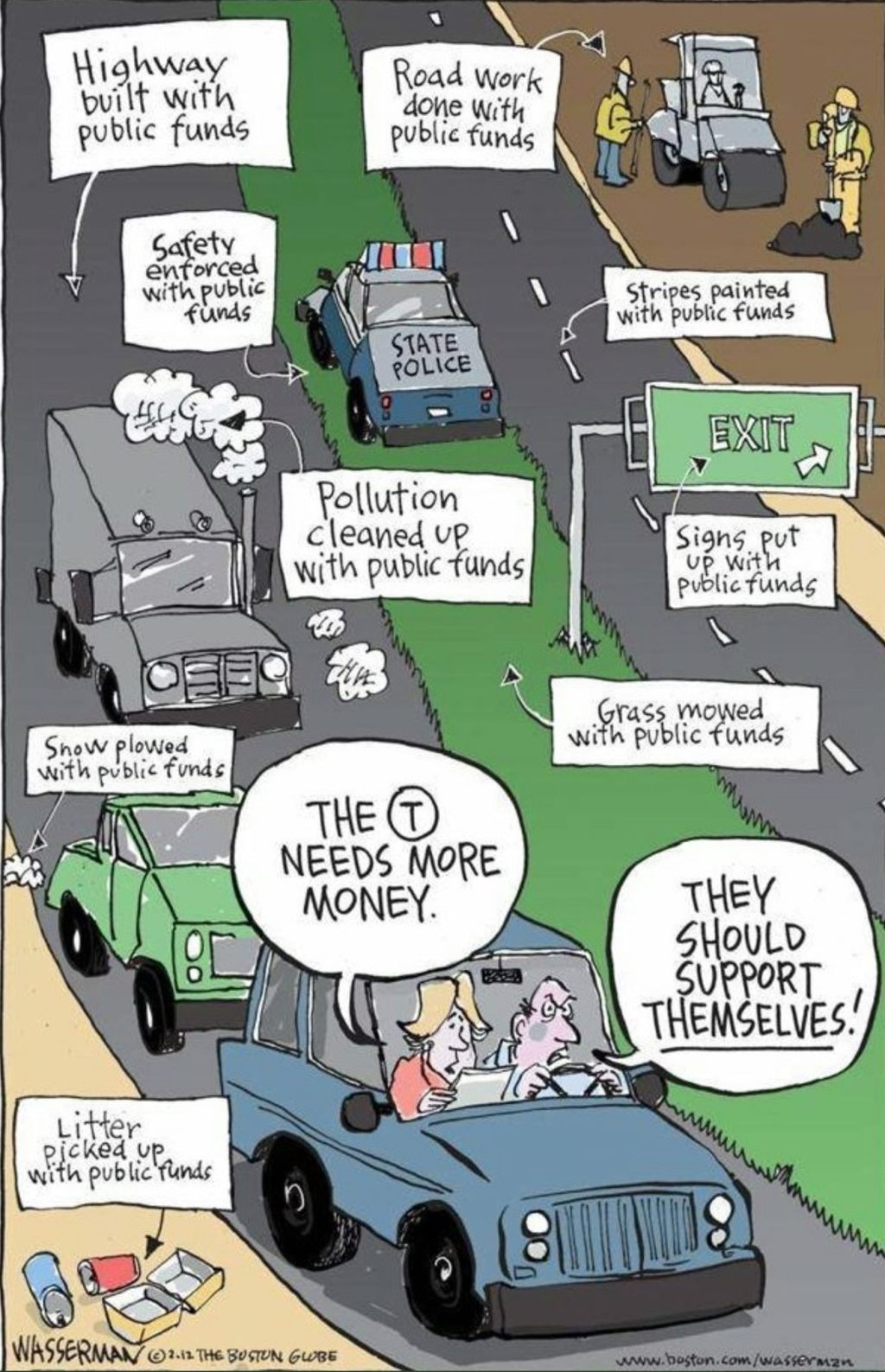
Joe Linton, Streetsblog Board Chair and CicLAvia consultant: Many public subsidies to reduce the cost of owning a car are already in place: from free parking to subsidized gas to huge public investments in expensive car-centered infrastructure (and those are more direct subsidies – there are externalities like environmental and health care costs that are caused by and not paid for by the driving public.) No Los Angeles driver today ever pays the real cost of their driving. They’re already getting a bargain.

I think that if we’re looking to subsidize transportation in ways that are good for low-income people, it’s better for the public to invest in a balanced system that gives people choices.Subsidizing transit, walking, and bicycling will yield mobility that’s affordable for all and accessible to all. If low-income people have many viable choices, then they are less at the mercy of loan-shark car dealerships. Read more…

12 Comments

“Buy Here Pay Here” Series Conclusion: We Need to Subsidize Cars for the Poor

The Los Angeles Times wraps its three part series on the “Buy Here Pay Here” used car dealers — those that often times con low income people into high interest loans for low quality cars — with a plea for policy to make cars cheaper.

My favorite "Buy Here Pay Here" promotional picture.

For more than a century, efforts to help the disadvantaged have focused on education, healthcare, nutrition and housing. Almost nothing has been done to help the working poor afford cars, despite research that indicates it would help alleviate poverty.

About 1 in 4 needy U.S. families do not have a car, according to the Annie E. Casey Foundation. That’s a serious handicap for the millions of Americans who don’t have access to robust mass transit.

Oh, so close to getting to a sustainable solution, so close. Read more…