Skip to content

Posts from the "Bicycle Boulevards" Category

3 Comments

Announcing: The Spring Street Green Buffered Bike Lane Photo Contest

Following the surprisingly strong response to yesterday’s sarcastic short on the Spring Street Green Buffered Bike Lane, Streetsblog is proud to announce a new photo contest to our endangered bike lane project. For those that missed it, at the insistence of L.A. Film and other film industry groups the city seems poised to let the green paint on the Spring Street Buffered Bike Lane fade away. In response, Streetsblog published this helpful map to help confused film crews find places to film that don’t have green lanes.

Sadly, sarcasm isn’t enough to turn the tide of the debate. So today we’re proud to announce our own photo contest for the best pictures, captions included, of the green lane in action. The first two submissions are already in. Can you do better? Send a link to damien@streetsblog.org or just post a link in the comments section. We’re not going to reveal who took which pictures until after voting is completed. The winner gets a Streetsblog prize back, including t-shirts and other schwag.

The Spring Street Green Buffered Bike Lane stopping film crews from working in Los Angeles....errrrr....

I live on Spring and took this photo two weekends ago. As the green paint wears off, so does the respect for the bike lane itself--all it takes is one or two people to start driving on it in a traffic jam, and suddenly no more bike lane.

12 Comments

Colorado, Figueroa, Lankershim, Westwood…Checking in on the Bike Wars

As LADOT and City Planning continue outreach over proposals for bike lanes and road diets in the city’s bike plan, opposition has sprung up from entrenched community activists and business owners and at least one stoner. As LADOT wraps up this round of outreach, Streetsblog checks in on the status of the bicycle projects along three of Los Angeles’ iconic corridors: Lankershim, Colorado, and Westwood.

Colorado Boulevard

Despite some vocal backlash, especially at community meetings and in Patch’s comments section, it appears that the proposed bike lanes on Colorado Boulevard for three miles from Avenue 64 and Glendale City Limits will move forward. The Bike Plan proposes removing the third lane on Colorado Boulevard as well as on Eagle Rock Boulevard, and replacing them with buffered bike lanes, similar to the ones on Main Street in Downtown Los Angeles.

Last night, the Eagle Rock Neighborhood Council voiced its support for the bike lanes with a 12-1 vote (h/t Walk Eagle Rock on Twitter), and Councilman Jose Huizar is already on the record in support of the project.

That being said, there is another Neighborhood Council vote on the bike lane at the Highland Park Neighborhood Council meeting tomorrow. If the opposition to the lanes is going to gain some ground, it’s going to be at the Neighborhood Council level, no matter how many silly editorials run in the Boulevard Sentinel.

LADOT looks at the Lankershim bike lanes as one way to provide access to the NBC Universal lot. Image: LADOT Bike Blog

Lankershim Boulevard Read more…

28 Comments

Breaking News: City Releases DEIR for 5 Year Bike Plan Implementation/My Figueroa Project. Further Study Not Needed

39.5 miles of bicycle lanes on congested streets and the My Figueroa Project are headed towards environmental clearance following release of a DEIR and a new law signed by Governor Brown. Map via: The 2010 Bicycle Plan - First Year of the First Five-Year Implementation Strategy and the Figueroa Streetscape Project

When Governor Jerry Brown signed A.B. 2245 into law, a law allowing certain bicycle projects to opt-out of the CEQA process, the news was somewhat buried. On the same day, the Governor vetoed the “Give Me 3″ safety legislation that created a legal buffer between cyclists and passing automobiles earning the scorn of cyclists everywhere.

While the veto of Give Me 3 is still a sore subject, cyclists can take solace that the City of Los Angeles is taking advantage of A.B. 2245 to speed up bicycle, and even some pedestrian, projects in Los Angeles.

When the Department of City Planning unveiled the Draft Environmental Impact Report for the next five years of bicycle plan implementation and the My Figueroa! project, one small paragraph in Section II shows how the game has changed.

In September 2012, Governor Brown signed in to law Assembly Bill (AB) 2245, which allows re-striping of  urban roadways to proceed under a Statutory Exemption as long as a traffic and safety analysis is prepared  and hearings are held in affected areas…The city will not be certifying the EIR or preparing a Final EIR. Rather, Notices of Exemption will be filed pursuant to 1) California Public Resources Code (PRC) Section 21080.20.5 (c)(2) – for the bicycle lanes and 2) CEQA Guidelines, Article 19, Sections 15301, 15304, and 15311 for the streetscape improvements proposed as part of the My Figueroa Project.

In plain English, the city is opting out of the lengthy EIR process for the rest of the certification and using the public outreach, traffic and safety studies to meet the requirements of A.B. 2245. This will save the city money and months of planning and allow many projects to move forward on an accelerated timeline. At this point, neither LADOT or City Planning were able to release a timeline on when each of these projects or the sensational My Figueroa! project will move forward. Read more…

No Comments

LADOT Brings Bike Friendly Design to Yucca Street

Yucca Street, L.A.'s first "Bicycle Friendly Street."

“Bicycle Friendly Street.”

Yucca and Wilcox, facing north. For more images fro Yucca Street, visit LA Streetsblog/Flickr

The term first appeared in the City of Los Angeles’ Draft Bike Plan in 2009. Despite its nice sounding name, advocates groaned. Instead of the universally approved “Bicycle Boulevard,” LADOT, City Planning and their consultants had coined their own phrase. At the time, it was widely assumed that whenever the City tried to innovate, disappointment would soon follow.

Today in Hollywood, just north of Hollywood Boulevard, the LADOT has christened their first “Bicycle Friendly Street”. On Friday, I had a chance to ride on all .8 miles of the “Bicycle Friendly” Yucca Street. Back and forth, back and forth. I rode the length between Vine and Highlands four times, following the Sharrows.

I admit it. I liked it. And I wasn’t alone.

“Designing the Yucca project was a collaborative process with the city and local residents and it’s been a win-win for the community, explains Council Member Eric Garcetti. “It reduces cut-through traffic and creates a safer environment for bicyclists as well as pedestrians.

To earn the “Bicycle Friendly” designation, a street needs to undergo three treatments that make the street a friendlier place for cyclists to ride. The side effects of the new design and infrastructure are lower car speeds, fewer cars and a more pedestrian friendly environment. On Yucca, Sharrows direct cyclists across the .8 mile stretch with ease. Learning from past mistakes, the Sharrows direct cyclists away from turning lanes when necessary. Following a change in state guidelines, some of the Sharrows are even in travel lanes where there are no parked cars with the point four feet from the curb.

Stay out of the turn lane! This Sharrow approaching Cahuenga Boulevard directs cyclists into the through travel lane.

The Yucca Street bike signs have earned LADOT some positive press in social media after they were unveiled on the LADOT Bike Blog. Instead of the traditional “bike route” signs that even some members of LADOT Bikeways admitted were close to useless, these signs place the bicycle image next to the street name. It sends a clearer message that these streets are safe ones for bicycles more than the uniquitous and vague “Bike Route” signs that can be found nearly everywhere.

But the really exciting part is the third treatment.

The really exciting part. Cherokee and Yucca, facing west.

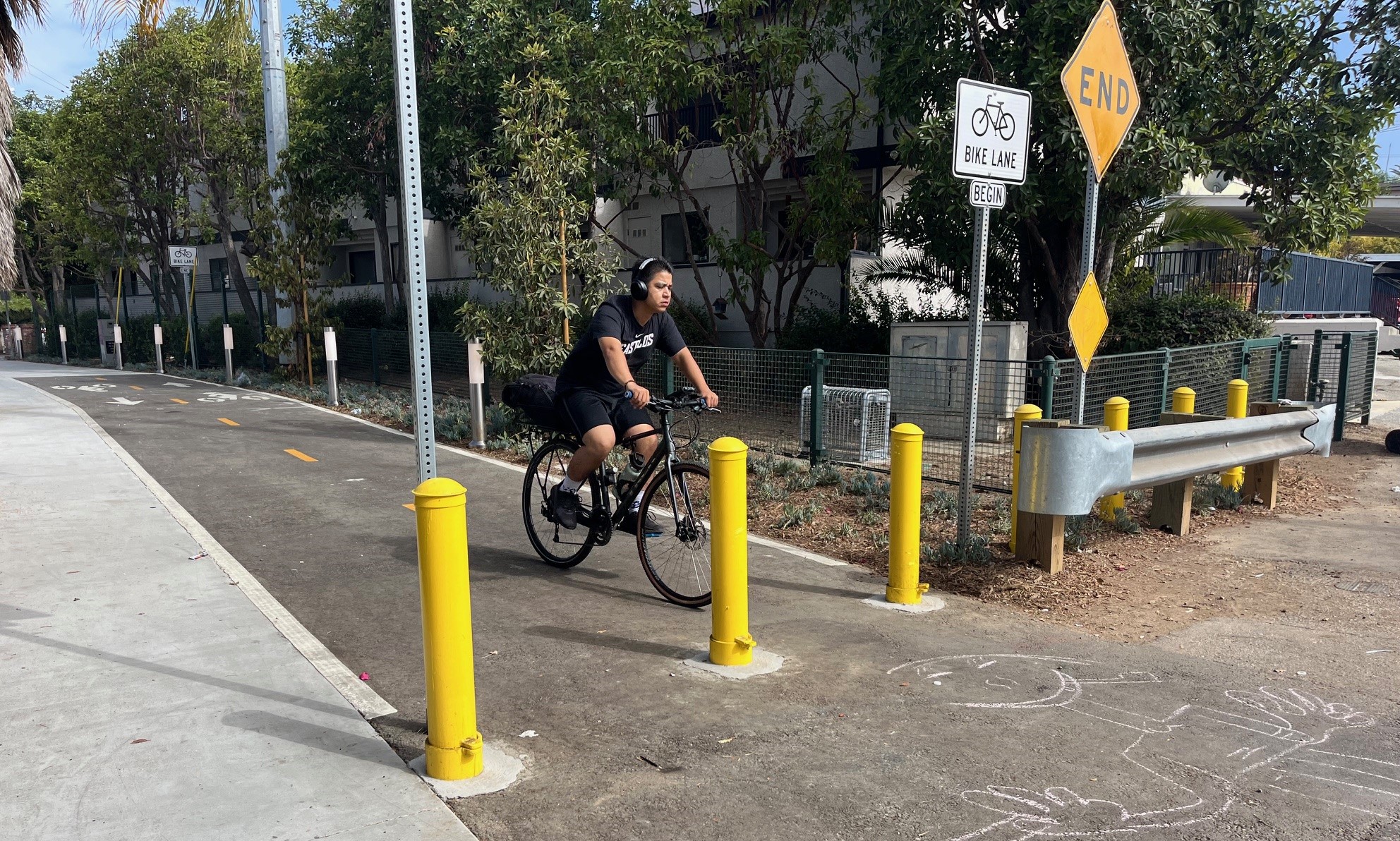
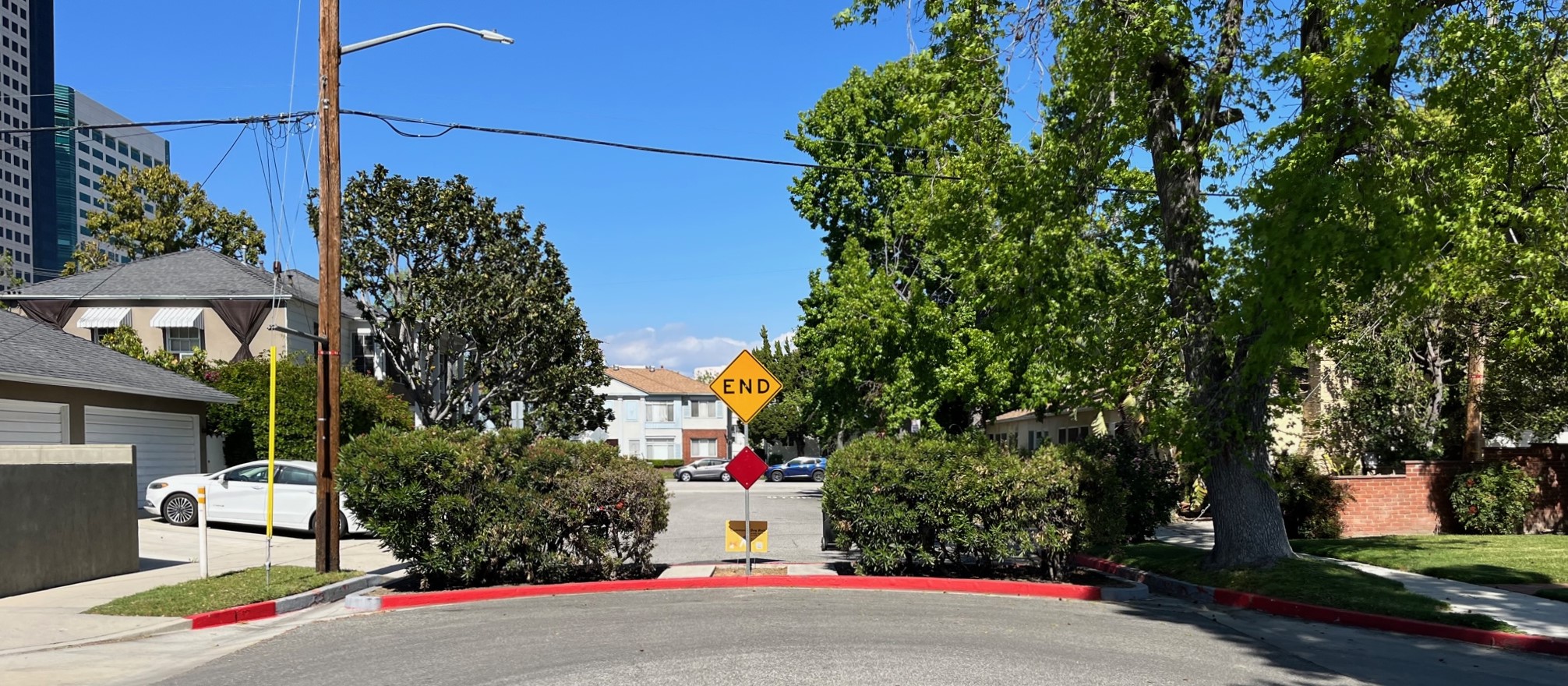
Last year we wrote about an effort by Council Members Garcetti and Tom LaBonge to restrict car access to Yucca Street. The residential portions of the street were being used every day by commuters tired of the congestion on Hollywood Boulevard. To that end, pedestrian islands and signs forbid left turns and through traffic onto Yucca making it nigh impossible for use as a cut through. As a result, cars accessing the streets are almost uniformly cars making local trips.

“The bollards were originally put in to mitigate some negative impacts in the neighborhood,” adds LaBonge. “This new route has turned a negative into a positive. This is another great addition to our bike infrastructure, though we have more work to do.”

I didn’t have my notebook or voice recorder with me, but I did stop to talk to some residents of the apartment buildings to ask about the changes to their street. To a person, they said there was less traffic at rush hour and the street was a better place to walk. The two cyclists I chatted with agreed, Yucca is one of L.A.’s best .8 miles of bikeways.

Of course, some communities have proven resistent to changes that make their streets more livable. While advocates point to the beautiful Vista Street Bike Boulevard in Long Beach, Yucca provides a case study closer to home. There’s three major differences between Yucca and Vista.

First, Vista Street is entirely residential in its Boulevard while Yucca stretches east through some shopping areas. Second, while Vista uses traffic circles to slow cars, Yucca outright stops certain turns and through traffic, making a cut-through not difficult and slow, but impossible. Last, Vista Street is a mostly upper-class area of Long Beach where most people are homeowners. Despite the Lowes mixed-use development at its easter end and its proximation to Hollywood, Yucca is mostly middle-income rental properties.

All in all, Yucca provides a great first start to the Bicycle Friendly Street Program. In some ways, this “Friendly” street is even superior to Long Beach’s boulevards. It will be interesting to see going forward if Yucca is an outlier of the program, or an example of what can and will be done.

12 Comments

The 4SBB, Homeowner’s Groups and How to Avoid a Bikelash

Councilman Tom LaBonge directs traffic at the 2008 Tour LaBonge "Positively 4th Street" Ride. Photo:Ingrid Peterson/Flickr

(The LACBC’s 4th Street Campaign has an open meeting tonight at the Halal Indian restaurant at 4th and Highland at 7:00 P.M. Just got word that the location has moved to Larchmont Bungalow, 107 Larchmont Blvd. Sorry for the last minute change.)

As a city that has for so long embraced car culture in its personality and planning, a change to pushing for bicycle and pedestrian projects is bound to create confusion and anger in some quarters and provoke a backlash from communities. After the battle on Wilbur Avenue in the Valley, where angry car drivers lobbied their City Councilman to remove a chunk of a road diet that proved popular with cyclists and the residents who lived on Wilbur itself.

LADOT expected to be on friendlier ground when pushing its concept for a Bicycle Friendly Street on 4th Street. Not only has the concept of a 4th Street Bike Boulevard has been a sort of holy grail for many cyclists, there are many more bike commuters on and near 4th Street than there are on or near Wilbur Avenue. The Los Angeles County Bicycle Coalition has a campaign centered around making 4th Street safe haven for cyclists and Neighborhood Councils along the route have backed the concept of a bike friendly 4th Street.

A safe and attractive route off major streets connecting Downtown to the Park La Brea development in Fairfax would be a game changer for thousands of cyclists who would use part of the route or would use it to connect to other locales north or south of the route.  4th Street has even been home to one of Councilman Tom LaBonge’s annual summer rides named “Positively 4th Street.”

But the movement to create a Bike Boulevard on 4th Street, or Bicycle Friendly Street as LADOT prefers to call them, hit a major snag last month. An organized homeowner’s group in well-to-do Hancock Park put together a survey with some pretty slanted misinformation and followed up with a petition that attracted over 200 signatures in an effort to beat off bicycle and pedestrian signal lights at two dangerous intersections, 4th and Highland and 4th and Rossmore. Their combined effort spooked Councilman LaBonge’s office who pulled their support for the proposed signal changes and LADOT has dropped the proposal.

The difficulty in explaining new infrastructure is perhaps best exemplified by an article on the controversy between LADOT and the homeowners in the Larchmont Chronicle.  Everything from the title to the text creates more confusion about what LADOT is proposing.  Crossing signals for bicyclists and pedestrians are not traffic lights and they’re certainly not stop signs.

Some proponents of the concept of a completed Bicycle Friendly Street claim the Hancock Park Homeowner’s Association is against the project because of some sort of Not-In-My-Back-Yard syndrome. Others have speculated that the group was spooked that LADOT had only one plan, instead of a variety of options, for the signals and that the residents were reacting to a “design and defend” approach to transportation planning. The Homeowners Association didn’t respond to requests to comment for this story so all we have is speculation. Read more…

6 Comments

Long Beach’s Leap Towards Livability Part III

For more information on Long Beach's bicycling efforts, visit Bike Long Beach.

(If you’re not familiar with the infrastructure innovations in Long Beach, you should read this article first.  In 2009, Joe Linton wrote a two part series on Long Beach’s “Leap Towards Livability.”  Today and tomorrow’s stories are both part of our Annenberg School of Journalism Public Health Fellowship and a continuation of that series.)

Sometimes, the politician in Charlie Gandy still comes out.  ”Hi, I’m the bike guy,” he introduced himself to other cyclists, pedestrians, people at cafes or whoever happened to be at hand while I was taking pictures or doing an interview during my visits to Long Beach this summer.

“The bike guy” was hired by the City of Long Beach’s transportation program manager Sumire Gant in early 2009, with funds from a Los Angeles County Public Health Grant known as the Policies for Livable and Active Communities and the Environment (PLACE) Grants that Long Beach won in 2008.  The grants were given to five cities to improve their planning documents to make the connection between promoting active transportation options and the health of the surrounding communities.

To give you an idea how much things are changing, this 2010 Bike Map is considered outdated 14 months after publication. Advocates keep track with their own map on Google.

Most of the grantees used their funds to create long and impressive planning documents.  While Long Beach has produced its own planning documents as part of the grant (more on that tomorrow), the major impact of the city’s grant is the addition of the “bike guy” who sells the city’s bike projects to residents, visitors, reporters and the state and federal officials who fund the projects with a steady demeanor and seeming ease.

“Long Beach is what happens when middle-aged athletes are put in charge,” Gandy joked when asked about the changes the city’s infrastructure was undergoing.

In 2009, the city needed all the athletic help it could get.  Census figures from 2005-2009 show that nearly one quarter of school age children (22.4%) in Long Beach were obese and the number of people commuting by bicycle (.9%), walking (2.7%) or by public transit (7.2%) were in line with the city’s sprawling neighbor to the north.

There are many reasons why using census data to look at transportation usage can be misleading, minorities are under-represented, and the statistics look only at commuting trips and not recreational trips, trips to the store, or church, or the dry cleaners, etc.  But for comparison purposes, Portland’s commuting mode share for active transportation options were much higher for the same period.  12.4% of respondents commuted by transit, 5.1% walked and 5.9% rode their bicycles.

Enter Charlie Gandy, and things began to change.  By October of 2009, Long Beach had moved aggressively on some ground-breaking bicycle projects, high profile traffic calming, and even some road diets.  Writing for Streetsblog, former Long Beach resident Joe Linton, who co-founded the Los Angeles County Bicycle Coalition two years after moving to Los Angeles in 1998, wrote approvingly about what was already happening in Long Beach.

This is not to say that everything that’s happening is one man’s doing. Gant was responsible for the city’s grant writing for transportation, and she’s brought in an impressive $12 million for active transportation projects. Allan Crawford is the program manager for the bike program, April Economides is working on the Bicycle Friendly Business District Program and Georgria Case is working on the “Share our Streets” Campaign. While Gant may have moved on, her team continues to push the envelope on Long Beach.

But, for better or worse, Charlie Gandy has become the face of Long Beach’s Livability efforts, and it was Gandy who took me for a pair of bike rides throughout the city.

The day before Streetsblog published Linton’s article in 2009, a traffic calming plan in the downtown business district was put into place.  The plan made it easier for pedestrians to cross the street with better crosswalks, dramatically increased the bike parking in the area through a bike corral (where a car parking space is converted to hold 12-14 bicycles) and, by “bumping out” the curb, slowed traffic down and created patio space for the local cafe, aptly named Utopia. Read more…

56 Comments

City Council Gives Unanimous Nod to New Bike Plan

It’s all over but the signing.  And that’s scheduled for tomorrow.

By a 12-0 vote, the Los Angeles City Council approved the Bike Plan sending it to the Mayor Antonio Villaraigosa’s desk for a signature.  The Los Angeles County Bicycle Coalition and Villaraigosa have already announced the signing will take place tomorrow on the steps of City Hall.

Too bad Council Members Alarcon, Parks and Smith weren't present. Especially Alarcon who helped push for progressive planning at the Transportation Committee when the plan was more controversial.

The only drama that remained was how to placate the representatives of the city’s equestrian community who were fighting to get any mention of mountain biking in city parks removed from the plan.  A motion by Councilman Tom LaBonge, which basically re-stated existing city law that any changes would have to go through the parks commission, seemed to mollify the group much to the relief of nearly everyone involved.  There’s already enough progressive transportation planning being held up by lawsuits in this town.

However, if you block out the testimony by the horse people, the meeting was pretty much a love fest.  Councilman Ed Reyes gave shout outs to the Bike Kitchen, Bike Oven and “Pigeon Bike Shop.”  Later, he complimented the LACBC and their City of Lights Program.  Councilman Bill Rosendahl recounted his first story visiting the “Bike<mumble>wave” and twice noted the hard work of Alex Thompson.

While not at today’s hearing, Villaraigosa tweeted his congratulations and released a statement to Streetsblog promising a bright, and well-funded, future for bike planning.

“The 2010 Bicycle Plan is another great example of Measure R funds at work–we are investing in bicycling as a viable transportation option and in the process encouraging Angelenos to lead healthy, active lifestyles. With the addition of 1,600 miles of bikeways, Los Angeles is on the path to becoming a world-class city for bicycling.”

To top it off, city officials were sounding like advocates, or at least adopting our terms.  LADOT Interim General Manager Amir Sedadi referred to the Backbone Bikeway Network and Councilman Paul Koretz talked about the “4th Street Bike Boulevard.”  These terms have been the turf of insiders for years.  But today, everyone was an insider.

As for the plan itself, there are many highlights.  Quoted text via a fact sheet from the Mayor’s Office. Read more…

12 Comments

A Photo Tour of Long Beach’s Vista Street Bike Boulevard

And now for a quick photographic update from the one bicycle project you’ve all been waiting to hear about: Long Beach’s new bike boulevard on Vista Street. There have been a few hangups along the way; additional money needed to be allocated to remove unwanted concrete from under the street, and apparently the painters had difficulty spelling “yield”. Nonetheless, the project appears to be progressing nicely, with construction of a new stop light at Redondo scheduled for next month – providing there aren’t any more typos.

This photo tour is going west to east for 1.3 miles of bike boulevard

Vista at Argonne

Vista at Argonne

More pictures after the jump. Read more…

9 Comments

Bike Boulevards: The SLO Solution

2_5_10_reed2.jpgFor an image from a differnt angle, click on after the jump. Photo: Drew Reed

(editor's note: Welcome our newest guest blogger, live from Long Beach, Drew Reed.  Reed is a writer, film editor, and cycling activist based in Long Beach. He blogs about cycling issues in Long Beach and the greater LA area at LA Loyalist.  We first met Drew when we interviewed him about his experience traveling the country to go to the inauguration of Barack Obama. - DN)

San Luis Obispo, the central California town best know for its wineries, cozy inns, and occasional rowdy Mardi Gras celebrations, has quietly been building a reputation as a hub for bike-friendly innovation on the Central Coast. The San Luis Obispo Bike Coalition has helped to install sharrows along busy Monterey Street, and runs a popular bike valet service every week. But perhaps the most unique piece of SLO's bike infrastructure is its bike boulevard along Morro Street.

SLO is not the first city to install bike boulevards; they have been used in Berkeley, Portland, and Vancouver. But what's significant about the Morro Street/Bill Roalman Bike Boulevard is its effective bike-only intersection medians, which allow bikes to pass while redirecting cars to turn onto the cross street. As opposed to traffic circles and other traffic calming devices, the bike medians are more effective at encouraging cars to use alternate routes, creating a more bikeable street. Berkeley has some similar medians, but the regularity with which they appear in San Luis Obispo greatly augments their effect. They also provide an opportunity for prominent signage.

There's a lesson to be learned here. With bike boulevards in the works for Long Beach and Pasadena, and the beloved 4th Street Bike Boulevard in Central LA slowly gaining ground, we should look how our Central Coast brethren have perfected their bike boulevard and do the same here.

Read more...