Skip to content

Posts from the "LASD" Category

32 Comments

A Tale of Two Communities: New Security Measures at USC Intensify Profiling of Lower-Income Youth of Color

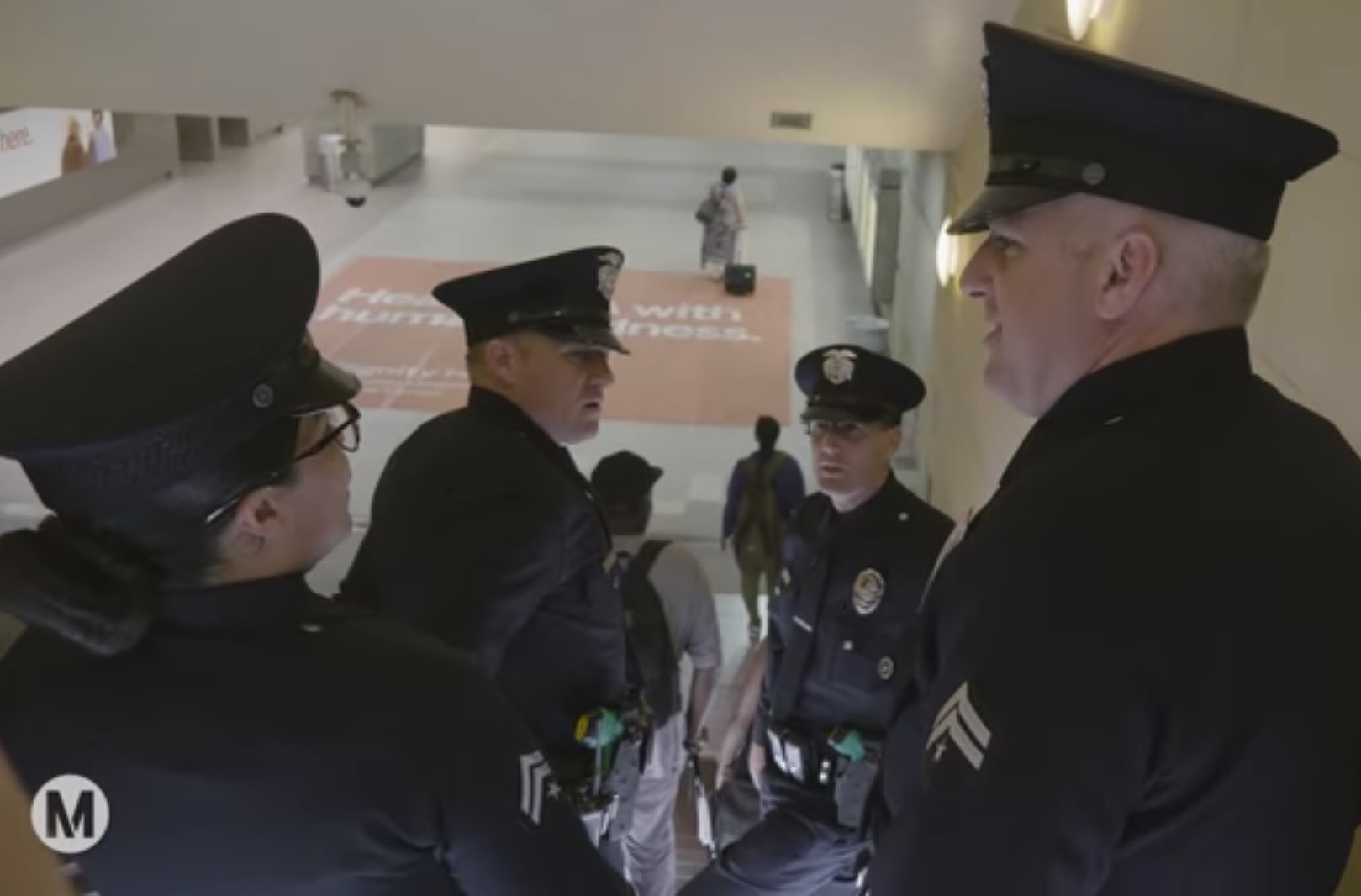
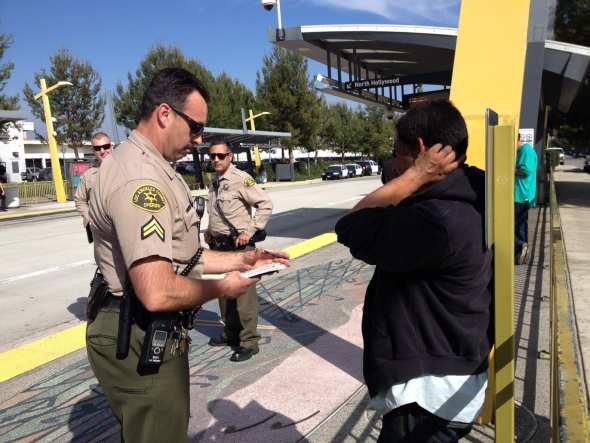
This is what stopping teens can look like. Mikey, Jonathan and George/Jorge were frisked for weapons on Ave. 50 and York Blvd. in Highland Park last spring. They were stopped while waiting for friends. Note: the photo is not from South L.A., as many of the youth I spoke with wished to remain anonymous. Sahra Sulaiman/LA Streetsblog

“What you got on you?” the 15 year-old girl says the cops pulled up alongside her asked as she walked along Vermont one night.

Bundled up in her boyfriend’s jacket to stave off the chilly air, she didn’t realize that they were actually talking to her until she heard one grumble, “Fucking Mexican!” and repeat the question.

Now she found herself both amused and pissed — not only were they messing with her, she’s Salvadoran.

“I was like, ‘Dayum, for real??’” she laughed as she recounted the incident to me over a plate of fries at a little restaurant not too far from where she had been stopped.

She was just going to the market, she told them. She didn’t have anything on her.

“Well, you just look [like you're] bad,” she says the cops told her before pulling away.

“Geeeez-us,” I groaned, cradling my head in my hands.

I had spent the last month and a half moving up and down the streets around USC, speaking with lower-income black and brown male youth (aged 14 – 25) about the encounters they have had with officers from the LAPD and USC’s Department of Public Safety (DPS). Every single one of the approximately 50 youth I had randomly approached for an interview told me multiple stories about getting harassed, insulted, stopped, and sometimes even frisked and handcuffed by both DPS and the LAPD.

But I hadn’t expected to hear a story from her.

She’s tiny – maybe 4’10” tall on a good day – and she’s been working hard to stay out of trouble. In fact, she had recently moved up to the USC area to get away from the craziness and drama of the streets in Watts, where she had lived for the last several years. There, she was stressed from having to constantly watch her back. Her new neighborhood seemed so peaceful in contrast.

“You realize there’s a Harpys clique just up the street, right?” I laughed, pointing over my shoulder.

“Huh?”

She had never even heard of that gang. The only trouble she had had was with the cops. But it didn’t faze her, she said, waving me off dismissively. That kind of thing is normal.

Rites of Passage in the ‘Hood

“Normal.”

“Happens all the time.”

“It’s like a rite of passage.”

All across Los Angeles, these are ways that a lot of youth of color from lower-income communities describe being stopped, questioned, searched, or, on occasion, falsely accused of misdoing and arrested or even brutalized by the police. Such incidents are so prevalent, in fact, that I’ve had to postpone meeting up with people that wanted to tell me their stories about enduring harassment in order to finish this article. The list of friends, acquaintances, and random people I’ve encountered that regularly experience this kind of discrimination is actually that long.

Most strikingly, although all describe hating how disempowering, humiliating, and even traumatic it can be, and that it feels like the police prefer sweating them to keeping them safe, they tend not to think of getting stopped as anything out of the ordinary.

It sucks, they tell me, but it comes with growing up in the ‘hood.

Until recently, many of the residents – young and old — in the neighborhoods around USC might have felt no differently. They were used to being scrutinized by both the LAPD and DPS, monitored by some of the now 72 cameras USC has set up on and around campus (watched 20 hours a day by LAPD and round the clock by USC), and observed by the more than 30 security ambassadors positioned on campus and throughout adjacent neighborhoods.

“We know [LAPD and DPS] are going to slow down [their cars] when they see a group of us standing out here like this,” an older black gentleman said of himself and his friends as they chatted in front of his home under the watchful gaze of cameras posted up on Normandie Ave.

“They always do.”

His friends nodded solemnly.

Since the implementation of new security measures around USC following two shootings in the area last year, however, things have apparently become more intense than “normal” for some. In particular, the stepping up of DPS patrols on and around campus combined with the arrival of 30 officers to the Southwest Division to conduct high visibility patrols and “more frequent parole checks on local gang members” (the $750,000 worth of personnel costs which were paid for by USC) have put everybody on notice.

Neighbors (and, most recently USC students of color, apparently) really began to feel the shift in tone with the beginning of the fall semester, when the new measures went into full effect.

The reason? Despite DPS’ use of “video patrol” techniques and the LAPD’s use of cutting-edge computer-generated models to aid in predictive policing, the methodologies behind the identification of suspicious behavior or candidates for “parole checks” appear decidedly unsophisticated.

And aggressive.

Black and Latino youth report that officers from both the LAPD and DPS regularly pull up alongside them and verbally accost them with a barrage of questions. Read more…

14 Comments

Metro Diary: Three Trains, a Tourist, Some Eager-Beaver Sheriffs, and a Former Foster Child…All in the Space of an Hour

The Willowbrook Station, looking South. (photo: sahra)

Whenever I travel in and out of LAX, I do my best to Metro my way there.

It requires a forty-minute walk, three trains, and an airport shuttle ride for me to go one way. But, it’s cheap and, remarkably, it all goes down in less than two hours. And, it is never dull.

For one, I get to watch new arrivals stumble their way through the TAP machine at Aviation.

This time, it was a lawyer from Toronto who hung back from the crowd that lunged for the single TAP machine near the elevator, where we were dropped off.

I hadn’t actually taken a look at this ticket-vending machine (TVM) before because I always reach the platform via the stairs at the east end of the station, where the shuttles usually stop. This TVM had none of the semi-helpful maps and informational posters (if you are an English speaker) present by the base of the stairs.

The lawyer hoped that watching other people go through the motions, he’d figure it out.

He didn’t.

He reassured me later that he would have gotten the hang of it with a little more time. He rides public transit a lot, he said.

Having watched him try to navigate the system, I wasn’t so sure.

He was going to have to take three trains (Green, Blue, Purple) and maybe a bus in order to get himself close to LACMA, and didn’t realize that meant that he would need to pay several separate fares. That part wasn’t in the directions his friend had sent him.

He stared at the screen and looked back at the directions on his phone. Buy a card or add a fare? He looked at me.

It dawned on me that while Metro has made it somewhat easier for frequent riders to navigate the system with recent changes to the menus, those shortcuts may make it more challenging for newbies.

As found during a recent Metro-run focus group, people don’t look at the information on or around the machine itself, they focus on the screen and the menus, assuming those will provide answers at some point. It would therefore make sense if the first screen greeting users also had a static list of fun, helpful tips such as “Each Train Requires a Separate Fare!” “ALWAYS Touch Your Card to the Blue TAP Circles at the Turnstiles or Validators Before Boarding!” or “Seniors Get Discounts!” It would also help if the “help” option was, instead, an interactive “information” option that took you to a list of things you could get more specific information about, such as transfers, fares, maps, passes, basic how-to stuff, timetables, and so forth (instead of the achingly slow and not particularly helpful scrolling screen it is now).

Things got fun at the Rosa Parks station, where we descended into the bottleneck that is the stairs to the Blue Line Platform to find a couple of Sheriffs waiting for us. They checked everyone that came through, making people anxious because the delay meant they were going to miss the train or buses they could see waiting below. At least they didn’t have the canines with them. Read more…

17 Comments

LASD Continues Campaign of Intimidation Against Metro Customers

First rule of LASD, don't take pictures of LASD.

Earlier this week, a Streetsblog reader, let’s call him Anthony, sent the email at the bottom of this post and the picture above. To wit, Anthony noticed “at least 8″ sheriffs at fare gates checking TAP Cards as well as a k9 unit. When he stopped to take pictures, he was harassed by another member of the LASD, and then threatened with basically false arrest.

Given the events of the past eight days, its possible the Sheriffs were on edge, but the pattern of intimidating (and sometimes attacking) Metro patrons is far too common. Since Metro seems completely unwilling to do anything about this, in fact the transit agency often helps the scofflaw law enforcement agency cover up its misdeeds, its no surprise that a member of the Sheriff’s would have no issues or shame harassing someone for taking pictures.

The only question left, is when is someone on the Metro Board of Directors going to step up and do something about Metro’s Bloody Mouth? The Metro Board of Directors regularly renews their security contract with the Sheriffs with almost no debate, despite complaints from advocates and riders that the law enforcement agency doesn’t respect passengers.

The full text of the email to me is after the jump. I didn’t edit it at all.

Read more…

No Comments

At Pro Walk Pro Bike, Activsts and Police Officers Talk About Working Together

On Tuesday, I was honored to be featured on a panel at the Pro Walk Pro Bike Conference entitled, “Crash Reduction through Advocacy, Enforcement, and Support Programs.” In addition to myself, I was joined by Peter Flucke and Rebecca Resman. Since we know most Streetsblog readers don’t get to go to conferences such as Pro Walk Pro Bike, Flucke, Resman and I thought we would do our best to bring our small part of this conference to you.

Our panel was led by Flucke, a former law enforcement officer, who introduced me and Resman. For anyone reading Streetsblog for the first time I’m the editor of the Los Angeles site and have been since March of 2008. Resman is with the Active Transportation Alliance (ATA), formerly the Chicagoland Bicycle Federation.

Flucke explained that while we were all coming from different directions, the thread that tied our presentations together was that we were all interested in improving the relationship between bicycle and pedestrian advocates and the police. I would be going first discussing what advocates can do to improve the relationship from their end. Next, Flucke discussed the training available to police departments, including a program he offers and another one by the National Highway Traffic Safety Administration (NHTSA). Last, Resman introduced the Crash Support Program offered by ATA to victims of crashes.

Then Flucke handed over the microphone.

Streetsblog for PWPB – Police Relations (1)

Comparing New York, Los Angeles and San Francisco Streetsblog, I’m comfortable saying that in Los Angeles we have   the most positive relationship with our local police department. Obviously, a big part of that is that the local police are willing to work with us and give us straight answers to questions. As I noted in the panel, “Some of the things that worked with us and the LAPD won’t work with every department. It’s not as though our relationship with the County Sheriffs is near what it is with the LAPD.” Read more…

37 Comments

Los Angeles County Sheriff’s Department, Metro’s Bloody Mouth

The cover story for this week’s Pasadena Magazine, “One Day on the Gold Line” tells the story of a middle-aged Jewish mother who was assaulted on a Gold Line train, thrown off the train, smashed into the concrete on the platform chipping her tooth and breaking her nose. When an Los Angeles Sheriff’s Department Deputy arrives on the scene, he berates the woman and places her under arrest.

The deputies stand around, chatting and ignoring me even when I beg, “Please help; let me call someone,” and “I hurt so bad; everything hurts.” I squat, dripping blood and mucous. A deputy belches loudly. Another asks, “Did you call?” and the response is, “Must be a busy day for the paramedics.” Photo and text, Pasadena Weekly"

By now, you’ve probably figured out that the thugs that manhandled this woman were members of the Los Angeles County Sheriff’s Department. What did the woman do to “earn” such treatment from the Sheriff’s? She couldn’t find her ticket. Eight hours after her assault, she’s released from the hospital jail,without a way to get home and a dead cell phone. When a family-member finally gets her home at 1 am, she finds the ticket where it had “slipped behind her wallet” in her purse.

Eventually, the Sheriff’s fork over nearly $200,000 to avoid trial. Reading the depositions and following the news, the victim is amazed at the brutality and cluelessness of our badged protectors.

Every six months or so, the Metro Board of Directors mindlessly re-approves the contract with the Los Angeles County Sheriff’s Department.  Usually, the motion to re-approve the contract is on the consent agenda. The victim of this recent abuse can find no record that anyone at the Sheriff’s was disciplined for their group assault. Read more…

30 Comments

Commentary: Does “Locking the Gates” and All the Associated Costs Even Make Fiscal Sense?

(Dana Gabbard is a Board Member of the Southern California Transit Advocates and an occasional contributor to Streetsblog. When he opines, he does so on behalf of himself as a long-standing transit watcher. Gabbard has written about the fare gate issue several times since Metro first proposed putting up gates in 2008.)

One justification offered for the need to gate Los Angeles’ rail system is that the present “Proof-of-Payment” system is evaded by a large number of people and that gates will increase revenue collection. This presumes only gating can reduce the level of fare evasion occurring. But as shown by Tri-Met in Portland, Oregon over the past year catching scofflaws and sending the message to users that fare evasion will not be tolerated can be achieved cost effectively by increasing the number of roving fare enforcers.

Metro’s current gating plan involves dedicating 160 Sheriff Assistants (which is 60 more than we currently have for the entire Metro Rail system) to watching fare gates. Wouldn’t it make more sense to have them as part of an enhanced roving fare inspection program? Consider that unlike the gate sentinels that these enforcers will be able to provide assistance aboard vehicles as they move through the system and have flexibility in targeting the stations where evasion problems are most numerous without the draconian choke point effect on patron flow patterns imposed by gating. Read more…

6 Comments

Accountability? Metro Denies Access to Video of Potential Sheriff Mis-Conduct

12.04.25 Newton Response Letter

Way back on February 23rd, Streetsblog updated its readers on our request to get a copy of the video from a Metro bus on January 19th when two Los Angeles County Sheriffs boarded, had an altercation with a mentally disabled woman, and eventually punched the woman in the face. The end of the incident was caught on camera by an army veteran and his smart phone. According to the veteran, the sheriffs tried to confiscate his phone.

During the back and forth in the press between Sheriff Lee Baca, witnesses and the victim; it became clear that the only end to the “he said, she said” was to be able to view the entire scene, from the moment that the law officers entered the bus through the altercation. Fortunately, such a record exists. Unfortunately, Metro is refusing to let anyone look at it.

Streetsblog requested a copy of the video from Metro’s usually helpful public relations department. They referred us to the public relations office. In early February, Metro rejected our request citing state statutes that didn’t seem to apply to this request. When we asked for clarification as to how these statutes applied, Metro sat on the request for ten weeks then sent us a response that didn’t answer any of our myriad of questions.

When we started this investigation, we were looking for information to clarify a public debate. As Metro continues to stonewall, our concerns have become more broad about a culture of policing that doesn’t allow for true public oversight.

We’re continuing to review our options going forward, but it’s clear that Metro isn’t going to hand over the records out of a sense of public responsibility. If you would like to contact a member of the Metro Board of Directors on our behalf, I’m including links to their email addresses after the jump. Read more…

1 Comment

Who Watches the Watchers? Documenting a Public Records Oddyssey

Our response to this denial of public information from Metro:

Back at the end of January, a special needs woman was struck in the face by a Deputy with the Los Angeles Sheriffs Department on board a Metro Bus.  The end of the incident, after the Sheriffs approached the woman, was caught on a cell phone camera by a man who claims the Sheriffs tried to intimidate him to turn over the footage.  Video of the incident was turned over to NBC4 and was reported on throughout the world.

But the account of the citizen journalist and woman who was struck, that the Sheriffs boarded the bus was disputed by the deputies and some of the other riders on the bus that reported that the woman was the aggressor.  With only the hand-held video and a “he-said, she-said” version of events, we asked Metro to release the video of the incident, from the moment the Sheriffs stepped on the bus, to Streetsblog.  The request was denied by the media relations department who pointed us to the public records department.  A formal public records request was submitted, but we were denied again.

Read more…

No Comments

Update on Case of Sheriff Punching Woman in Face on Metro Bus: Metro Refuses Public Records Request

12.02.06 Newton Response Letter (2)

Earlier this week, the public records office of Metro refused a request by Los Angeles Streetsblog for a copy of the recording made by a Metro bus camera during the January 9th confrontation between a special needs woman and sheriff that led to the woman getting punched in the face.

A video caught by a “citizen journalist” shows the sheriff striking the woman with his fore arm while the woman is restrained by the sheriffs partners.  However, witnesses vary on what degree the woman instigated the incident.  Some claim the sheriff’s attack was unprovoked.  Others claim the woman was acting violently.  A copy of a tape that starts when the sheriffs enter the bus could tell a more complete story of what actually happened that day.

If the Sheriffs presence on Metro vehicles and stations is to keep us safe, Streetsblog believes the public has a right to know what happened in that incident and what actions are being taken to address that behavior.  Streetsblog will stay on top of this issue until we can report on the full story.

In the meantime, here’s the text of the legal code used to justify the rejection.  Sounds as though Metro and/or the sheriffs are facing a legal challenge.

Read more…

11 Comments

Friday Poll Day: Guess the Sheriff’s Punnishment

Will the sheriff who struck a partially restrained woman on board the Metro bus receive any discipline outside of "retraining?"

View Results

Loading ... Loading ...

The day after video surfaced of an L.A. County Sheriff punching a woman in the face while his partner restrained her on a Metro Bus, the story had been told around the world.  Strong arm of the law: Video shows shocking moment cop punches woman, screamed the headline of the Daily Mail in England.  LA County Sheriff’s Deputy Elbows Woman in the Face [SHOCKING VIDEO] exclaimes the headline at the International Business Journal’s Website.

Closer to home, the Los Angeles Times managed a full seven paragraphs on the attack in its print edition, five of which were excuse making from the Sheriff’s Department (LASD), despite the story being featured on every local English and Spanish language news show in Los Angeles.  Even though the assault occured on a Metro Bus, The Souce hasn’t seen fit to even mention the incident.

To its credit, the paper of record has been following the story in its blog section LA_Now.  Despite it’s rather lame headlines, these four stories give enough background to get a clear picture of the story. Read more…