Streetsblog Interview: Angela Johnson-Meszaros

When I first decided to conduct a series of interviews instead of guest posts to keep Los Angeles Streetsblog fresh while I'm away next week, I wanted to talk with some people that were and weren't regular readers and with at least one person who would be entirely new to me.
Jessica Meaney at the Southern California Association of Governments suggested Angela Johnson-Meszaros, a tireless advocate on behalf of air quality and implementation of A.B. 32, the groundbreaking legislation that rocketed California to the front of the air quality movement. I was able to sit down with Johnson-Meszaros at a Pasadena coffee house on chilly Monday afternoon.
Streetsblog: Let’s
start with some of the basics, such as who are you and what do you do for a
living?
AJM: I’m Angela Johnson-Meszaros. I’m with the California Environmental Rights
Alliance and my title there is director of policy and general counsel. The Alliance works at the local level
providing technical assistance to
community organizations that are mostly working on air-quality issues. We work on brownfields and water quality and
other issues such as land use that are relevant for communities’ quality of
life.
We work on the regional level mostly at the Southwest
Regional Air Quality Management District on policy, rulemaking and
regulation. My colleague Joe Liu sits on
their governing board. At the state
level we do lobbying and regulatory work around air quality and public health
issues and other community participation.
Right now, I’m co-chairing the state’s A.B. 32 Implementation Advisory
Committee.
Streetsblog: Just in case anyone doesn’t know, can you give
a brief description of A.B. 32, what it is and what it does?
AJM: A.B. 32 is the
Global Warming Solutions Act of 2006.
Passed by the legislature and signed by the Governor in 2006. The purpose of A.B. 32 is to have California
reduce it’s Greenhouse Gas emissions.
The goal was to have our emissions in 2020 to be what our emissions were
in 1990.
As part of that effort, there is a three part process. The first part are early actions the state
took to reduce green house gases. The second
piece, which we’re in right now, lays out the scoping plan from where we are
now to 2020. The third phase begins in
2012 which is the implementation phase.
Between 2012 and 2020 is when we
hope to really begin reducing emissions.

Streetsblog: Ok. So,
how are we doing?
AJM: (laughs) Not so good.
I work primarily with environmental justice communities, primarily
low-income communities and communities of color. These communities are often are the host of a
lot of air pollution and are most impacted by the inability of California to
deal with not only Greenhouse Gasses but also the criteria and air
pollutants. Most notably, people think
of smog.
We thought A.B. 32 had a lot of promise for dealing with the
health issues caused by air pollution.
People in Los Angeles don’t usually recognize that for most of the South
Coast area, which is all of LA County, Orange County, Riverside and San
Bernadino Counties, the average person is exposed to a 1 in 15,000 chance of contracting cancer just
from the air quality. Depending upon
where you live, if you live near the port, those chances are close to 1 in
7,000 or 1 in 8,000.
So, we have bad air quality.
If you think about transportation, a large portion of that
pollution comes from our transportation infrastructure, cars and trucks with
diesel toxins being the largest contributor.
Streetsblog: When you talked about the “early actions” the
state is taking now, what are some of the things the state can do between now
and 2012 while the state is planning.
Are we already on our way?
AJM: Well, there’s a long, exciting political tale that we
can tell when we’re talking about the implementation of the early action
items. In the shortest possible telling,
they were supposed to adopt the series of early action, the so-called low
hanging fruit. They went through a huge
process, including a multiple day international conference. They brought in people from all over, to talk
about what can be done…
Streetsblog:…they got on the cover of TIME Magazine…
AJM:…on the cover of TIME Magazine. The Governor was very fancy. There’s all this stuff going on, but what
ultimately ended up happening was they adopted three early action goals.
One of them was the low-carbon fuel standard which was
supposed to reduce the carbon intensity of our transportation fuels. One was a methane capture of landfill
gases. This is one thing our committee
pushed hard for the inclusion of. For a
variety of reasons this proposal is zero dollars to implement.
After adopting the three, the Governor fired the Chair of
the Air Resources Board. There was a lot
of turmoil. The legislature was
unhappy. We were unhappy. Everyone was unhappy. That’s when Mary Nichols got the job as chair
of the Air Resources Board. Then we
adopted another set of measures to improve air quality.
We are making progress…
Streetsblog: Do you believe the political problems that came
up during the first implementation phase our things that are going to keep
popping up as we try to implement other parts of this law?
AJM: This is an incredibly political process. Implementation, the decision about what kinds
of things to implement, what is doable, and what is not doable has been an
incredibly political process. In fact,
there has been a fight going back to before A.B. 32 was even adopted about
whether or not to use a policy tool called “Cap and Trade” as the way to address our Greenhouse Gas
emissions.
The environmental justice community has long opposed “Cap
and Tradeing.” There is a lot of
evidence from around the world that every time a pollution trading program has
been tried, it hasn’t worked. That seems
like something that should be worthy of consideration when you’re making your
policy choices, but it hasn’t happened that way. It’s very clear the governor wants to have a
trading program that’s what he’s put out there from the very beginning. There’s a lot of mainstream environmental
groups that have joined him so we’re moving forward with that. However, it’s created a lot of turmoil.
In short, this will always be a political process because
there are a lot of people who are winners and losers in this process. I think the most recent version of this has
been in the last couple of weeks when ARB had to do their economic analysis.
ARB sent out their economic analysis for peer review. The peer reviewers all came back and said
that their economic analysis was really bad.
It’s just substandard. It
couldn’t possibly be worse that it is.
That was the same thing that we’ve been saying. It looks like you decided on the policy first
and then constructed an analysis to support the choice you already made.
Then, the legislative analysis office did a report on
it. Their report said, “You know, this
really isn’t so good.” But, the ARB said
it was fine and they’re going to adopt
the thing on Thursday.
Streetsblog: Hooray! A story idea for Wednesday.
ALM: In particular for transportation issues, one of the
early action measures included was this low carbon fuel standard which is
supposed to reduce the carbon intensity of fuel. Really, for California, in order to reduce the
intensity of carbon in fuel, what we’re talking about is corn based
ethanol. That’s a very significant issue
that we should consider when thinking about transportation policy. Because it’s very clear that corn-based
ethanol is not a good way to fuel our cars.
Burning food for fuel is a poor idea.
It effectively, literally, causes worldwide starvation. We can feed 100 people for the same amount of
corn that it takes to fill one tank of an SUV.
Part of the increase in food prices has been driven – pardon the pun –
by the increasing use of corn-based ethanol for fuel.
It’s got all these ripple problems for hunger issues
worldwide. The U.N. has called for a
five year moratorium on using corn-based
ethanol because of this issue of it making the world more hungry. It’s also leading to price increases in the
United States, in California, and locally of corn. Since corn is such a building block, it leads
to increases for eggs, for milk, for everything on the food chain.
This leads to the building of these large farm refineries
that are being planned in the Central Valley.
They have pretty serious air pollution issues. They also have massive impacts on water. There was a report about a year and a half
ago where it was estimated that just by growing the corn that you would need to
meet the federal ethanol requirement would completely deplete all of the
aquifirs underneath South Dakota.
And…it’s not even clear that it reduce Greenhouse Gasses.
So, what does all this mean.
What it means that we have this moment where the public is
really focused on dealing with climate change.
The public is also focused on a lot of transportation issues if for no
other reason than in Los Angeles you can’t go anywhere. It’s just not convenient to travel. That creates a lot of opportunities to really
think about how we move ourselves around the region. For those of us that care about the urban
environment, wanting to create a cleaner urban environment and the roll of
transportation in those environments, this is really an opportunity to interact
with decision makers to say that we need to make decisions that will result in
positive things.
This is the time to do it.
We have an extra opportunity with the economic collapse
because there are going to be HUGE amounts of money available for
infrastructure. For those of us that
care about these issues it’s time to say, “You’re not really going to build
another eight lane highway. We should
build some real urban infrastructure that makes our communities more livable
and walkable. You’re going to take
seriously walking paths. You’re going to
think about liking residential centers to retail and other places people want
to go. That’s what we want our tax money
to be used for. We’re all going to work
on making our urban environment more sustainable.”
We also would get the kind of communities where people can
connect on a more personal level. That
would reduce the amount of transportation, the amount of fossil fuels, that we
use and now the agri-fuels that we use.
That would have a TREMENDOUS impact on our health because of what would
happen to our air…Studies show that particulates from Diesel fuel kills more
than 24,000 people a year. That’s more
than die in car crashes in the state of California and more than the number of
people that were killed by second hand smoke.
If we were able to take this opportunity and really require
that they put the interests of all of us first, instead of all of them first,
whoever they are, it would make a massive, huge difference.
Streetsblog: If you
could give one piece of advice that might be out of the box on how we can make
our air cleaner, what would it be?
AJM: As an individual, there are three key things that every
individual can do.
The first is to really think about one opportunity to begin
leaving your car at home and start taking some other way to get to your
destination. What you’ll find is there
are lots of ways to get around without taking your car. It may seem on an individual level that it
doesn’t matter that much, but really what you’re doing is setting up a
framework that makes everything a more viable option.
All of a sudden you’ll notice things like, “If there were a
crosswalk here it would be easy to walk my kid to school everyday.
The second thing is to contact an elected official. Take the time, make a phone call, send a
letter…those things make amazing impacts in political offices. They take note when they start to get letters
from people. It doesn’t have to be a
massive treatise, it just has to ask them to take leadership on a particular
issue.
Once you’ve done those two things, you’re well on your way
to the third thing which is, having casual conversations with people about what
you’re doing. Don’t accost people, but
let them know and encourage them to join you.
Streetsblog: I’m going to ask this question of everyone we
interview for this series, if I remember.
It’s magic wand time. If you
could change one thing, having to do with transportation, what would it be?
AJM: Maybe I’m
tainted, because I work on this all the time…
Streetsblog: Everyone gives strange answers
AJM: I think the key issues of our time is whether we can
harness the interest and focus around climate change. I think Cap and Trade can dissipate all of
that. One thing that I would say is to
have a climate change program that focuses on how we make and use energy. From there, all good things would flow.
Images: Climate Action Team, Marten Law
Stay in touch
Sign up for our free newsletter
More from Streetsblog Los Angeles
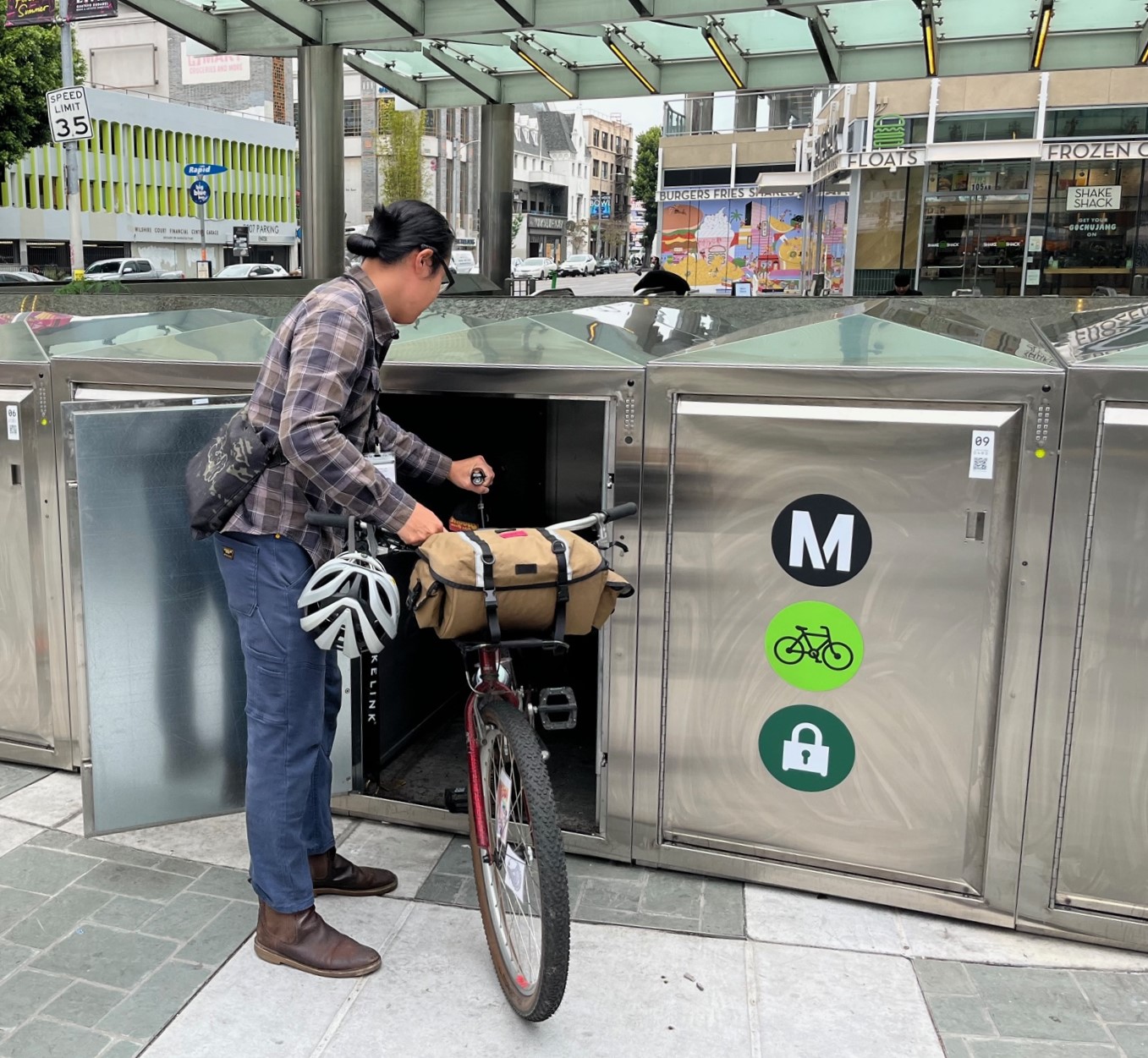
Metro Debuts New Smart Bike Lockers at Nine Stations
New Metro on-demand electronic bike lockers cost just 75 cents for the first 12 hours. Download the BikeLink app for easy access


Eyes on the Street: Recent Centinela Bike Lanes in Culver City
The new partially-protected Centinela facility is a welcome safety upgrade for a stretch that long lacked any type of bikeway, but the area remains not all that bike-friendly