Skip to content

Posts from the "DC Streetsblog" Category

Streetsblog DC 67 Comments

Does the Gender Disparity in Engineering Harm Cycling in the U.S.?

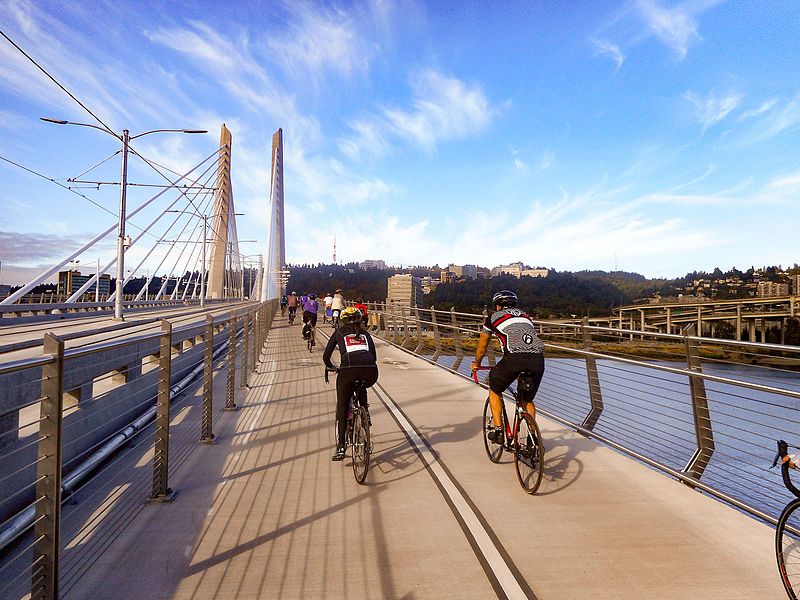
Research has shown that women are more comfortable biking on protected bike lanes, but the male-dominated engineering profession has discouraged this type of street design. Photo copyright Dmitry Gudkov

A study published in this month’s American Journal of Public Health finds that highly influential transportation engineers relied on shoddy research to defend policies that discourage the development of protected bike lanes in the U.S. In their paper, the researchers point out that male-dominated engineering panels have repeatedly torpedoed street designs that have greater appeal to female cyclists.

The research team, led by Harvard public health researcher Anne Lusk, examines four engineering guides published by the American Association of State Highway and Transportation Officials between 1974 and 1999. All of these guides, treated like gospel by engineers across the country, either discourage or offer no advice about protected bike lanes, despite the fact that research has shown that women, in particular, are much more likely to bike given facilities that provide some separation from vehicle traffic.

Lusk found that many of AASHTO’s official claims regarding the purported safety problems of protected bike lanes were offered without supporting evidence. AASHTO refused to consider data demonstrating the proven safety record of protected bike lanes outside of the United States. And since there have been almost no protected bike lanes in the U.S. until quite recently, AASHTO based its position against protected bikeways on domestic street designs like sidewalk bikeways, not real bike lanes designed specifically to integrate physically protected bicycling into the roadway.

The researchers came to this rather damning conclusion: “State-adopted recommendations against cycle tracks, primarily the recommendations of AASHTO, are not explicitly based on rigorous and up-to-date research.”

Lusk and her team carried out a safety study of their own, examining crash reports on protected bike lanes in 19 U.S. cities. They found that protected bike lanes had a collision rate of about 2.3 per million kilometers biked — lower than the crash rates other researchers have observed on streets without any bike lanes. (Those rates vary from 3.75 to 54 crashes per million kilometers.)

Lusk’s research also suggests the lack of gender balance in the engineering profession may have contributed to the resistance to protected bike infrastructure. Researchers found that in 1991 and 1999, AASHTO’s Bikeway Planning Criteria and Guidelines were written by a committee made up of 91 and 97 percent men, respectively.

“The AASHTO recommendations may have been influenced by the predominantly male composition (more than 90%) of the report’s authors,” Lusk writes.

Read more…

Streetsblog DC No Comments

With Less Driving, Can We Tone Down the Hysteria About Congestion?

TTI may try to paint a picture of ever-worsening congestion, but their own data show that reduced VMT is having a positive impact. Image: TTI

There’s so much to unpack in the landmark report released by U.S. PIRG and the Frontier Group earlier this week on transportation trends. Tuesday, we focused on the disparity between government transportation forecasts and recent realities. We also took a look at a few reasons to believe that the millennial generation – those aged 13 to 30 right now — will continue to drive less than previous generations. One of those reasons is that technology has reduced our need to drive in many different ways.

The report also makes clear the need to recalibrate our strategies around congestion. When roads get congested, calls for highway expansion grow to a deafening pitch. The reality that transit and road pricing are better solutions for congestion don’t compute amid the panic.

The most recent Texas Transportation Institute congestion report came out under the headline, “As Traffic Jams Worsen, Commuters Allowing Extra Time for Urgent Trips.” Lots of doom-and-gloom language when what they really mean is that congestion is easing.

That’s right. Reduced congestion has been one of many benefits of the reduction in miles driven over the past eight years. As of 2011 – the latest year for which data is available – congestion was about as light as it was in 1998. And it had been down at that level for four years. The annual toll on car commuters went from 43.1 hours of delay to 42 hours in 2007 and then dipped way down to 37.6 – and stayed there for the next three years. In 2011 it inched up by less than half an hour to 38.0 [PDF].

So where is all this “urgency” about “worsening” congestion coming from?

Read more…

Streetsblog DC 55 Comments

There’s No Doubt: Traffic Enforcement Cameras Save Lives

A 2011 study by Insurance Institute for Highway Safety comparing cities with red light cameras to those without them found that in the 14 largest U.S. cities, the cameras reduced fatal red-light-running collisions by 24 percent. Click to enlarge. Image: IIHS

Gawker dished out some richly-deserved ridicule to Tennessee State Senator Jon Lundberg yesterday, following reports that he is co-sponsoring legislation to outlaw the specific speeding camera that nabbed him doing 60 in a 45 zone last October. Lundberg denied that the incident had any impact on his decision to sponsor in the legislation, and contested the violation to boot.

But the case is a telling one. State governments around the country have demonstrated hostility to automated enforcement programs. Twelve states specifically forbid the use of speed enforcement cameras, except in very limited circumstances, according to the Governor’s Highway Safety Association. Nine states prohibit red light cameras. Others, like New York, have yet to enact legislation that would enable cities to use these traffic enforcement tools.

A proposed ban in Iowa failed narrowly in the Senate last year and one is currently under consideration in Ohio.

The Ohio legislation, framed as a defense of due process and privacy, has received mostly favorable coverage in the press and has enjoyed the support of groups like the Ohio ACLU and Ohio PIRG. One Ohio PIRG official characterized speed cameras as “cash cows designed to rip off drivers.” Ohio Lawmaker Ron Hood went so far as to assert that red light cameras are themselves a safety hazard.

Adrian Lund, president of the Insurance Institute on Highway Safety, told the Washington Post last year that these kind of debates tend to get distorted: “Somehow, the people who get tickets because they have broken the law have been cast as the victims.”

Read more…

Streetsblog DC No Comments

Is This Our Future? Solo Driving Drops in DC as Transit and Biking Soar.

Transit's mode share in the DC region grew 30 percent between 2000 and 2011, with growth in every jurisdiction. Image: National Capital Region Transportation Planning Board

We’ve been writing a lot this week about the national shift away from car travel and toward transit, biking, and walking. Yesterday, Washington area officials released new data that indicates the DC region is at the forefront of that trend.

The region added half a million new workers between 2000 and 2011, according to a report by the National Capital Region Transportation Planning Board [PDF]. During that period, transit was the fastest-growing mode of travel for commuters, soaring from an 11.8 percent mode share to 15.4 percent, nearly a one-third increase. That’s an additional 162,000 regular transit commuters across the greater DC area.

More than half of that increase has occurred since 2007, probably spurred in part by the recession, though undoubtedly helped along by many other factors.

Puzzlingly, the major exception to that rule was among federal government workers: All of their increased transit ridership happened between 2000 and 2007, when mode share jumped from 19 percent to 28 percent, where it remained in 2011. That means transit ridership among federal employees wasn’t affected by the transition from a Republican to a Democratic administration or by the recession.

Region-wide, 65.8 percent of commuters drive alone, a slight drop from 67.2 percent in 2000. Driving alone decreased or stayed the same in every jurisdiction but Prince William County, where admittedly unreliable data shows it rose from 74 percent to 77 percent.

The changes in the region are happening even more intensely in the city of Washington alone. In DC, 40.2 percent of workers commute via transit, compared to 32.3 percent in 2000. Meanwhile, the share of DC workers driving alone shrank from 39 percent to 33.6 percent.

Read more…

Streetsblog DC 110 Comments

Refereeing the Raging Debate Over the “Specialness” of Cyclists

There’s a tussle going on right now about how cyclists should ride on city streets. Yesterday’s Streetsblog Network post took a snapshot of this debate yesterday, excerpting the WashCycle’s response to a Sarah Goodyear piece in Atlantic Cities.

Wrong-way cycling isn't the way to assert cyclists' rightful place on the streets. Photo: Big Shot Bikes

Sarah wrote that cycling is no longer a mode for daredevils and mavericks weaving through traffic. Some cities now have street infrastructure that accommodates cyclists and guards their safety. Bicycling is increasingly incorporated into the transportation system in these cities, and as such, cyclists need to follow the rules.

Few people would contest the idea that for the transportation system to function well and safely, drivers need to abide by the rules of the road. It’s obvious that when drivers break the rules, the consequences are dire, since they’re operating a heavy vehicle capable of high speeds.

But safety isn’t the only issue. The orderly functioning of our streets is also a priority of planners, and should be a priority for all of us. When the signal says walk, we ought to know that we can walk without being hit by a motorist — or a cyclist — who’s decided that the rules don’t apply to him.

“I am truly sick, at this late date, of people wanting to have it both ways: calling for protected bike lanes and a bike-share system, demanding that cops step up enforcement when it comes to cars, and then blithely salmoning up a major thoroughfare and expecting everyone look the other way,” Sarah writes. “It makes all of us look terrible and it’s a real hazard.”

She also claims that cyclists aren’t special and don’t deserve their own rules. I part ways with her there. Riding a bike doesn’t make you special because it’s badass or good for the environment. It’s special because roads designed exclusively for automobiles don’t work well for cycling. And we should advocate for rules and infrastructure that safely accommodate sustainable and efficient modes of transportation at least as much as destructive and polluting ones.

Read more…

Streetsblog DC 26 Comments

Seven Ways Technology Is Rendering the Automobile Obsolete

As we try to understand why young people are so much less jazzed about driving than previous generations, one possible explanation always comes up: Kids today just love their smart phones.

That is part of it. But the full picture is far more nuanced.

The internet, and the ability to carry it wherever you go, has changed society in so many profound ways it’s no surprise that transportation is among them. A new study by U.S. PIRG and the Frontier Group, “A New Direction,” illustrates the myriad ways mobile technology has transformed young people’s relationship with transportation.

Yesterday, we covered the report’s critique of government travel forecasting and its analysis of why young people’s driving rates will probably remain lower than those of previous generations. Technology is one of the biggest reasons. Here’s why:

Go ahead, check your stocks online – but not if you’re behind the wheel, please. Photo: PC Mag

Constant connectivity. As you’ve undoubtedly noticed at the dinner table or on city sidewalks, people have trouble putting down their phones. It’s not just compulsive Facebook status checking that keeps people glued to their devices. People perform an increasingly broad assortment of tasks on phones: make travel reservations, go through work email, catch up on the news, diagnose children’s ailments — the list is nearly infinite. While car companies are trying heartily to incorporate digital connectivity and social media into their cars, they still need to battle the fact that such technology is dangerously distracting for drivers. Given the option, many young people would rather take transit, where they can use their phones harmlessly, making far better use of their commuting time.

Alternative social spaces. Older adults may think it’s weird when teens would rather text each other than see each other, but hey, the world is a weird place. “A survey by computer networking equipment maker Cisco in 2012 found that two-thirds of college students and young professionals spend at least as much time with friends online as they do in person,” write report authors Phineas Baxandall and Tony Dutzik.

Online shopping. More and more people are making purchases online rather than in stores. Young people are leading the way on that, too. And it can be greener than going to the store yourself.

Read more…

Streetsblog DC 19 Comments

Millennials Will Drive More As They Age, But Still Less Than Their Parents

At some point over the past few years, a lot of my friends started moving to Silver Spring and Takoma Park and Falls Church. These inner-ring, transit-connected suburbs of DC are still far less compact and walkable than the neighborhoods my friends moved from. So they bought cars.

Many young people still opt for urban living in walkable, compact neighborhoods -- even once they have kids. Photo: Let's Save Michigan

Why did they do this? They’re entering peak driving age, which is historically between 35 and 54. They have more money than they did in their early 20s. But mostly, they had kids. Of all my friends, I now have exactly one that is still proudly car-free with kids.

In light of the new U.S. PIRG and Frontier Group report on changing driving habits, led by young people, we have to ask: Won’t those young people also drive more as they get older?

Reports of diminished interest in driving focus on two groups: baby boomers, the generation that came of age with the automobile and settled in car-dependent suburbs, who are now retiring and driving less; and millennials, the oldest of whom are 30 now and the youngest of whom aren’t even old enough to drive.

Millennials’ shift away from automobile travel is well documented, especially in last year’s report, “Transportation and the New Generation,” by U.S. PIRG and the Frontier Group. That report found that between 2001 and 2009, annual driving by the 16-to-34 age cohort decreased 23 percent, from 10,300 miles to 7,900 miles per capita. That age group also took 24 percent more trips by bike and 40 percent more trips by public transit over those eight years.

With more and more people starting families later in life, the vast majority of millennials haven’t had babies yet. They also haven’t hit their prime earning years, which tend to be prime driving years.

That’s right, said Phineas Baxandall of U.S. PIRG, co-author of the transformative new report, “A New Direction,” which outlines three possible scenarios for driving trends in the coming years, all of which would mean far less driving than government models predict.

“Our scenarios all assume that millenials will drive more when they get older,” Baxandall told Streetsblog. “The real question isn’t, ‘Will millennials drive more as they get older?’ It’s, ‘Will they drive more than their parents as they get older?’”

There are persuasive reasons to think they won’t.
Read more…

Streetsblog DC 12 Comments

U.S. PIRG: The Driving Boom Is Over But the Road-Building Binge Continues

All government forecasts predict far more driving than even the most conservative scenario envisioned by U.S. PIRG and the Frontier Group. Image: A New Direction

The driving boom is over.

After decades of steady growth, U.S. driving rates have stagnated and even fallen. Per capita driving is as low as it was in 1996. And yet, federal and state government estimates continue to predict inexorable growth, relentlessly building expensive new highways for drivers who might not materialize.

A groundbreaking new study from U.S. PIRG and the Frontier Group shows that any of three likely scenarios for future U.S. driving trends show far lower vehicle miles traveled than any of the principal current government estimates. That creates a disconnect between the kinds of transportation Americans are choosing with their feet and the kinds of transportation the system is designing for them.

Transit ridership is rising steadily – Americans took 10 percent more transit trips in 2011 than in 2005 – yet more than half of U.S. transit systems have been forced by budget constraints to either raise fares or cut service – or both – since the beginning of 2010. Meanwhile, although Americans are showing a flagging interest in automobile travel, states are breaking the bank to build shiny new roads.

Here are the three possible future scenarios for driving behavior that authors Phineas Baxandall of U.S. PIRG and Tony Dutzik of the Frontier Group laid out:

Back to the Future: This scenario assumes that the decline in driving is a temporary “blip,” largely due to the economic recession, and not a lasting trend. It assumes driving rates will soon pick right up where they left off. In this scenario, driving rates by age cohort and sex return to 2004 levels by 2020 and continue marching upward.

Enduring Shift: Under this scenario, the last decade’s shift in driving behaviors is real and lasting, with people continuing to embrace different forms of transportation and more compact communities. Gas prices stay high, the economy bounces back without leading to a huge jump in VMT, and the digitally-connected world continues to reduce the need for travel. This assumes each age and sex cohort keeps driving at lower rates than the same cohort did in previous generations. “For example, if 20 year-old males in 2009 drove 20 percent less than 20 year-old males did in 2001, it is assumed that eleven years later in 2020 they will similarly drive 20 percent less than 31-year-old males did in 2001,” Baxandall and Dutzik write.

Read more…

Streetsblog DC 6 Comments

Parking Madness Champion Tulsa Moves to Limit Surface Parking Downtown

Tulsa ran away with the "Golden Crater" award in our Parking Madness competition. Now local leaders are taking steps to help build a healthier balance for the city's downtown. Image: Google Maps

Just last month, we were shaming Tulsa, Oklahoma, with our “Golden Crater” award for the downtown most riddled with surface parking lots. But today, we applaud the city for taking steps to reverse the plague of excess parking.

Tulsa World reported Friday that our Parking Madness competition winner is moving forward with a ban on new surface parking lots. The Tulsa City Council has extended a temporary moratorium on new surface parking through September. Between now and then, Tulsa will be working to prepare permanent changes to the city’s zoning code that will help contain the tide of surface parking lots and, hopefully, set the stage for some redevelopment.

The legislation is being championed by City Councilman Blake Ewing, who gave a shout out to Streetsblog in his remarks to the newspaper.

“Ewing pointed to a recent online contest by a nonprofit transportation advocacy publication in which Tulsa was named the worst city in the country for ‘parking craters’ — areas of historic downtowns that have been bulldozed for surface parking,” wrote Tulsa World reporter Zack Stoykoff.

Tulsa is in the early stages of the same program the city of Denver took on to repair its woeful surface parking lot problem two decades ago.

We’re proud that, by shining a light on the damage caused by Tulsa’s excess parking, Streetsblog was able to help catalyze change. Whether by highlighting best practices or worst practices, we’re thrilled when we can inspire cities to re-think their priorities and plan for a more sustainable future.

If this kind of reporting makes you proud too, make a donation today. We rely on donations from our readers to make this kind of thing possible.

Streetsblog DC 21 Comments

How Green Is Grocery Delivery in Cities?

Grocery delivery can cut carbon emissions compared to driving your car to the store and back. But delivery services also replace walking, biking, and transit trips. Image: Transportation Research Forum

In a recent study out of Seattle, researchers Erica Wygonik and Anne Goodchild found that having groceries delivered by truck can cut mileage by up to 85 or 95 percent compared to driving a car. ”It’s like a bus for groceries,” Goodchild told NPR. ”Overwhelmingly, it’s more efficient to be sharing a vehicle, even if it’s a little larger.”

The most efficiency can be squeezed out of grocery delivery when dispatchers can design short routes that serve many people. When customers can choose their delivery times, however, the routes become significantly less efficient.

But in urban areas, where houses are close enough together that delivery might be relatively efficient, not everyone drives to the store. And people without access to a car might be the most likely to use a delivery service. In these locations, perhaps delivery services are replacing walking, biking, and transit trips more than driving trips.

It looks like more research is needed to evaluate the full impact of grocery delivery services on travel choices and carbon emissions. “We don’t have great data about how people get to the store,” Goodchild said in an email exchange. “We also don’t know to what extent these shoppers (bike/ped) might choose to shop online, versus those who drive to the store.”

She said she and her co-author have talked about conducting simulations where they consider biking “but would need to estimate calorie burn.” Yes, calorie burn — but hopefully not “increased respiration.”