Skip to content

Santa Monica

Streetsblog’s Santa Monica page is brought to you through the support of Santa Monica Bike Center and the Library Alehouse.

5 Comments

A questioning look back at Bike to Work Day

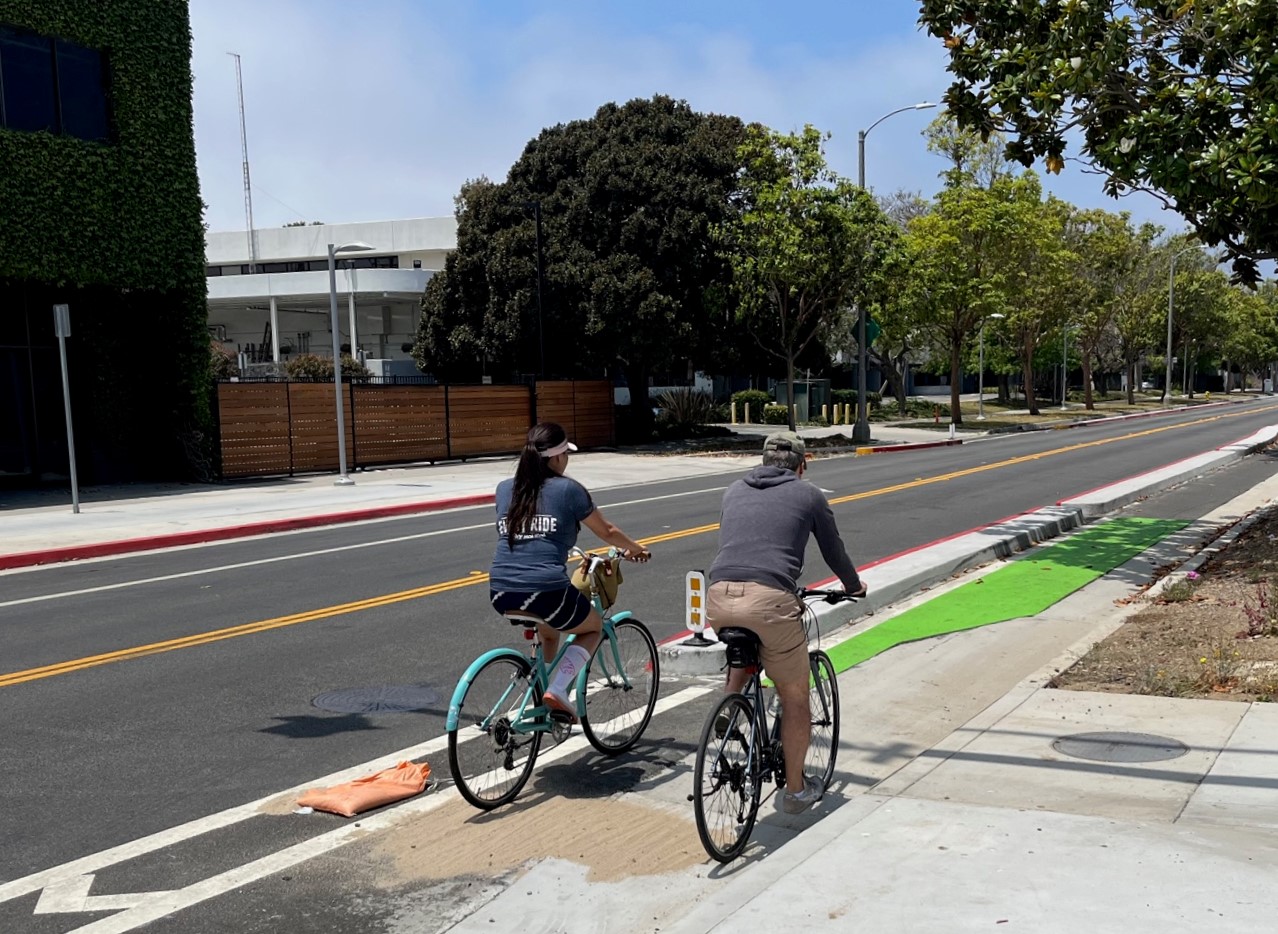
A typical pit stop on the Westside

Don’t get me wrong.

I love Bike to Work Day. I had a blast yesterday trying to hit as many Westside pit stops as I could before making my way back to my home office to get down to work.

Which isn’t exactly the point, I know.

The idea is to encourage people who would otherwise drive to their places of employment to try bicycling by providing incentives and information, in the hope that once they try it, they’ll like it. And hopefully, keep doing it.

I get that.

And I enjoyed the opportunity to partake in a free rolling breakfast and gather up mini-Clif Bars and other assorted bike swag, while talking with other riders I might not otherwise meet on the roadway. As well as offering my insights to anyone looking for a little advice on bike commuting while, sadly, finding no takers.

Everyone I met seemed to know as much about the subject as I do.

Which is part of the problem.

As with many bike advocacy efforts, we too often find ourselves preaching to the choir; rewarding those who already ride rather than getting more people to leave their cars behind, if only for one day.

Not that there’s anything wrong with that.

Bicycling, and bicyclists, should be celebrated.

Whether or not some impatient drivers, or even the wider community at large chooses to acknowledge it at times — particularly when it involves removing a traffic lane in order to carve out a little space for those of us on two wheels. Read more…

4 Comments

Santa Monica Awarded Silver & 83/100 Bike Score, But Just How Helpful Are Such City Rankings?

Walk Score's heat map Bike Score of Santa Monica gives an 83/100

Santa Monica was just awarded a bump in it’s Bicycle Friendly Community (BFC) classification by the League of American Bicycling, from bronze to silver. Coinciding with that news the walkability web application Walk Score released a new round of Bike Score rankings which now includes Santa Monica, which received an average score of 82.5 (rounded up to 83), high enough to come 5th in analyzed cities. Now there are probably few people more excited than myself about the real progress being made toward normalizing bicycling in Santa Monica, but I feel compelled to maintain some skepticism toward popular systems of classification for bicycle friendliness.

Our Santa Monica weekly column is supported by Bike Center in Santa Monica.

Relative to other cities ranked in the LAB system, the sliver may be an appropriate and deserved award, but about that bike score putting us in the same league as the platinum awarded cities of Davis,CA and Boulder, CO, I think it’s a little early to pop the champagne bottles just yet. Some e-mail blasts, Facebook shares, and a locals news post have already circulating touting Santa Monica ranking #5 on Bike Score, so I think it’s worth putting this in some needed context.

The first and most obvious issue here is cities are not all alike, and trying to compare them as such often ends up as in exercise in trying to put square blocks in round holes. Santa Monica has a higher score overall than Portland, OR, but Santa Monica is a small city boxed in by the city of Los Angeles in the patchwork of municipalities that form L.A. county. Our score covers a smaller foot print without any isolated sprawl or hilly regions. So while the core of Portland actually scores higher, the number that spits out for each city includes in some cases very disparate areas like steep hillside homes that are tanked with topography penalties in the Bike Score methodology. Even among cities more approximate to each other, comparing averages will always leave out important details.

What is bicycle friendly or bikability, is inherently subjective, and can mean very different things for different people. What’s bikable enough for me is not good enough for many others. We should be asking bikeability for whom? Are we making it accessible for all who wish to, or just certain groups. Do parents feel comfortable allowing their kids to bike to school? At what age? Are facilities only accessible to certain neighborhoods and not other? Are political, social, racial, gender or economic inequities or other differences apparent in where a city makes investment in improving bicycling conditions or who feels they can ride? These questions and many others are critically important, but nuanced and defy simplistic efforts to rank a city as a whole or comparing one city to another. Read more…

4 Comments

The Climate Imperative of TOD in Santa Monica

One of the sub-rifts I’ve observed within the debates and backlashes against development in Santa Monica reflects the diverging views within environmentally conscience minds about balancing localized and broader impacts. There are people who have advocated for environmental initiatives of various kinds their entire life, who I fundamentally clash with despite also considering myself a passionate advocate environmental protection. We’re seeing the same issues with completely different lenses.

Our Santa Monica weekly column is supported by Bike Center in Santa Monica.

In what I am going to refer to as a slow or no growth locally perspective, to add development intensity of any kind here is to further potentially increase the impact of Santa Monica. This impact is a net negative, and one perceived to be associated with a linear increase in more vehicle traffic or other negative consequences.

Anchoring around walkable areas tied to transit investments already under construction, is lower impact and more sustainable (ecologically speaking and financially) than having the investment capital for development flow outward. Adding transit oriented development as non-linear, and facilitating more walkable and bikeable distances between a greater number of potential homes and businesses with the potential for longer trips by transit made more convenient. A shift away from automobile dependency and centrism is an imperative.

Within the realm of choices Santa Monica can make for itself, allowing for more transit oriented development near our already under construction electric light rail line connecting us to Downtown Los Angeles, is one of the best things we can do to enable lower energy use per capita for more people, maintain strong city finances, and address some of the supply side of the forces making the city less affordable and accessible. People living in Santa Monica along the Expo Line corridor already have shorter commute times than most places in the region, I’m guessing in part because so many jobs already exist within that area (my own 10 minute daily bike commute fits completely within that light pink slice).

Our ideal climate also reduces household energy demand significantly. As of this writing, Burbank just set a new record high of 103 degrees. Santa Monica was in the low 70′s and upper 60′s during the same part of the day, wrapped in that natural air conditioning we call the marine layer. Given a choice of adding units in Burbank or Santa Monica, units in Santa Monica will by default use less energy without residents even having to think about it. The means to live a lower carbon lifestyle, so long as one can afford the barriers to entry and the capacity exists, is just plain easier in Santa Monica. Read more…

1 Comment

Long Beach, Santa Monica, If YouDonate to Streetsblog in May…You Can Win More Than Just a New Bike

This? all photos by Joe Linton

The Southern California Streets Initiative, the local non-profit that staffs and edits Streetsblog Los Angeles, has voted to support local journalism outside of the city limits to Long Beach and Santa Monica. Thanks to local support from Santa Monica Bike Center and Long Beach Community Foundation, we’ve been able to do this without reaching into our regular operating funds.

Or this? Photo: Gary Kavanagh

Our goal is to expand coverage into Santa Monica and Long Beach, and with your help, these dreams will come true. We’re proud to announce we’re raising funds for both a Streetsblog Long Beach and a Livable Streets/Green Living news website in Santa Monica (which would be sort of a cross between Streetsblog and the old Green L.A. Girl website). This is where you come in. Your gift can help determine which city gets its own Livable Streets news site first.

We’re holding  the “Long Beach v.  Santa Monica” Livable Streets Contest. Whichever city raises the most funds between April 15, 2013 and the end of this month wins and will be the first city to get its own Southern California Streets Initiative either Streetsblog Long Beach or <Un-named project> Santa Monica. Regardless of which city wins, we’ll continue trying to raise the funds to bring each city its own Livable Streets news site.

There’s a lot of ways you can contribute:

  • Make a donation to Streetsblog Los Angeles by clicking here. Make sure to designate the funds to go towards “Los Angeles” and indicate the city you’re supporting in “why you support this work” section.
  • Make a monthly donation. If fifty people make a $5 monthly donation, that creates a $3,000 funding stream for your local website.
  • If you’re a major donor or potential advertiser for either site, email me at damien@streetsblog.org. Your commitment will count towards picking the Livable Streets Fundraising Champion.
  • Write a check to Streetsblog Los Angeles, 11539 National Boulevard, Los Angeles, CA, 90064.

If you don’t care about Santa Monica or Long Beach, shame on you! But you can still contribute to support Streetsblog, and and we’ve got some great prizes, including a Dahon Folding Bike and a Bike Commuter Pack courtesy of Planet Bike..

Oh, and for those keeping score at home:

Santa Monica: $450

Long Beach: $100

2 Comments

Santa Monica: Air Traffic Control

SMO sunset, photo used with creative commons share alike license from Flickr user Nogwater

The debate over the ultimate fate of Santa Monica Airport (SMO)  is contentious with impassioned views from stakeholders on all sides. More concerned with the state of our ground transportation, I hadn’t given much thought to my own views about the local airport operations or followed very closely the prior discussions on the issue (although it’s impossible to not hear some about it).

Our Santa Monica weekly column is supported by Bike Center in Santa Monica.

I felt I should get caught up on the issue so I tuned into the council meeting this week for an action packed SMO agenda (video of meeting here). I’m glad that I did, both for getting a sense of what’s the latest going on with the airport, and because nested within the various coalitions for and against SMO are so many of the debates that define other points of contention on land use and transportation within the city.

There were two major agenda items. One to raise the landing fee from $2.07 to $5.48 per thousand pounds, and include planes based out of SMO. The second was to consider alternative scenarios for the airport land in addition to other efforts that might mitigate impacts. In 2015, an agreement from 1984 with the FAA governing a portion of the runway will expire, opening the possibility that the runway could be shortened so that jet aircraft could not use the facility. At times the public comment flowed across both items interchangeably, and was extensive at over 90 requests to speak with overflow seating.

From my observation most voices fell into one of a few camps. There were the pilots and others from the airport who see the fee increase as an unwelcome burden, and talk of an eventual full closure of the airport as a threat to their employment or operations at the facility.

There are residents that are simply fed up with the airport for various reasons from the annoyance of sound to the more serious concerns of leaded fuel emitted so close to dense neighborhoods. However there are some residents and homeowners who split in support of the airport status quo on the assumption that without it the land would become intensely developed and cause more automobile congestion. There are those who view the airport as a critical part of the city’s historic character that should not be lost. Some voices have articulated a vision for a substantial park to be financed by a public bond measure, a one last chance for a truly significant park on the Westside that isn’t a golf course. Read more…

No Comments

Santa Monica: From Bike It! Day to Biking Cross Country

Rachel & Owen from image right, blowing the minds of Roosevelt Elementary students ( who were competing for active miles to school) with their cross country trip plans. (source: odog4life.wordpress.com)

Owen Gorman and Rachel Horn, two friends who’ve known each other since their time attending Samohi, are embarking on a coast to coast bicycle tour combining their advocacy interests along the way. The two college graduates were both part of the early student led effort to host a bike to school event on the Samohi campus that became the successful Bike It! Walk It! program. I caught up with them recently to chat about their plans for riding coast to coast and about their advocacy.

Our Santa Monica weekly column is supported by Bike Center in Santa Monica.

Owen, who you may have seen behind the scenes at many Santa Monica bike advocacy events, first filled me in on some of the back story to the early days of the Bike It Day! movement at the school. I was curious to hear more details about the beginning as I had seen it all developing from the outside back when I was first taking interest in blogging the local bike movement, but I had never been involved directly.

He told me he had started going out to Santa Monica Critical Mass rides, back when it was bigger and before the police campaign had completely stifled its momentum. That participation sparked his interest in the politics of bicycling, and new possibilities for the way life and local transportation. Owen was a school newspaper photographer at the time and started covering Santa Monica critical mass and started the Santa Monica High School Bicycle Coalition, with students he got to know through covering critical mass.

Around the same time, the Samohi Solar Alliance, a school club that started in 2004, succeeded in their goal of getting solar water heating installed on the school’s Drake pool building. The scope of issues the group tackles has revolved around moving away from fossil fuel dependency and environmental sustainability, with a think global act local ethos. From solar power, to waste reduction, to reducing car trips, the Solar Alliance has had it’s sights set on promoting forward thinking at the school.

Rachel Horn was a member of Solar Alliance club when the group, led by then Samohi student Lulu Mickelson, decided they wanted to promote biking to school as an alternative to the line of cars drop off culture that became the norm.  Rachel told me the idea was proposed as a collaboration with the Bike Club. The initially generically titled “Bike To School Day” event was born at Samohi in 2007. The effort expanded and later became known as Bike It! Walk It! day, which I’ve watched continually and gradually shift the culture not only at the local schools, but of the whole community.

Owen stayed involved in bike advocacy while he was studying cultural anthropology at UC Santa Cruz, helping to get a student bike library program going to make bikes more accessible to incoming students. He also helped put together an after school bike club at the local middle school. I’ve also seen him teaching student bike safety classes since returning to Santa Monica among other things to keep building the local bike culture. Read more…

1 Comment

Santa Monica’s First Kidical Mass A Success

Untitled

Santa Monica’s first Kidical Mass (with support from Safe Routes to School grant funding) successfully drew in quite a a crowd of young kids, toddlers in seats or trailers, and their parents, for a distinctly different vibe than the typical social rides. I absolutely adore efforts like this because they renew my faith that perhaps all is not lost for the project of human civilization. Going back through the pictures for processing, seeing those smiling faces rolling through neighborhood streets, was exactly what I needed after such a crazy week.

As kids rolled into the John Adams Middle School (JAMS) campus, Bikerowave was there lending a helping hand getting bikes tuned up, air in tires and chains lubed. A table was set out with supplies for helmet decorations for the arts and crafts inclined. Some kids opted to do figure 8′s through the basket ball courts.

Longtime Recreation & Parks commissioner Phil Brock and city councilman Terry O’Day were in attendance for opening remarks. Brock recounted his days riding a bike to school in Santa Monica and lamenting the drive and drop off culture that developed in the years since. O’Day emphasized the importance of family focused events toward fostering healthy and sustainable habits and lifestyles. The comments were kept fairly brief, and it was readily apparent the kids were ready to get rolling.

The 2.5 mile ride consisted of a short loop down neighborhood streets and through Clover Park before coming back to JAMS. City Planning and Office of Sustainability Staff, joined by of advocacy groups like Santa Monica Spoke and Sustainable Works, helped lead the ride, with an obviously special interest in safety, especially at intersection. Safe riding tips were announced often and encouraged.

UntitledThe group featured a broad mix of riders of varying levels and wheel inches. The kids seemed to have more patience than I expected when we would wait for the group to get together again. Smiles were plentiful and at least from my observation within the group, the ride went off without much of an issue. Following the ride, the morning was finished off with a well received pizza party lunch on the front steps of the school auditorium. Read more…

No Comments

Santa Monica Bike Update: Pedicab Ordinance Passes, Kidical Mass This Weekend, & The SMC Bike Club Goes Camping

Our Santa Monica weekly column is supported by Bike Center in Santa Monica.

In Santa Monica becoming a little more Portland (without the rain):the Santa Monica city council just approved an ordinance on Tuesday to regulate pedicab operators interested in setting up shop in town, this Saturday is the first Santa Monica Kidical Mass (a concept I first saw roll by in Portland OR and originated in Eugene OR), and the Santa Monica College bike club returned from a group bike touring and overnight camping jaunt, of the sort promoted by Cycle Wild.

I first wrote about the emerging interest of pedicab operators in Santa Monica for Streetsblog in October. Recently, City attorney City Attorney Marsha Jones Moutrie has concluded there isn’t a solid basis by which to deny pedicabs completely. This week the City Council passed regulations for pedicabs, including provisions for ensuring a drivers license, city vetting of pick up routes and  disclosing maximum rates was passed unanimously.

Kidical Mass, a tamer, family and kid focused sort of mass social ride is the latest event in a slate of efforts, such as the Bike It! Days, to promote children and family bike riding. Helmets are required and the festivities begins at 9:30am, with more info here. If you’re wondering about just what exactly is a Kidical Mass, this handy FAQ is a great place to start.

The SMC Bike Club rolled out for some overnight coastal camping at Leo Carrillo State Park. One of the great things about Santa Monica is that if you’re willing to put up with a little time on the admittedly intimidating stretch of PCH through Malibu, there is some absolutely gorgeous campgrounds and hiking trails on the other side. Leo Carrillo is a very easy one day bicycling distance on mostly moderate rolling terrain (easy and moderate being somewhat relative here, but very accessible to many who bike regularly).

SMC Bike Club at Leo Carrillo

Read more…

No Comments

Parking Ordinance Timeline Not Deferred, & Thoughts On Future Of Parking

Santa Monica Planning Commision 4-3-13This Wednesday, the Santa Monica Planning Commission deliberated on whether or not advise the City Council to push back the updates to the parking ordinance of the zoning code a full year, and after other land use zoning changes are completed. During testimony, I personally testified against delay and was glad that amongst the back and forth discussion and numerous public comments that included a lot of skepticism about parking policy changes (along with some support for change).

The final motion did not defer the timeline. Instead they called for a second draft update to be presented before the rest of the zoning code, along with options for forming a transportation management association.

The whole conversation was a bit much to cover and the Santa Monica Daily Press has some of it. My favorite string of comments for the night came from commissioner Jim Ries, who drew a connection from parking policy and auto-orientation to public health, the environment, and foreign entanglements…“Where our oil ends up on other people’s land.” I was glad someone on the commission made this about more than just driving convenience.

After planning and zoning decisions are made, communities have to live with the results for many years. Relaxing or reforming minimum parking zoning is more about how much parking will be built moving forward than what has already been done. Santa Monica is making policy choices (and leaving existing policy in place is choice), which are by their nature very future oriented. However the local conversation is based on present conditions or clinging to nostalgia for an era long since past.

Attempting to chart how best to respond to the conditions of the future is no simple task, both because the number of variables at work are vast, and because we both shape future conditions and adapt and respond to them. If everything operates in a predictable fashion, than rigid systems may work fine.

However, there is little reason to expect consistency in the next 20 or the next 40 years. Adaptability, resilience, or Nicholas Taleb’s concept of “anti-fragility”, however we call it is critically important. The inflexible systems of arbitrary mandates such as high parking minimum zoning, we have dating back to policy thinking several decades ago, is not what we need right now.

This column is supported by Bike Center.

Read more…

1 Comment

They Paved Paradise, Parking In Santa Monica

The Real Problem Sat Right Behind Us
Parking has been dominating the public policy debate in Santa Monica the past few weeks, ever since the local lobbying group Santa Monica Coalition for a Livable City (SMCLC) made transportation consultant Jeffery Tumlin into a target. Unfortunately they subsequently succeeded in having him removed from Santa Monica projects after years of great work with city planning efforts including our Bike Action Plan.

Our Santa Monica weekly column is supported by Bike Center in Santa Monica.

The open letter against Tumlin created a stir about the use of the word “nimby” on his website biography, which Tumlin used to characterize the discussion around development in Santa Monica prior to the LUCE process, and has since apologized for. However, that comment had been on the website for years while Tumlin worked on Santa Monica planning projects, as Frank Gruber points in his recent post on the history underlining this whole matter.

The controversy over using the word nimby was most likely a convenient pretense for the real reason SMCLC wanted him gone: he has been pitching ideas to reform our outdated parking policies. Reform ideas which groups like SMCLC have depicted as radical, unfortunately contributing to the local media lens on this issue, which so often adopts or promotes the language of status quo advocates. Paul Barter of Reinventing Parking makes a a compelling case “it is the status quo that is extreme” in Santa Monica and most of the USA.

Looking back over the SMCLC letter, there is the line “…we are concerned by Mr. Tumlin’s proposal to decrease the amount of parking required by new developments in our city– this in spite of residents asking for MORE parking not less…”. One could also just as forcefully assert that residents have asked for less traffic congestion, perhaps even more loudly than for more parking. These two goals are at odds with each other in most contexts, especially locations as popular as Santa Monica.

Santa Monica Parking Land Use

My 2010 off-street parking land use map of DTSM

This is symptomatic of the “have our cake and eat it too” approach to traffic management so often advocated. Of course we cannot have everything we want simply because we want it. Real life involves trade offs. So despite having high parking minimums for decades, a sort of individual mandate for cars, on-street traffic only got more congested. If we build parking spaces faster than we build housing units, as has been the case for quite sometime and which high parking minimums ensure, it really shouldn’t be surprising that streets fill up with cars and that the scale of our parking lots dwarfs our parks for people.

When I look at the backlash to eliminating or even just dialing back parking minimum zoning, I encounter a lot of mistaken ideas about the proposals. One of the most egregious misinterpretations I encounter is believing that somehow dialing back the mandate is a grab for people’s existing parking. The reality is that removing or lowering the mandate is more akin to saying some developments in the future may build fewer parking spaces than one’s built since the 80′s, but would not be obligated to. Read more…