Skip to content

Posts from the "environmental justice" Category

2 Comments

BNSF Falsely Claims Marginalized Communities “Better Off” with Proposed Railyard; Public Hearing Tonight


The proposed site for BNSF's SCIG railyard.

In a sadly misunderstood and ill-grounded editorial, the Press-Telegram endorsed Burlington Northern Santa Fe’s (BNSF) proposed 153-acre railyard project west of the 710 freeway, the Southern California International Gateway (SCIG). The endorsement comes right before a public hearing featuring demonstrations from some 20 community organizations who will offer evidence denouncing the benefits of the project as well as proposals for a new site.

The initial draft environmental impact report (DEIR) released September of last year was re-visited due to overwhelming complaints from community members and groups, particularly the South Coast Air Quality Management district. BNSF then re-circulated the EIR (RDEIR) in a study that was, in some sense, relatively the same as the first which, by the way, stated clear and significant health hazards.

When asking BNSF to comment in regards to the fact that the RDEIR is heavily contested, BNSF correspondent Lena Kent replied, “The updated DEIR completed by the [Port of Los Angeles] affirms that building SCIG is better than the no project alternative or continuing with the current use at the site. The report shows that residents, students, teachers, and workers nearby would be better off with the project than without the project, in terms of air quality and health risk improvements, as well as all of those living, working, and going to school along the I-710 freeway. We think if folks review the report, the benefits will be clear.”

Sounding oddly reflective of BNSF’s (obvious) support of the project, the P-T continued along the same lines with their stance:

“[BNSF] says its proposed [SCIG] railyard would eliminate about 2 million [sic] annual truck trips, with most of the relief targeted for the Long Beach (710) Freeway. [...] The revised report essentially says the same as the study released last year: that local residents and schools are better off with BNSF’s proposed railyard[.]“

Firstly, it seems no one has actually read the report. Read more…

1 Comment

Transportation and food Access idea 3: Regional Food Hubs

I’ve written about how transit could be improved  and sidewalk vending legalized to increase access to healthy food. Before food can get from stores and food trucks and carts to shoppers, it first has to be transported from farms, through distribution chains, to retail sources. This third installment in a short series on transportation and food access considers how we can improve food distribution channels to expand the availability of good, healthy food in the Los Angeles region.

Apparently California is a good place to grow oranges. Photo:Budget Travel Adventures

Orange empire

Los Angeles grew up around three discoveries of what the local soil was good for. First, the ground harbored petroleum. Second, and probably more significantly, it was good for growing citrus at a time when a confluence of plant breeding and the completion of transcontinental railroad links with refrigerated cars made it possible to grow fruit here and ship the produce eastwards.  Third – linked to the second by way of picturesque citrus crate labels that advertized a pleasant life in the sun –  the land was good for subdividing.

As a result, the L.A. region boomed first as an agricultural zone and then as a population center.  In 1910 there were 8000 farms in Los Angeles County and the county was the most economically productive ag county in the state, probably number one in the country as well, with 1.7 million orange trees and more than 7000 ‘backyard’ cows not on farms but kept for milk like someone might have a chicken nowadays.

The population of Los Angeles County rose by 1197 percent between 1900-1930, the golden years of local agriculture, followed by a second demographic jump in the 40s and 50s and a third in the 90s. Groves and fields were converted to houses, businesses, asphalt.  Today, there are approximately 90 farms left in L.A. County, now ranked the 28th leading agricultural county in the state. Read more…

6 Comments

Transportation and Food Access Idea 1: Transit and Good Food

This image, taken in South L.A., is used around the world to demonstrate how you can have lots of options, and still be in a food desert. Photo: David McNew/Getty Images

(Mark Vallianatos is Policy Director of UEPI and an Adjunct Professor at Occidental College, where he currently teaches the Environmental Stewards class. Mark is co-author of The Next Los Angeles: the Struggle for a Livable City and a number of publications on food access, transportation, and goods movement.)

Several years ago, our institute collaborated with community groups on a food assessment of three neighborhoods in South and Central Los Angeles. Residents, many of them students and parents at local schools, mapped over a thousand locations where food could be bought  and conducted surveys of food selection inside a random sampling of these stores. Project CAFE (Community Action on Food Environment) captured valuable data on the distribution of food retail establishments and the availability, price and quality of healthy foods in different types of food stores. These findings, which you can check out in a short report  and a peer reviewed article, are consistent with other research on food access in low income areas of Los Angeles (and other places). Fast food is pervasive. Supermarkets and farmers markets are scarce. Corner stores and liquor stores – the most common place to buy ingredients for cooking – have a worse selection, higher prices, and lower quality than full service grocery stores.

When we talked with residents about the challenges of accessing a healthy meal and ideas to improve the food environment in their neighborhoods, one of the themes that they came back to again and again was transportation. Mothers described the difficulty of using transit to reach stores with better selection when they had to transfer lines and carry bags and manage children on crowded buses.  We heard that some drivers wouldn’t let riders bring hand carts onto buses. The difficulties of getting around to shop for food meant that many people who don’t own a car end up walking to the closest store- which, as we have seen, probably doesn’t have a great selection of fruits, vegetables, lean meats, etc.

Struck by this input, we looked for opportunities to do more work on the ways that transportation impacts food and health. With funding from a Caltrans environmental justice grant, we partnered with the Community Redevelopment Agency / LA and Esperanza Community Housing Corporation on a follow-up study on transportation and food access in South Los Angeles. This recently completed project looked at a variety of ways to get good food to people and take people to good food. Read more…

2 Comments

USC Research: Freeway Pollutants Cause Brain Damage in Mice

In a study that should give pause to anyone proposing a highway expansion project near where people live, A  new study out of the University of Southern California should give them pause.  Research by University Professor and senior author Caleb Finch and Constantinos Sioutas of the USC Viterbi School of Engineering demonstrates a direct correlation between certain types of brain damage and highway pollution.

The report is especially timely as reports out of Washington suggest that Republican leadership is pushing for a transportation reauthorization bill that will expand the nation’s dependency on highway travel and slash funding for other forms of cleaner transportation.

Photo:KQED

The pollutants aren’t caused just by the air pollution created by the internal combustion engine alone, but by a mix of tiny particles from burning of fossil fuel and the weathering of car parts and the freeway itself.  Finch explains that the toxic particulates are roughly one-thousandth the width of a human hair and too small for car filtration systems to trap, so that its not just the people living near highways that are endangering their brain cells, but those driving on the freeway.

Many studies have drawn a link between vehicle pollution and health problems. This is the first to explore the physical effect of freeway pollution on brain cells, Finch said.

The study measured the brain activity and health of mice after exposure to the toxic particulates caused by freeway driving.  In the study, mice were exposed for a relatively short time: 150 hours, spread over 10 weeks, in three sessions per week lasting five hours each.  The results? Read more…

Streetsblog DC 15 Comments

Are Environmental Reviews to Blame for Infrastructure Project Delays?

Highway projects can take 10 to 15 years from planning through construction. The length of the process leads to cost overruns, some due to inflation, some from having to pay engineers and contractors for years on end. No matter how you feel about the worthiness of road capacity expansion, if a project gets built it doesn’t do anybody any good to have that project cost twice what it ought to because of delays. Plus, reducing delays is going to be a key element in upcoming debates over cost-effectiveness in the transportation sector.

Road-builder Thomas Margro told Congress that the completion of SR 241 has been held up for 15 years due to environmental reviews. Photo: craiginvegas/flickr

House Transportation Committee Chair John Mica (R-FL) has pressed the issue, insisting that the industry, together with government, must find ways to streamline to process to save money. He’s hinted that environmental reviews might, at times, be too burdensome.

Rep. John Duncan (R-TN) says U.S. projects take two to three times longer to get off the ground than other developed countries, and he chaired a Transportation Committee hearing today on project delivery delays.

Lawmakers and witnesses from transportation companies focused on the National Environmental Policy Act (NEPA) as a cause of the delays. NEPA was enacted in 1970 and in many ways still serves as the foundation for environmental review policies throughout the nation.

Thomas Margro, CEO of Transportation Corridor Agencies, which builds toll roads in California, testified, “Our agency completed the first 51 miles of our planned 67 [mile] toll road system in 12 years. However, we have spent the last 15 years trying to accomplish and finish the last 16 miles, as it has been mired in the federal environmental review process.”

The first stage, to develop a Purpose and Need statement and the Alternatives for initial evaluation, took four years to accomplish, according to Margro. (Note: his written testimony says it took 28 months.) The second stage, preparing technical studies and environmental measures, he says, took six years.

In the end, the National Marine Fisheries Service agreed that the SR 241 project “would not likely adversely affect endangered or threatened fish species” but at the first hint of controversy, they backtracked. Margro says the process has failed them.

Read more…

12 Comments

The Lorenzo Project in South L.A. Is Controversial, But Is it T.O.D.?

Doesn't look transit oriented from here.

Doesn't look transit oriented from here. Both pictures via Curbed

Last week, at a packed meeting of the City of Los Angeles Planning Commission, the Commission punted on a proposed $250-million residential development known as the Lorenzo.  The developer, Geoffery Palmer of Palmer Construction, is known for his other Italian-themed apartment developments Medici, Visconti, Orsini and Piero.

He’s also known for successfully challenging a local law that required him to put a certain amount of low-income housing into his developments.

Lorenzo would add nine-hundred residential units and thousands of parking spaces adjacent to the a station for the Expo Line in South L.A. just a stop away from both USC on one side and the Los Angeles Convention Center on the other.

The developer and his allies in organized labor claim (note: It’s been pointed out to me that Palmer doesn’t use union workers.  I was referring to the people he turned out at the Planning Commission.  Apparently, those workers were just given the day off from work on one of his other projects.)  the project is a win for the community and construction industry.  Opponents say it’s an attempt to gentrify South L.A. and deprive the community of needed medical resources.  The land is zoned for medical developments, requiring the planning commission to change the zoning before the project could be approved.

For the local community, the issue of giving up medical space for a residential development their neighbors would be priced out of is a sore one.  And not one they’re planning on taking lying down.

“This is a community that is historically under-resourced when it comes to medical services. If the City were to deprive a predominantly low-income African-American and Latina community of another health care resource, it could open them up to a civil rights claim,” Serena Lin, Staff Attorney for Public Counsel.  Public Counsel represents the UNIDAD coalition along with a dedicated legal team including Legal Aid Foundation of Los Angeles, Chatten-Brown and Carstens, and Natural Resources Defense Council.

Given the heat of the debate, and the location of the proposed project, it’s time for Streetsblog to weigh in and decide whether the Lorenzo project even qualifies as a “Transit Oriented Development.” Read more…

2 Comments

Too Big to Miss: Confronting the Costs of Freight Transport at the Moving Forward Together Conference

The Port of Los Angeles.  Photo:##http://www.flickr.com/photos/ethanz/3267480659/in/photostream/##Ehtanz##

The Port of Los Angeles. Photo:Ehtanz

Community members, activists and researchers met at THE Impact Project’s Moving Forward Together conference in Carson last weekend. THE (Trade, Health, Environment) Impact Project is a local collaboration of environmental justice organizations and academic institutions that banded together to fight pollution from the goods movement/ logistics industry in Southern California. http://www.theimpactproject.org/

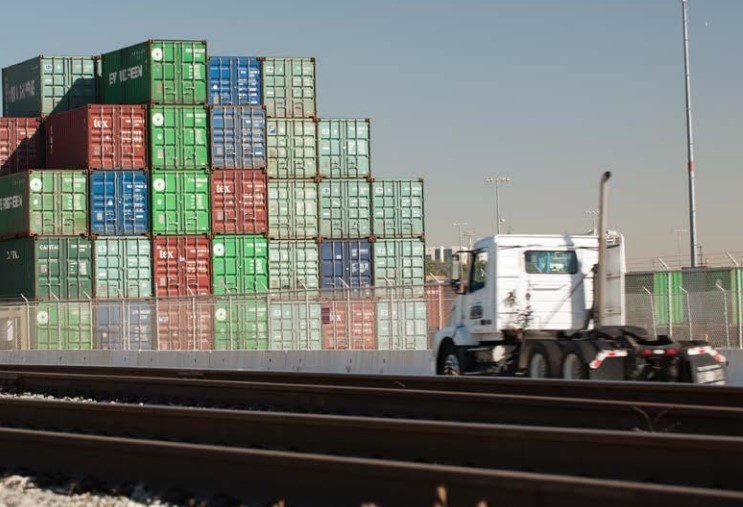
‘Goods’ movement or logistics or freight transport is the transportation and storage of products by/in ships, rail, trucks, and warehouses. I put ‘goods’ in quotes because the toys and clothes and computers and food moved around the world leave a trail of harm that is invisible when we see the products on a store shelf. In particular, diesel particulates from the ships, trucks and trains used to move products is the number one source of deadly air pollution in greater Los Angeles and other communities with major ports or distribution centers – a  point driven home by presentations by teams of scientists who have been studying the health impacts of regional air pollution for more than 15 years.

The logistics and freight industries are also among the most powerful advocates for new and expanded highways in and beyond Southern California. The infrastructure used to move goods – mega warehouses, distribution centers and rail yards – and the road configurations to direct trucks between these transshipment points, are about as far as one can get from a human-scaled street. Read more…